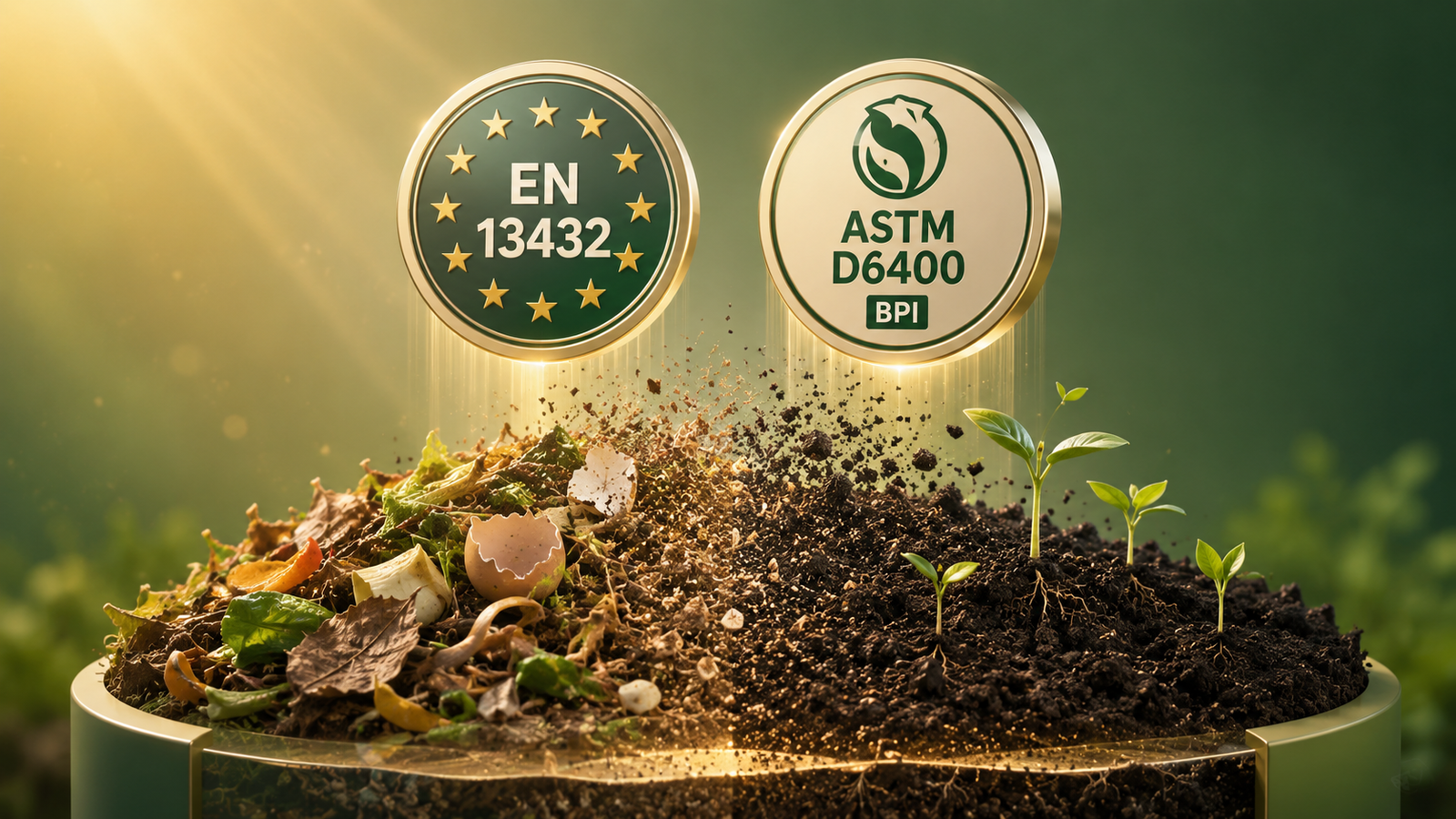
Choosing a high-quality biodegradable garbage bag supplier is crucial. First, verify that the supplier meets international authoritative biodegradability certifications such as ASTM D6400 and EN 13432, and ensure their production qualifications are complete. Key areas to consider include the safety and traceability of the supplier’s raw material sources, the standardization and stability of their production processes, and their independent testing capabilities.
The supplier’s actual production capacity, quality control system, and customer case studies are also important. It is recommended to select a partner with solid technical expertise, reliable reputation, and professional service through sample testing, on-site visits, and thorough background checks to ensure the product’s environmental commitments are genuine and credible.
I. Professional Certification: The Passport to Genuine Environmental Protection
When choosing a biodegradable garbage bag supplier, professional certification is the core basis for verifying its environmental authenticity. High-quality suppliers must hold ISO 14001 environmental management system and ISO 9001 quality system certifications.
Their products must pass international biodegradability standards such as ASTM D6400 and EN 13432 and be endorsed by authoritative organizations such as BPI and TÜV. It is recommended that companies verify the original certifications and their validity to ensure that the selected products meet genuine environmental requirements.
1. High-quality suppliers must have basic qualification review:
(1) Complete production qualification: Business license covers the production scope of environmental protection products and has relevant production permits
(2) Environmental management system certification: Passed ISO 14001 environmental management system certification
(3) Quality system certification: Has ISO 9001 quality management system certification
2. Genuine environmental protection products must pass authoritative certification:
(1) Degradation performance certification: ASTM D6400 (USA), EN13432 (EU), GB/T 38082 (China)
(2) Safety compliance certification: FDA food contact material certification, EU REACH regulation compliance
(3) Third-party authoritative certification: Endorsed by BPI, DIN-CERTCO, TÜV and other institutions
3. Enterprises should verify the authenticity of certification through the following methods:
(1) Require suppliers to provide the original certification certificate
(2) Check the certification status through the certification body’s official website
(3) Confirm that the certification scope covers specific product models
II. Technical strength: The fundamental guarantee of product quality
Technical strength is the core foundation for ensuring the quality of biodegradable garbage bags. High-quality suppliers should possess professional R&D teams, equipped with advanced laboratories and testing equipment, and master key patented technologies related to material formulation and production processes. Continuous R&D investment and innovation capabilities ensure that products meet high standards in terms of degradation performance, durability, and environmental safety, achieving stable and reliable production quality.
1. When assessing a supplier’s technical strength, the following should be considered:
(1) Technical talent reserve: R&D personnel should account for no less than 15% of the total workforce
(2) R&D investment: Annual R&D expenditure should account for more than 3% of operating revenue
(3) Industry-university-research cooperation: Establish long-term cooperative relationships with universities and research institutions
2. High-quality suppliers should possess core technologies and patents:
(1) Independent material formulation R&D capabilities
(2) Patented production process technologies
(3) Complete testing laboratories and testing equipment
(4) Continuous technical improvement records
3. Technical strength can be judged by the following aspects:
(1) Development cycle and update frequency of new products
(2) Quantity and quality of patented technologies
(3) Degree of participation in the formulation of industry standards
(4) Publication of technical papers and research results
III. Quality Control: Every batch of products is trustworthy
To ensure the excellent quality of every batch of products, we have established a three-level quality inspection system from raw material entry to finished product delivery. We are equipped with a professional laboratory to conduct full-process testing of key indicators such as physical properties, degradation rate, and environmental safety. Each batch of products comes with an independent test report and has a complete production traceability record, ensuring the stability and reliability of quality, giving customers confidence in every choice.
1. The quality control system should include:
(1) Three-level inspection system: full-process testing from raw materials to finished products
(2) Laboratory configuration: possessing physical, chemical, and biological testing capabilities
(3) Traceability system: realizing full-chain traceability from raw materials to customers
2. Key quality control
(1) Inspection standards for raw materials entering the warehouse
(2) Monitoring of key parameters during the production process
(3) Comprehensive testing of finished products before leaving the factory
(4) Handling process for non-conforming products
3. Suppliers should proactively provide:
(1) Test reports for each batch of products
(2) Annual quality summary analysis
(3) Customer complaint handling records
(4) Supporting documents for continuous improvement
IV. Product testing: Practice is the sole criterion for testing truth
To ensure the authenticity of the environmental commitment of biodegradable garbage bags, comprehensive testing and verification must be carried out. In terms of physical properties, it must meet the requirements for strength and dimensional accuracy; in terms of environmental performance, it must pass degradation rate testing under standard conditions and verify that the compost products are non-toxic and harmless; simultaneously, practical application testing must be conducted to ensure that it maintains stable and reliable performance under different waste types, seasonal changes, and long-term storage.
1. Physical performance testing must include:
(1) Mechanical properties: tensile strength, elongation at break, puncture resistance
(2) Dimensional accuracy: thickness uniformity, dimensional deviation, weight accuracy
(3) Usage performance: sealing performance, load-bearing capacity, tearability
2. Environmental performance verification:
(1) Degradation rate test under standard conditions
(2) Degradation comparison under different environmental conditions
(3) Ecotoxicity test of compost products
(4) Comprehensive analysis of degradation process products
3. Practical application testing:
(1) Applicability test for different types of waste
(2) Test on the impact of seasonal changes on product performance
(3) Long-term storage stability test
(4) Compatibility test with local treatment facilities
V. Environmental Responsibility: A Consistent Environmental Practitioner
A high-quality supplier not only provides environmentally friendly products but is also a practitioner of green concepts. We strictly adhere to the environmental management system, ensuring that the entire production process complies with environmental standards and continuously reducing energy consumption and emissions. At the same time, we actively fulfill our social responsibility, promote the green transformation of the supply chain, and deliver on our commitment to sustainable development with concrete actions.
1. Verify the supplier’s environmental performance:
(1) Emission management: Compliance certificates for wastewater and exhaust gas emissions
(2) Resource consumption: Energy and water consumption data per unit product
(3) Waste disposal: Compliance certificates for the disposal of production waste
2. Assess the supplier’s green actions:
(1) Carbon footprint accounting and emission reduction plans
(2) Implementation of cleaner production
(3) Development of circular economy projects
(4) Cultivation of employees’ environmental awareness
3. Examine the supplier’s social responsibility:
(1) Protection of employees’ rights
(2) Participation in community environmental protection activities
(3) Supply chain social responsibility management
(4) Issuance of transparency reports