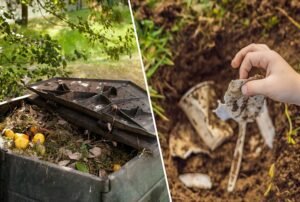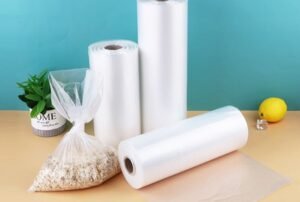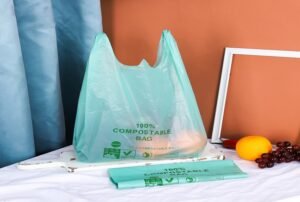
Plant-based bags, with their biodegradable and renewable properties, have become an important alternative to traditional plastics. But how are these seemingly simple eco-friendly bags meticulously manufactured? Let’s explore the complete production process of plant-based bags, from crops to finished products.
I. Raw Material Selection for Plant-Based Bags
For each product, we rigorously select sustainably grown natural crops as raw materials, primarily using non-GMO crops such as corn, cassava, and sugarcane. These crops undergo standardized cultivation in specialized planting bases to ensure no heavy metal pollution or pesticide residues during their growth. Harvesting is done at the maturity stage with the highest starch content; corn starch purity must reach over 95%, and cassava starch content must exceed 80%. Each batch of raw materials undergoes component testing and origin traceability to ensure compliance with food-grade standards, guaranteeing product safety and biodegradability from the source.
1. The raw materials for plant-based bags are entirely derived from renewable resources:
(1) Corn: Rich in starch, it is the main raw material for manufacturing PLA (polylactic acid).
(2) Cassava: With a starch content as high as 80%, it is widely used in Asia.
(3) Sugarcane: It can be converted into bio-based plastics through fermentation.
(4) Potato: A commonly used starch raw material in Europe.
2. Raw material harvesting standards: To ensure the quality of raw materials, we strictly adhere to the following:
(1) Selecting non-GMO crop varieties.
(2) Harvesting at the optimal maturity period.
(3) Conducting pesticide residue testing.
(4) Establishing a complete raw material traceability system.
II. Starch extraction from crops to basic raw materials
Starch extraction is a key step in the manufacturing of plant-based bags. First, raw materials such as corn and cassava need to be washed in multiple stages to thoroughly remove mud and impurities. Then, the raw materials are ground into a slurry using crushing equipment, and pure starch is extracted using centrifugal separation technology. This process requires precise control of temperature and rotation speed.
Finally, through dehydration and drying, dry starch with a moisture content ≤14% and a purity of over 95% is obtained. Each batch of starch must be tested for protein residue and microbial indicators to ensure compliance with the strict requirements of subsequent synthesis processes, laying the foundation for the production of high-quality bioplastics. The specific process is as follows:
1. Extraction process
(1) Cleaning and impurity removal: Multi-stage cleaning is used to thoroughly remove mud and sand impurities.
(2) Crushing and grinding: The raw materials are crushed into a slurry using special equipment.
(3) Starch separation: Pure starch is extracted using centrifugation technology.
(4) Dehydration and drying: Dry starch with a moisture content ≤14% is obtained.
2. Key points of quality control
(1) Starch purity must reach 95% or higher.
(2) Strict control of protein residue.
(3) Ensure that microbial indicators are qualified.
(4) Sampling and testing are conducted on each batch.
III. Bioplastic synthesis is a technological sublimation of natural raw materials.
Bioplastic synthesis is a technological sublimation of natural raw materials, through a precise transformation of four steps: saccharification, fermentation, polymerization, and granulation. First, plant starch is decomposed into glucose, then fermented by microorganisms to produce lactic acid, and then polymerized by catalytic polymerization to form polylactic acid (PLA), which is finally granulated into bioplastic particles. The entire process, through precise control of temperature, time, and molecular structure, transforms natural crops into stable and environmentally friendly materials, achieving a technological transformation from field crops to high-quality bioplastics.
1. Conversion Process
(1) Saccharification: Decomposing starch into glucose
(2) Fermentation: Generating lactic acid through lactic acid bacteria fermentation
(3) Polymerization: Synthesizing polylactic acid under the action of a catalyst
(4) Granulation: Producing plastic granules with a diameter of 3-5 mm
2. Key Technical Parameters
(1) Fermentation temperature precisely controlled at 38-42℃
(2) Polymerization reaction time strictly controlled
(3) Molecular weight distribution must meet standards
(4) Material properties must remain stable and consistent
IV. Film Preparation: The Transformation from Granules to Films
The film preparation process achieves a key transformation from plastic granules to practical films. First, PLA granules are dried and pretreated at 80℃, then fed into an extruder for precise temperature control and melting. Uniform film bubbles are formed through a ring mold, inflated to the required thickness by specific air pressure, and then rapidly shaped by a cooling air ring.
The entire process requires precise control of three core parameters: temperature, traction speed, and blow-up ratio, to ensure that the produced film has uniform thickness, consistent light transmittance, and a flawless surface, providing a qualified substrate for subsequent bag-making processes. This mature blown film process not only guarantees the physical properties of the film but also lays a solid foundation for the product’s environmentally friendly characteristics.
1. Blown Film Forming Process
(1) Raw Material Pretreatment: PLA granules are dried at 80℃ for 4 hours.
(2) Melt Extrusion: Heated to 170-190℃ using a screw extruder.
(3) Bubble Forming: A tubular film is formed using a special mold.
(4) Cooling and Rewinding: The film is rewound after passing through a cooling system.
2. Key Points of Process Control
(1) Melt temperature deviation should not exceed ±2℃.
(2) Film thickness error should be controlled within ±5%.
(3) Real-time monitoring of film transparency.
(4) Ensuring no crystal points and no impurities.
V. Bag Forming is the Final Form of the Product
Bag forming is the key step in transforming the film into a usable bag. The film needs to be precisely cut according to the design dimensions to ensure smooth edges without burrs. Then, the bottom and sides are sealed using a hot-pressing process, with the temperature strictly controlled within a suitable range to ensure a firm seal and prevent material degradation.
Precise punching of the handle holes is required to ensure comfortable lifting and adequate load-bearing capacity. Finally, after trimming and quality inspection, each bag is ensured to be tightly sealed, precisely sized, and neatly presented, achieving a ready-to-use, finished product.
1. Bag Manufacturing Process
(1) Film Cutting: Precisely cut according to bag size requirements
(2) Heat Sealing: Use low-temperature heat sealing technology to create the bag body
(3) Punching: Precisely punch handle holes
(4) Edge Trimming: Remove burrs to ensure safe use
2. Quality Inspection Standards
(1) Sealing strength must withstand 5kg of pulling force
(2) Dimensional error not exceeding 1mm
(3) No leaks or false seals
(4) Clean and uncontaminated surface
VI. Quality Inspection is the Core Link to Ensuring Product Reliability
Quality inspection is the core link to ensure the reliability of plant-based bags. We have established a comprehensive testing system from raw materials to finished products, conducting triple testing on each batch for physical properties, degradation performance, and safety performance. Physical testing covers thickness, tensile strength, and sealing; degradation testing verifies its decomposition rate in a composting environment; and safety testing ensures that heavy metal and ecotoxicity indicators meet standards. All products must pass international certifications such as ASTM D6400 to ensure that every product leaving the factory meets environmental standards, giving consumers peace of mind.
1. Physical Performance Testing
(1) Thickness Measurement: Using a precision thickness gauge
(2) Tensile Testing: Testing tensile strength
(3) Sealing Testing: Verifying leak-proof performance
(4) Load-bearing Testing: Ensuring safe use
2. Environmental Performance Verification
(1) Biodegradation Rate Testing
(2) Composting Decomposition Experiment
(3) Ecotoxicity Assessment
(4) Heavy Metal Content Testing
VII. Conclusion: Every Bag is a Testimony of Environmental Commitment
Every plant-based bag is our heartfelt declaration to the Earth. From field crops to finished products, it witnesses the perfect fusion of nature and modern technology. Choosing these plant-based bags is choosing to reconcile with nature and taking concrete actions to protect our shared home. It’s not just an eco-friendly product, but a weighty responsibility and commitment.
Let’s join hands and sow seeds of hope for our planet with every choice we make, leaving a green legacy for the future. Choosing plant-based bags is choosing a lifestyle of harmonious coexistence with nature. Let’s join hands and protect our beautiful planet with every eco-friendly choice.