In today’s market environment where environmental awareness is increasingly strong, “biodegradable” and “compostable” have become the most common environmental labels in product packaging and daily necessities. A scientific understanding of the precise meaning of these two terms is not only a prerequisite for choosing environmentally friendly products, but also a foundation for promoting sustainable consumption.
I. Conceptual Definition: Starting from Basic Scientific Understanding
1. Scientific Definition of Biodegradability
Biodegradability refers to the process by which materials, in the natural environment, are gradually decomposed into water, carbon dioxide (or methane), and biomass through the action of microorganisms (such as bacteria and fungi). The core characteristics of this process include:
(1) Biological Dependence: Decomposition is completed by microorganisms, rather than physical or chemical breakdown.
(2) End Products are Natural Substances: Ultimately transformed into simple compounds already existing in nature.
(3) Uncertain Time: The degradation rate is greatly affected by environmental conditions, ranging from several months to hundreds of years.
2. Specific Meaning of Compostability
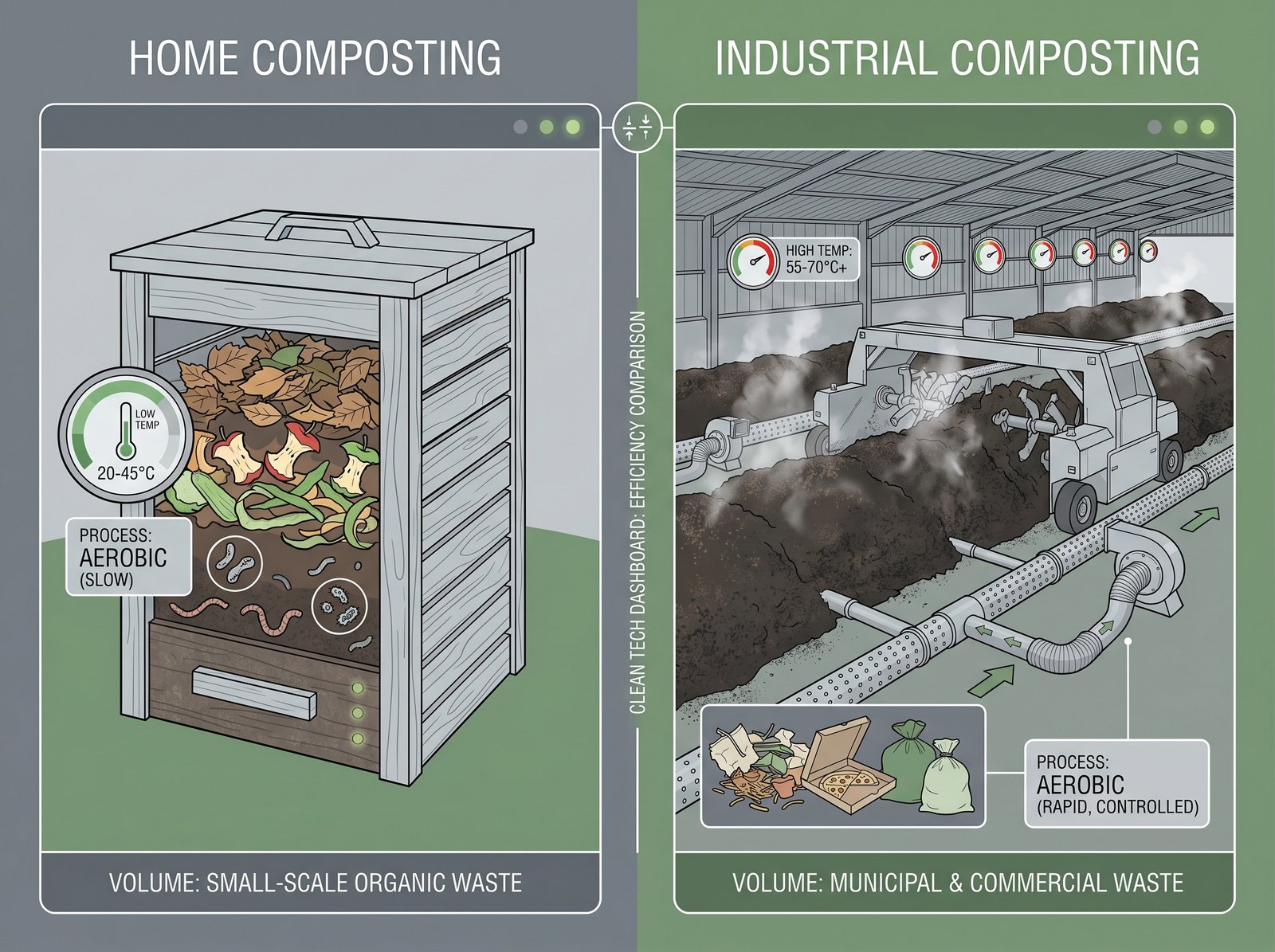
Compostability is a special subset of biodegradability, specifically referring to the transformation of materials into stable, non-toxic compost products through the action of microorganisms under artificially controlled composting conditions. Key limitations include:
(1) Controlled environment: Requires specific temperature, humidity, oxygen, and microbial conditions
(2) Time limit: Decomposition must be completed within a specified time (usually within 180 days)
(3) Product safety: Decomposition products must be safe and harmless to soil and plant growth
II. Standards System: The Scientific Basis Behind Certification
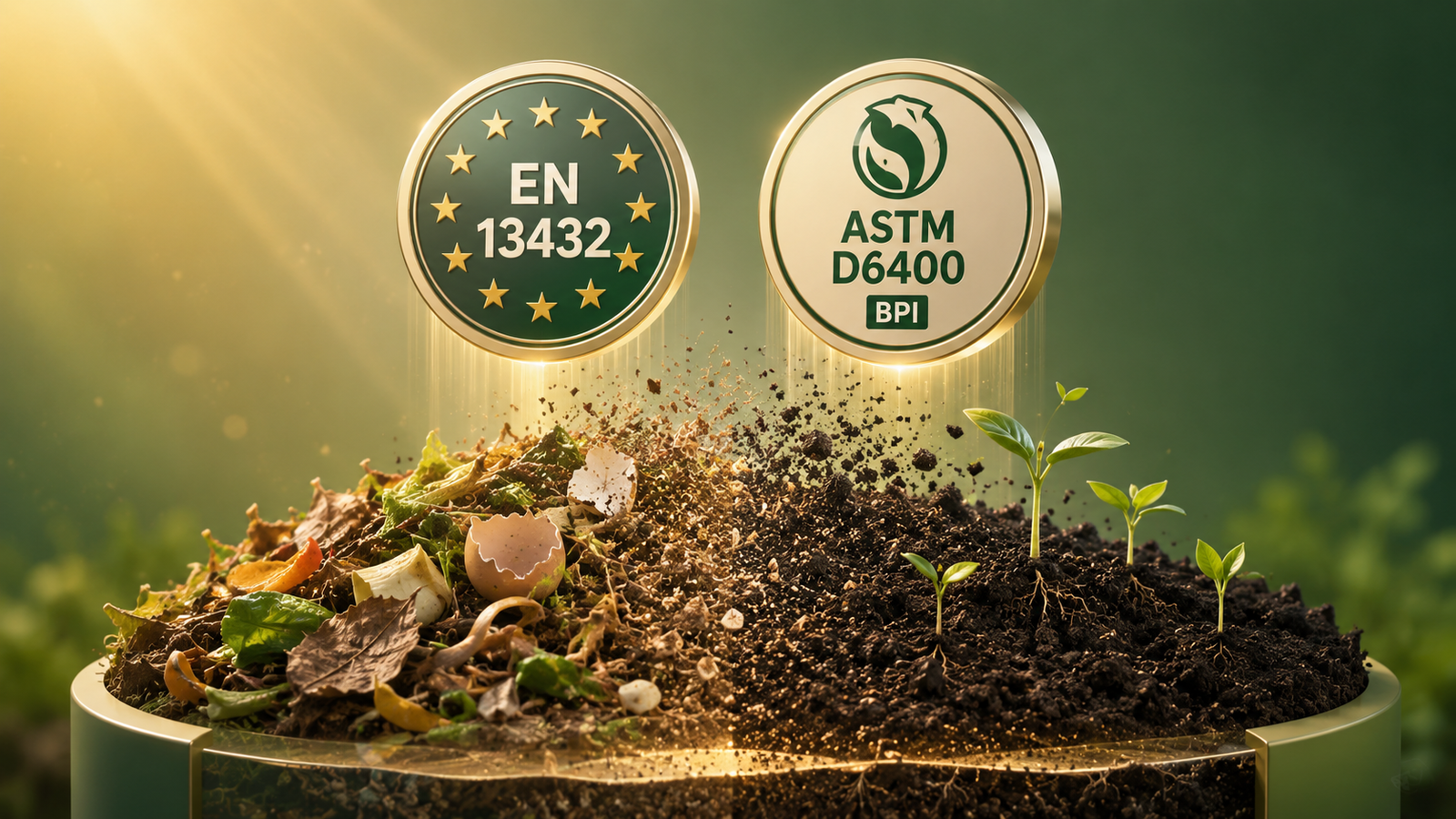
Biodegradability testing is mainly based on environmental simulation standards such as ISO 14855 and ASTM D5988. Compostability certification is more stringent, covering two categories of standards: industrial composting (e.g., ASTM D6400 requires a degradation rate ≥90% within 180 days)
and household composting (e.g., AS 5810). It also requires ecotoxicity and heavy metal safety testing to ensure the environmental safety of decomposition products. 1. Testing Standards for Biodegradability Currently, the international standards for testing biodegradability mainly include:
(1) ISO 14855: Determination of final aerobic biodegradability under controlled composting conditions
(2) ASTM D5988: Determination of biodegradability in soil environments
(3) OECD 301 series: Assessment of biodegradability in aquatic environments
2. Certification Standards for Compostability Compostability certification is more stringent and systematic. Mainstream standards include:
Industrial Composting Standards
(1) ASTM D6400 (USA): Requires a biodegradability rate ≥90% within 180 days
(2) EN 13432 (EU): Requires a biodegradability rate ≥90% within 6 months and passing ecotoxicity tests
(3) AS 4736 (Australia): Similar to EU standards, but with added heavy metal restrictions
Household Composting Standards
(1) AS 5810 (Australia): Requires a biodegradability rate ≥90% within 12 months
(2) NF T51-800 (France): Specific standards for home composting environments
(3) OK compost HOME: Internationally recognized home composting certification
III. Key Differences: Multi-dimensional Comparative Analysis
“Biodegradable” only requires materials to be decomposed by microorganisms in a natural environment, with no control over time or products; “Compostable” requires materials to be completely converted into safe compost within a specified time under specific temperature, humidity, and microbial conditions.
The former has broad conditions and uncertain results, while the latter has strict standards and a controllable process, representing a higher level of environmental commitment. Differences in Product Safety:
1. Biodegradable Products:
(1) May decompose incompletely, producing microplastic fragments
(2) Some additives may remain and enter the food chain
(3) Decomposition products have not undergone systematic safety assessment
2. Compostable Products:
(1) Must decompose completely, with no visible residue
(2) Passes rigorous ecotoxicity testing
(3) There are limits on the content of heavy metals and other harmful substances
3. Differences in Actual Processing Paths
(1) Biodegradable materials: Theoretically, they can decompose in the natural environment, but in reality, they are most likely to end up in landfills or incinerators.
(2) Compostable materials: Require specialized composting facilities; otherwise, their environmental value cannot be realized.
IV. Real-world Challenges: The Gap Between Theory and Practice
Ideal biodegradation often relies on standard laboratory environments, but reality faces complex constraints: insufficient composting facility coverage, oxygen-deficient landfill environments significantly delaying the degradation process, and weak consumer awareness of sorting leading to difficulties in getting environmentally friendly products into proper recycling channels.
The gap between certification standards and actual processing capacity means that many theoretically degradable products ultimately become an environmental burden.
1. The Dilemma of Compostable Products
(1) Only about 30% of cities worldwide have industrial composting facilities
(2) The household composting rate is less than 15%, and the technical requirements are high
(3) Even if a product is compostable, the lack of processing facilities still leads to it ending up in landfills
2. Misleading Information about Biodegradable Products
(1) Degradation is extremely slow in modern landfills (oxygen-deficient, dry)
(2) Some “biodegradable” plastics in the marine environment still take several years to decompose
(3) Consumers mistakenly believe that they can be discarded at will, which exacerbates environmental pollution
3. Loopholes in Certification and Supervision
(1) Some companies use standard differences to conduct “green cleaning”
(2) There is a significant gap between ideal laboratory conditions and the real environment
(3) Some regions lack effective certification supervision and enforcement mechanisms
V. Practical Guidance: How to Make Wise Choices
When choosing compostable products, prioritize looking for authoritative certification marks (such as OK compost, BPI) and confirm the composting environment they are suitable for. If local facilities are available, strictly follow the guidelines for waste sorting and disposal.
If no such facilities are available, biodegradable products can be used, but their actual degradation conditions must be understood, and proper disposal must always be ensured to avoid negating their environmental benefits.
1. Identify Certification Marks
(1) Compostable products should have clear certification marks (e.g., OK compost, BPI)
(2) Pay attention to the difference between industrial composting and home composting certifications
(3) Check if the certification body is authoritative (e.g., TÜV, DIN-CERTCO)
2. Understand the Limitations
(1) Note whether “compostable” indicates the applicable environment type
(2) Check if the degradation time is clearly stated
(3) Confirm whether there are reminders such as “for industrial composting facilities only”
3. Areas with Composting Facilities
(1) Prioritize certified compostable products
(2) Ensure the product is compatible with local composting processes
(3) Properly classify and dispose of waste according to requirements
4. Areas Lacking Treatment Facilities
(1) Biodegradable products may be a more realistic option
(2) However, it is necessary to understand their actual degradation performance in the local environment
(3) Always follow the correct waste disposal process
VI. Frequently Asked Questions
Q: Can compostable bags be decomposed in my backyard?
A: Only products clearly marked with “home composting” certification can. Industrial composting products require specialized facilities.
Q: Are biodegradable products more environmentally friendly than traditional plastics?
A: Theoretically yes, but the actual environmental benefits depend on the specific materials, usage, and processing facilities.
Q: How can I tell if a product is truly compostable?
A: Check for authoritative third-party certification, rather than relying solely on the company’s self-declaration.
Q: Are compostable products worth buying since they are more expensive?
A: If local processing facilities are available and they are used correctly, their life-cycle environmental benefits are generally superior to traditional plastics.