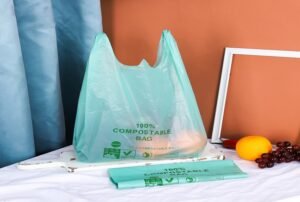
I. Industrial Composting: The Ideal Scenario for Compostable Bag Design
1. Industrial composting sites are professional composting facilities that provide the optimal decomposition environment for compostable materials through precise control of the following conditions:
(1) Temperature Control: Maintaining a temperature of 55-65℃ to promote efficient microbial activity
(2) Humidity Management: Maintaining a moisture content of 50-60% to optimize the decomposition reaction
(3) Oxygen Supply: Continuous ventilation to maintain the aerobic decomposition process
(4) Microbial Cultivation: Enriching specific degrading bacteria to accelerate the conversion of organic matter
2. Scope of Application of International Certification Standards
ASTM Authoritative certifications such as D6400 and EN13432 clearly stipulate:
(1) Certification is only applicable to industrial composting conditions
(2) A biodegradation rate of over 90% is required within 180 days
(3) The safety of decomposition products to the ecological environment must be ensured
3. Success Factors under Ideal Conditions
Compostable bags must meet the following conditions to achieve complete decomposition:
(1) The material itself passes relevant certification tests
(2) It enters a compliant treatment facility
(3) It undergoes a complete composting process
II. Differences Between Ideal and Reality in Landfills
Landfill environments are drastically different from industrial composting environments. Their highly compacted, oxygen-deficient environment almost cannot meet the degradation conditions for compostable garbage bags. In such enclosed spaces, the lack of suitable temperature, humidity, and microbial communities causes materials that should decompose within months to remain for years or even longer, ultimately failing to complete a true biodegradation cycle.
1. Environmental Characteristics of Landfills The design concepts of modern sanitary landfills are completely different from those of composting sites:
(1) Oxygen-deficient environment: Layered compaction and soil covering lead to extreme oxygen deficiency
(2) Temperature and humidity imbalance: Large regional differences make it difficult to maintain optimal decomposition conditions
(3) Limited microorganisms: Lack of dedicated degradation bacteria results in low decomposition efficiency
2. Actual research and monitoring data in landfills show that:
(1) Decomposition time is extended to several years or even decades
(2) Actual decomposition rate is far lower than the certification standard requirements
(3) Physical fragmentation may occur instead of biodegradation
3. Under landfill conditions, compostable bags may produce harmful substances:
(1) Producing greenhouse gases such as methane
(2) Releasing incomplete decomposition products
(3) Causing interruption of resource recycling
III. Key factors affecting decomposition effect
The decomposition effect of compostable bags is mainly affected by three factors: First, the material formulation—different components such as PLA and PBAT have significant differences in response to temperature, humidity and oxygen content; second, the landfill depth, as deep oxygen-deficient environments will severely delay the decomposition process; and finally, environmental conditions, including temperature fluctuations, humidity changes and microbial activity levels. These factors collectively determine whether compostable bags can translate from a “degradable promise” into real environmental benefits.
1. Differences in material formulation. Compostable bags with different compositions exhibit different characteristics:
(1) PLA material decomposes extremely slowly in an oxygen-deficient environment.
(2) PBAT material degrades relatively easily under various conditions.
(3) Starch-based components may decompose preferentially, leaving plastic residue.
2. Significant impact of landfill depth
(1) Shallow area (0-2 meters): With some oxygen, decomposition is relatively fast.
(2) Middle area (2-5 meters): With thin oxygen, the decomposition rate decreases significantly.
(3) Deep area (above 5 meters): Basically oxygen-free, decomposition almost stops.
3. Climate and seasonal variations
(1) Temperature changes affect microbial activity.
(2) Humidity fluctuations alter the decomposition process.
(3) Landfill conditions vary significantly in different regions.
IV. Through scientific experiments and empirical data
Under standard industrial composting conditions, compostable bags decompose more than 90% within 12 weeks; while in simulated landfill environments, the decomposition rate is less than 20% during the same period. Long-term tracking data shows that some certified compostable bags remain intact after 5 years in landfills.
A research report by the European Environment Agency points out that the anoxic environment of landfills reduces biodegradation efficiency by more than 60%. These data confirm the crucial role of professional treatment facilities in achieving the environmental commitment of compostable materials.
1. Tests by authoritative research institutions show:
(1) Under standard composting conditions: the decomposition rate can reach more than 90% after 12 weeks
(2) In simulated landfill environments: the decomposition rate is less than 20% during the same period
(3) Long-term monitoring shows that the decomposition efficiency in landfills is extremely low
2. International case studies are available:
(1) European research found that some compostable bags remain intact after 5 years in landfills
(2) North American monitoring data shows that the decomposition rate of compostable materials in landfills is generally less than 50%
(3) Asian experiments confirm that the “degradable” commitment is difficult to achieve without a suitable environment
V. Analysis of Potential Environmental Risks of Landfills
In landfills, compostable bags may be difficult to decompose completely due to the anoxic environment, and may also produce large amounts of methane—whose greenhouse effect intensity is 25 times that of carbon dioxide. Incomplete degradation products easily form microplastic residues, which may pollute soil and groundwater with leachate. This not only exacerbates greenhouse gas emissions but also disrupts the natural cycle of organic matter, undermines the environmentally friendly nature of resource recycling, and may even cause a more complex long-term environmental burden than traditional plastics.
1. Greenhouse gas emission problem. Compostable bags in landfills may generate a large amount of harmful substances:
(1) Large amounts of methane are produced during anaerobic decomposition
(2) The greenhouse effect of methane is 25 times that of carbon dioxide
(3) Existing collection systems may not be able to completely capture it
2. Impact on soil and water resources
(1) Incomplete decomposition products may seep into groundwater
(2) Chemical additives may be slowly released
(3) The risk of microplastic pollution still exists
3. Disruption of the resource recycling system
(1) Organic matter cannot return to the natural cycle
(2) Energy and resource value cannot be recovered
(3) Violation of the basic principles of the circular economy
VI. Proper disposal and optimal selection of compost
To ensure that compostable bags realize their environmental value, please prioritize their use in industrial composting or household composting systems. Before use, please confirm that the product has ASTM D6400 or OK compost certification marks and check if there are supporting treatment facilities in your area. If there are no professional composting facilities, alternative solutions such as energy recovery can be selected. Consumers are encouraged to participate in community composting construction to support the implementation of the circular economy system from the source.
1. Preferred Treatment Pathways
Verify local facilities: Check the local industrial composting capacity
Accurate sorting and disposal: Ensure entry into the organic waste treatment system
Home composting: Choose products suitable for home composting
2. Alternative Solutions for Reference, if composting facilities are lacking:
(1) Energy recovery and disposal: Power generation and heating through incineration
(2) Professional recycling and disposal: Find special material recycling channels
(3) Source reduction and control: Reduce unnecessary use
3. Consumer Action Guidelines
(1) Carefully check product certification marks when purchasing
(2) Understand the current status of the local waste treatment system
(3) Participate in environmental protection facility construction advocacy activities
(4) Practice correct waste sorting and disposal