Real‑world packaging decisions shouldn’t be based on labels. They should be based on materials science, certified standards, and honest end‑of‑life realities.
The Hook: Why Your “Eco” Packaging Might Be Failing
You’ve seen the headlines. You’ve felt the pressure. Switching to compostable packaging feels like the right thing to do. But then the complaints start: bags tearing at seams, leaks in the car trunk, customers posting photos of ripped produce bags on social media.
The problem isn’t that compostable plastics are weak. The problem is that performance isn’t guaranteed by a label – it’s engineered.
At ESINLE, we’ve spent years perfecting PBAT/PLA blends that match or exceed conventional plastic in puncture resistance, leak‑proof sealing, and tear strength – while fully degrading in composting conditions. This blog walks you through the science, the standards, and the real‑world decisions that separate truly durable compostable packaging from greenwashed disappointments.
Three Decision Filters That Actually Work
The fastest way to pick wrong is to start with what you want the label to say. Start with what the packaging has to survive, then look at what your local waste system can actually handle.
- Filter 1: How long does the product need protection?
Shelf life, oxygen/moisture barrier, grease resistance, seal integrity. - Filter 2: How badly will customers treat it?
Drop tests, puncture risk, hot‑fill, freezer storage, “tossed into a backpack next to keys.” - Filter 3: Where will it realistically end up?
Curbside recycling, commercial composting facility, landfill, or “wishcycling”.
At ESINLE, we apply these filters to every application – from pet waste bags and food caddy liners to agricultural mulch and stretch film. Performance isn’t optional. It’s the price of entry.
Material Foundations: How Each Plastic Is Made
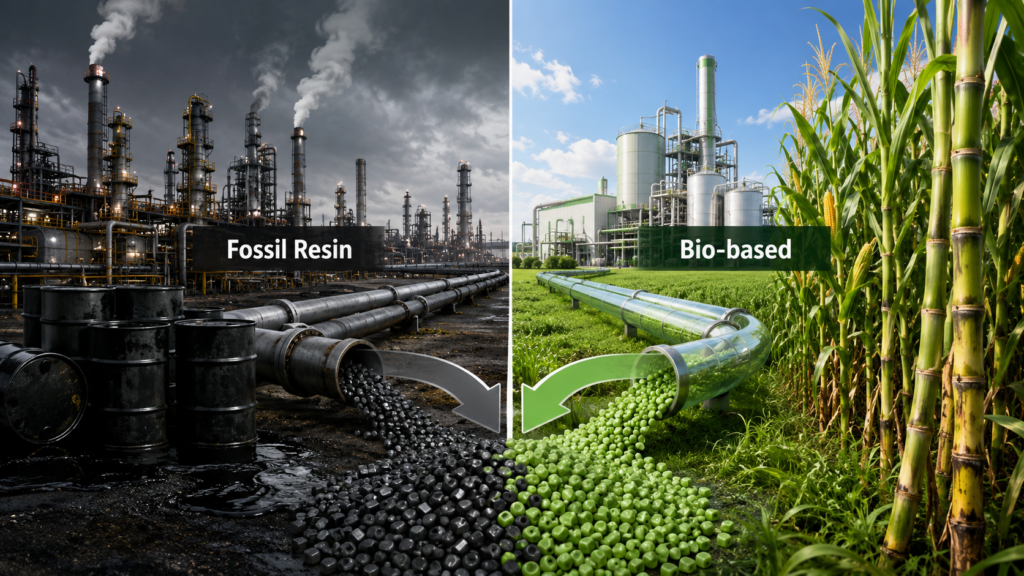
When people say “plastic,” they’re collapsing a whole universe into one word. That’s how bad decisions get made.
Fossil Resin Pathways (Conventional)
Traditional plastic uses petrochemical feedstocks refined into monomers, then polymerized into resin pellets. Polyethylene (LDPE/HDPE) and polypropylene are prized because they process cleanly and tolerate abuse. They are optimized for manufacturing – not for graceful decomposition. They fragment into microplastics that persist for centuries.
Bio‑Based Polymer Pathways (Compostable)
Compostable plastics are often made from plant‑derived feedstocks such as corn starch, sugarcane, or cassava. PLA (polylactic acid) is a common example, but PLA alone is stiff and brittle in thin films, especially when cold. That’s why we blend PLA with PBAT (polybutylene adipate terephthalate) – a flexible, tough biodegradable polyester. The right PLA/PBAT blend gives you the strength of conventional plastic plus full compostability.
⚠️ Heads up: “Bio‑based” does not automatically mean compostable, and “compostable” does not automatically mean bio‑based. Don’t confuse feedstock with end‑of‑life.
Additives & Fillers – The Hidden Performance Levers
Films are formulations: plasticizers, slip agents, mineral fillers (e.g., calcium carbonate), pigments, stabilizers, and compatibilizers. These can improve seal behavior, tear resistance, and clarity – but if poorly chosen, they can create brittleness or compliance problems.
ESINLE’s approach: Our proprietary PBAT/PLA/corn starch formulations balance mechanical performance and cost without relying on problematic additives. We use mineral fillers to boost stiffness and tear strength while maintaining full compostability – a method validated by independent material science.
Performance Showdown: Compostable vs. Conventional – By the Numbers
| Property | Conventional Film (PE/PP) | ESINLE Compostable (Optimized PBAT/PLA) | What to Watch |
|---|---|---|---|
| Tensile strength | Consistent, forgiving | Can be strong, can be stiff – >45% improvement vs. standard blends | Heat history, orientation, thickness |
| Tear behavior | Often ductile, stretches before tear | Can tear cleanly once initiated – >21% tear resistance improvement | Notch sensitivity, tear propagation |
| Puncture resistance | Usually excellent at thin gauges | Excellent with right blend – passes dart‑drop tests | Gusset corners, handles, sharp contents |
| Leak‑proof seals | Reliable with proper settings | 100% leak‑proof when seals are dialed in – validated by liquid containment testing | Heat‑seal window, contamination |
The takeaway: When engineered correctly, compostable films deliver industrial‑grade durability. The “compostable = flimsy” myth is based on cheap, poorly formulated products, not on the material class itself.
Deep Dive: The Three Tests That Matter
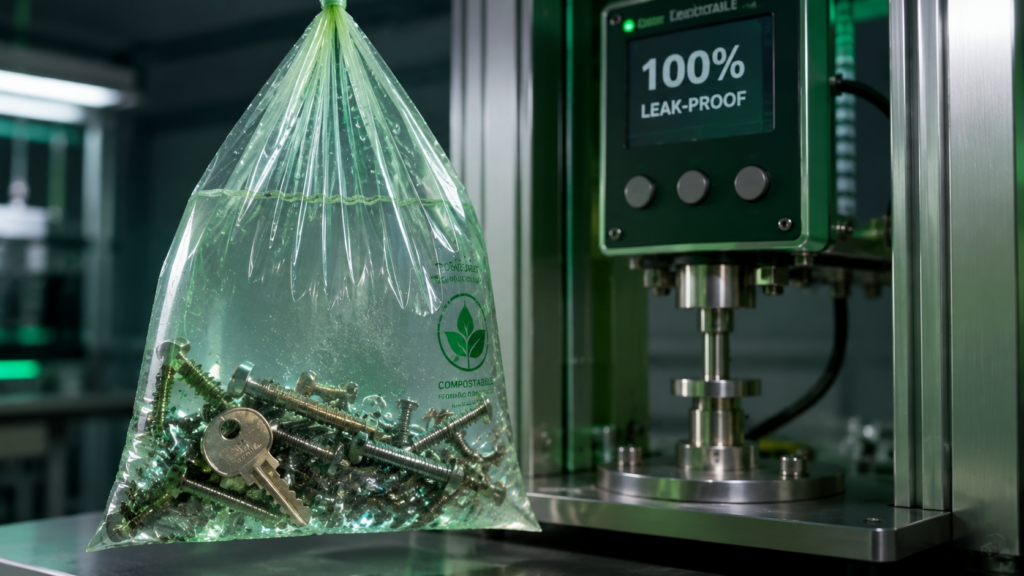
1. Puncture Resistance – The Bar Fight
Whether it’s pet food bones, kitchen scraps, or keys thrown into a tote bag, puncture resistance is where most bags die. PBAT is inherently flexible with excellent stress‑crack resistance. ESINLE’s engineering team fine‑tunes PLA ratios to reinforce rigidity while keeping the film tough.
What we do: We run standard industrial puncture tests (comparable to ASTM D5748) and dart‑drop impact tests. Our PBAT/PLA blends consistently show higher toughness and improved puncture strength compared to unmodified PBAT.
2. Leak‑Proof Seals – No Excuses
A bag that leaks is a bag that fails. Period. ESINLE’s PBAT/PLA blends are precisely calibrated on blown film extrusion lines to create a smooth, dense barrier. The proof is simple: fill the bag halfway with water, leave it under room conditions for 24 hours. No seepage = pass.
We test every batch. Our leak‑proof seals are one reason customers switch from conventional plastic and never look back. Request a free sample and see for yourself.
3. Tear Strength – ASTM D1922 and Real‑World Abuse
ASTM D1922 is the recognised industry method for measuring tear propagation force. By incorporating specialty fillers into the PBAT/PLA matrix, ESINLE reinforces film toughness across the entire material structure – not just at the surface.
Result: Tensile strength increases by >45% and tear resistance improves by >21% compared to standard formulations, while maintaining full compostability. View our technical data sheet for full details.
What Labels Mean – And What They Do Not
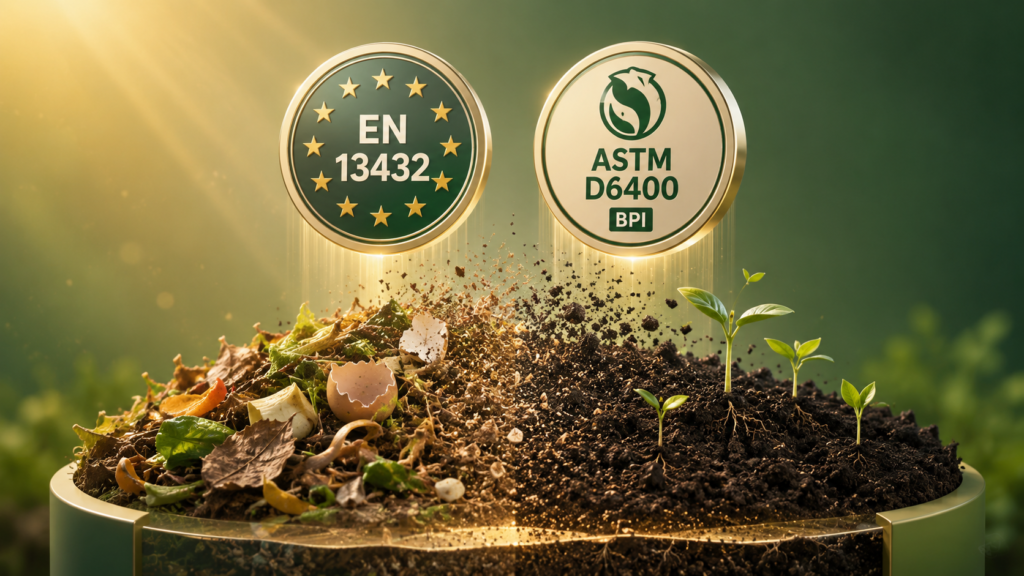
If you only remember one thing: marketing terms are not standards. Standards are standards.
Compostable vs. Biodegradable
- “Biodegradable” without a timeframe and specific environment is essentially a ghost claim. Soil? Marine? Landfill? It matters enormously.
- “Compostable” is better – it points to a test standard – but watch the fine print: many items are industrial‑compostable, not home‑compostable. If your customers only have a backyard bin, you need OK compost HOME certification.
EN 13432 & ASTM D6400 – What They Actually Prove
EN 13432 is the European standard for packaging recoverable through composting. ASTM D6400 is its North American equivalent (BPI certification). Both require:
- Biodegradation ≥90% organic carbon converted to CO₂ within 6 months (EN 14046 / ISO 14855)
- Disintegration ≥90% of fragments <2mm within 12 weeks
- Eco‑toxicity – no harm to plant growth
- Heavy metals – below strict thresholds
All ESINLE products carry EN 13432, ASTM D6400, OK compost HOME, and BPI certifications. Independent, third‑party verified. See our full certifications.
Bio‑based vs. Fossil‑based
Bio‑based is about carbon origin. A bio‑based plastic can still be non‑compostable (bio‑PET exists). A fossil‑based polymer can be designed to biodegrade under certain conditions. Don’t confuse feedstock with end‑of‑life.
Choose the Right End‑of‑Life Pathway
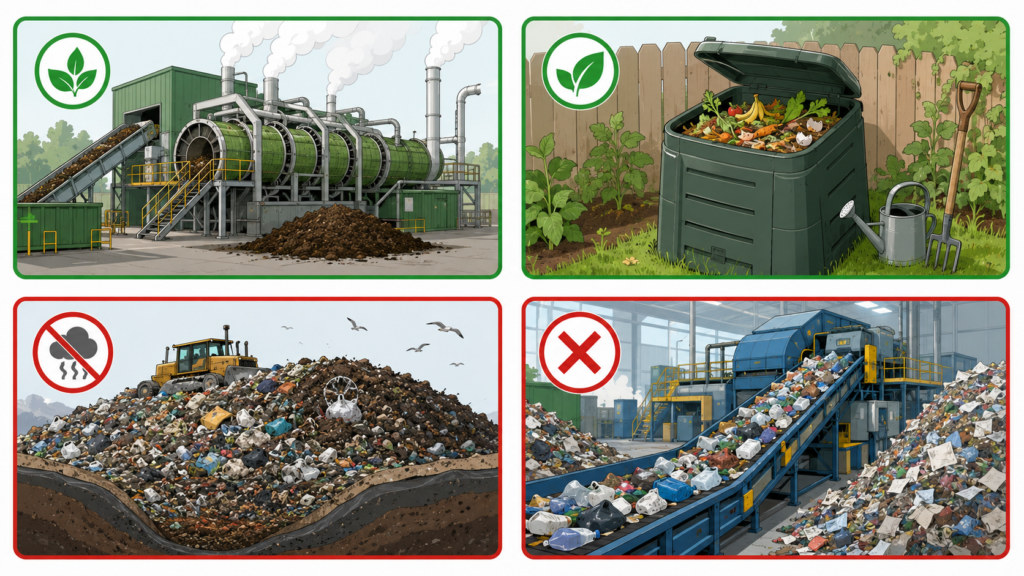
| Pathway | Best for | Reality Check |
|---|---|---|
| Industrial composting | Certified compostable packaging, large volumes | Needs access to a commercial composting facility |
| Home composting | OK compost HOME certified items | Slower, temperature‑dependent, but convenient |
| Landfill | Not ideal for any packaging | Compostables degrade slowly, may produce methane; conventional plastic persists for centuries |
| Recycling | Conventional plastic (when clean) | Compostables contamination can ruin recycling batches – do not mix |
ESINLE’s approach: We offer both industrial‑compostable and home‑compostable lines. Our policy & market tracker helps you understand local infrastructure before you commit.
Why ESINLE? – Proof, Not Promises
- Radical transparency – We publish test reports, batch traceability, and full material data sheets.
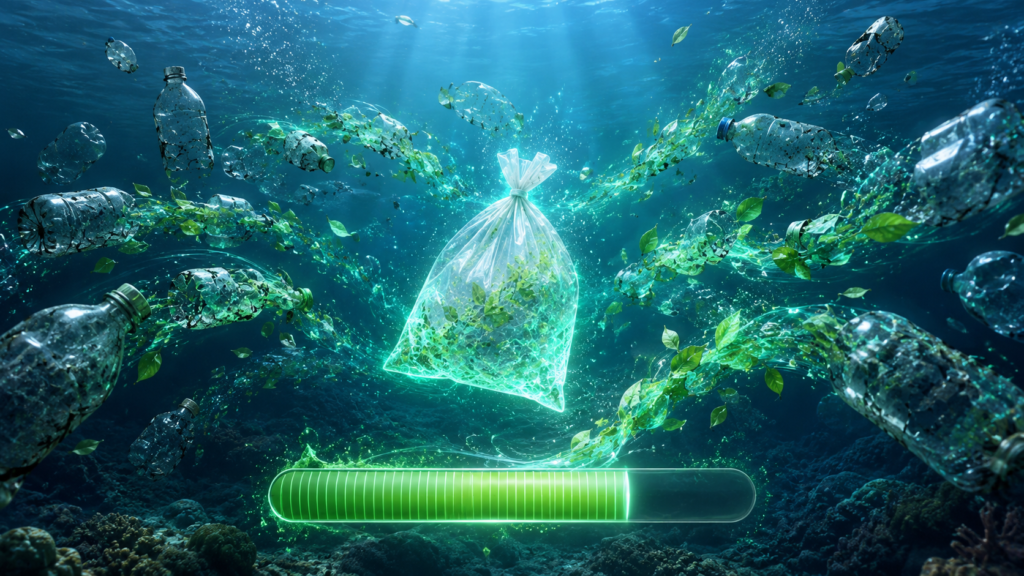
- 10 Million Bottle Mission – Every product you purchase recovers 4 plastic bottles from the environment – a measurable ESG outcome.
- Low MOQ & free samples – Test our performance before you commit.
- Global compliance support – Our documentation (DoC, TDS, certification files) helps you meet EU PPWR, California SB 54, and other regulations.
👉 Request free samples | View certifications | Talk to our compliance team
FAQ – Quick Answers to Common Questions
Q: Are compostable plastics automatically better for the environment?
A: No. It depends on feedstock, manufacturing, additives, and most of all end‑of‑life. Compostable packaging without access to composting can be a feel‑good dead end.
Q: Does EN 13432 mean it will break down in my backyard compost?
A: No. EN 13432 is for industrial composting. For home compost, look for OK compost HOME certification.
Q: Is PLA strong enough for pouches and bags?
A: PLA alone can be brittle, but PLA‑PBAT blends deliver excellent toughness and puncture resistance. Our formulations prove it.
Q: Can compostable packaging go in recycling?
A: Generally no. Most recycling programs do not want compostables mixed into conventional plastic recycling because of contamination risks.
Q: Does ESINLE offer free samples for performance testing?
A: Yes. Contact us – we’ll send samples and provide batch‑traceable test reports.
Conclusion: Compostable Doesn’t Mean Compromised
Compostable vs. conventional plastic isn’t a cage match between good and evil. It’s a materials selection problem wrapped inside a waste‑management problem.
When you choose ESINLE, you get:
- Certified compostability (EN 13432, ASTM D6400, OK compost HOME)
- Industrial‑grade performance (>45% better tensile strength, >21% tear resistance)
- Leak‑proof, puncture‑resistant films tested to real‑world standards
- Full supply chain transparency and batch traceability
- A measurable environmental mission (10 Million Bottle Mission)
Stop guessing. Start testing.
This blog is part of ESINLE’s commitment to radical transparency. Read our policy & market tracker and case studies & insights.