The era of voluntary green claims is over. 2026 marks the year when compostable packaging compliance becomes a legal and commercial necessity – not an option.
Introduction: The Compliance Tipping Point
If 2025 was about announcements, 2026 is about enforcement.
Two major regulatory shifts take effect this year, directly impacting any brand that sells packaged goods into the EU and US markets:
- EU PPWR (Packaging and Packaging Waste Regulation) becomes fully applicable from 12 August 2026.
- California’s SB 54 recyclability thresholds move toward implementation.
At the same time, Extended Producer Responsibility (EPR) fees are now being eco‑modulated – meaning your packaging’s compostability directly affects your costs.
For B2B buyers and compliance officers, the question is no longer “Should we switch to compostable packaging?” but rather: “Are we ready to prove it – with certified standards, audited documentation, and market‑specific compliance?”
Need a quick way to assess your readiness? Try our free PPWR compliance navigator – answer 4 questions and get an instant gap analysis.
This guide walks you through the three pillars of 2026 compostable packaging regulations: PPWR compliance, the EN13432 and ASTM D6400 standards, and EPR.
The market momentum is clear: the biodegradable plastics market grew from $7.89 billion in 2025 to $9.28 billion in 2026, a compound annual growth rate (CAGR) of 17.6%. The biodegradable plastic packaging market reached $3.62 billion in 2026 and will grow at an extraordinary 20.12% CAGR through 2031 to reach $9.04 billion.
The message is unambiguous: regulators and markets are moving in unison toward verifiable compostability.
PPWR Compliance 2026: The New Rulebook for Packaging
What is PPWR?
The Packaging and Packaging Waste Regulation (PPWR) – Regulation (EU) 2025/40 – replaces the old Packaging Directive (94/62/EC) with a binding regulation that applies identically across all 27 EU Member States. No national interpretation, no delays.
Official source: The full text of Regulation (EU) 2025/40 on packaging and packaging waste is available on EUR-Lex, the official EU legal database. On 30 March 2026, the European Commission also published implementation guidance to facilitate uniform application of the new rules across Member States.
The regulation entered into force on 11 February 2025 and will generally apply from 12 August 2026. The PPWR aims to ensure packaging is recyclable, minimally wasteful, and clearly labelled.
Key dates for your diary
| Deadline | Requirement |
|---|---|
| 12 August 2026 | Full applicability. Declaration of Conformity (DoC) required for every packaging item placed on the EU market. |
| 12 February 2028 | Mandatory industrial compostability for: fruit & vegetable stickers, tea bags, coffee capsules (in bags), and very lightweight plastic carrier bags (where required by Member States). |
What PPWR compliance means for your business
- You need a DoC for every packaging type you sell into the EU – a legally binding self‑declaration backed by test reports.
- EPR registration is already required in countries like Germany, France, Italy and Spain. From 2026, fees will be higher for non‑compostable packaging.
- Member states differ – Germany enforces strictly, Italy leads on home compostability, France demands detailed labelling.
Action point: If you export to Europe, verify that your packaging supplier holds EN13432 or OK compost HOME certification – and can provide batch‑traceable test reports.
EN13432: Europe’s Gold Standard for Industrial Compostability
What is EN13432?
EN13432 is the European standard that defines when packaging (and all its components) can be described as “compostable” under industrial composting conditions. Official source: The standard is administered by DIN CERTCO, the independent certification body of reference in the European bioplastics market.
To meet the standard, a material must pass a rigorous, four‑part testing protocol:
| Criterion | Requirement |
|---|---|
| Biodegradation | ≥90% within 180 days under controlled industrial composting conditions (around 58°C, with regulated moisture and oxygen levels) |
| Disintegration | ≥90% passes through a 2mm sieve within 12 weeks |
| Eco‑toxicity | Compost must not harm plant growth |
| Chemical limits | Heavy metals below set thresholds |
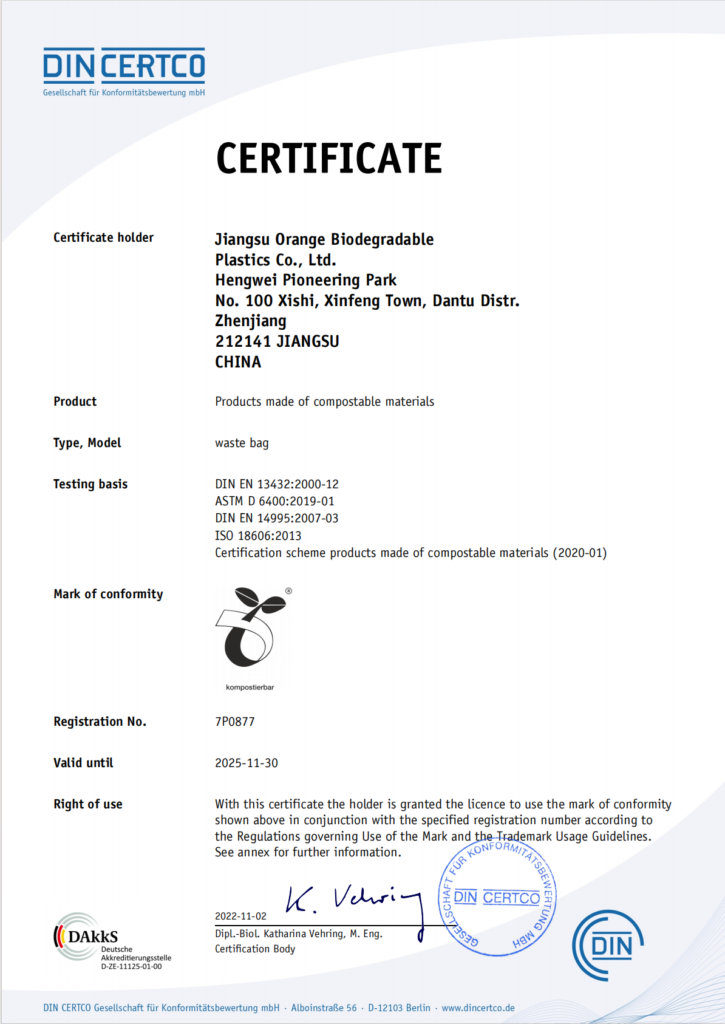
EN13432 Bag Certificate
Following successful certification, manufacturers can advertise and label their products as “industrially compostable”. The EN13432 standard requires that the entire packaging – not just the base polymer, but also inks, adhesives, and coatings – be certified. Products that meet DIN EN 13432:2000-12 receive a DIN CERTCO registration number and appear in the public certification database.
EN13432 compliance in 2026
- PPWR explicitly references EN13432 as the benchmark for mandatory compostability.
- Italy has proposed a draft regulation requiring four categories of single‑use plastic packaging to carry UNI EN 13432 certification by 1 January 2030.
- Whole‑package certification is now expected – not just the base polymer, but also inks, adhesives, and coatings.
Why this matters: If your packaging claims “biodegradable” without EN13432, you are at high risk of greenwashing litigation in the EU.
Buyer tip: Ask your supplier for the DIN CERTCO or TÜV Austria certificate – not just a “self‑declared” compliance statement.
ASTM D6400: The North American Compostability Standard
What is ASTM D6400?
ASTM D6400 is the US standard for industrial compostability of plastics. It is the technical equivalent of EN13432 and is widely recognised as the benchmark for compostable packaging in North America.
The ASTM D6400 standard constructs a “three‑in‑one” testing system covering biodegradation rate, disintegration performance, and eco‑toxicity – all three must be met for a material to be certified. This framework verifies the environmental credentials of biodegradable plastics from the three core dimensions of “degradation efficiency,” “physical dissipation,” and “environmental safety”.
Certification body: BPI
Products meeting ASTM D6400 can carry the BPI (Biodegradable Products Institute) compostable logo – the most recognised compostability mark in North America. Official source: The BPI Certification Mark is an official third‑party certification symbol. It signifies that independent testing and verification have confirmed the product meets ASTM standards D6400 or D6868 for compostability.
The mark tells composters, policymakers, and consumers that the product performs as promised – breaking down safely and completely, without leaving behind microplastics or contaminants.
ASTM D6400 is the United States equivalent to European standard EN13432.

BPI
2026 regulatory drivers
- California SB 54 requires that by 2032, all single‑use packaging and foodware must be either recyclable or compostable. Official source: CalRecycle’s SB 54 program page provides full details on the extended producer responsibility (EPR) program for packaging and single‑use plastic food service ware products.
- Several US states (Washington, Colorado, Oregon) have now enacted EPR laws that reward compostable packaging with lower fees.
Important distinction: ASTM D6400 is not automatically recognised in the EU. If you sell into both markets, you need both EN13432 and ASTM D6400 certification (or a harmonised scheme like OK compost).
Extended Producer Responsibility (EPR): Paying for the True Cost of Packaging Waste
What is EPR?
Extended Producer Responsibility (EPR) means that brands and manufacturers – not municipalities – pay for the collection, sorting and treatment of packaging waste.
2026: The year EPR fees become “eco‑modulated”
| Region | What’s changing in 2026 |
|---|---|
| EU (PPWR) | Member States must set up EPR schemes with fee modulation – lower fees for compostable packaging, higher fees for non‑recyclable. The European Commission has issued implementation guidance clarifying the application of extended producer responsibility for packaging and the obligation to set up deposit and return systems. |
| UK | First eco‑modulated fees apply to the 2026‑27 financial year, based on 2025 packaging data. Year 2 producer invoices will be modulated, reflecting the level of recyclability within each material category for the first time. |
| US (California) | SB 54 mandates a producer‑funded EPR program; compostable packaging is explicitly favoured. Producers, importers and distributors must register with a national EPR register in each EU country where they place packaging on the market – including financing the collection, sorting and recovery of packaging waste. |
What this means for your bottom line: If your packaging is not certified compostable, you will pay higher EPR fees – starting this year.
Action point: Include EPR cost forecasting in your packaging sourcing decisions. Switching to EN13432 or ASTM D6400 certified materials can reduce your compliance costs significantly.
Your 2026 Compliance Roadmap
Use this checklist to assess your readiness for complying with the new packaging regulations. If you‘re not sure where you stand on recyclability and packaging recyclability, use our free compliance assessment tool – it takes 3 minutes and gives you a personalized gap analysis on new packaging requirements.
| Step | Action | Priority |
|---|---|---|
| 1 | Identify which of your products fall under mandatory compostability rules (EU 2028 categories: fruit & vegetable stickers, tea bags, coffee capsules) | 🔴 High |
| 2 | Request EN13432 (or OK compost HOME) certificates from your existing packaging suppliers | 🔴 High |
| 3 | For US sales, confirm ASTM D6400 / BPI certification | 🟠 Medium |
| 4 | Register for EPR in Germany, France, Italy, Spain (and UK, if applicable) | 🔴 High |
| 5 | Prepare Declarations of Conformity (DoC) for each packaging SKU | 🔴 High |
| 6 | Update your packaging labelling to meet SB 54 (California) and PPWR transparency rules | 🟡 Medium |
Conclusion: Compliance as a Competitive Advantage
The wave of 2026 compostable packaging regulations – PPWR compliance, SB 54, eco‑modulated EPR – is not a threat to be feared. It is a market shift that rewards early movers.
Brands that secure EN13432, ASTM D6400, and OK compost HOME certifications now will:
- Avoid regulatory penalties and market access delays
- Pay lower EPR fees
- Differentiate themselves from competitors still relying on vague “green” claims
- Build trust with B2B buyers who demand third‑party proof
In the compostable packaging space, compliance is the new brand value.
The market data supports this shift: the biodegradable plastics market grew at 17.6% CAGR to $9.28 billion in 2026, with the biodegradable plastic packaging segment projected to grow at over 20% CAGR through 2031. This is not a niche trend – it is the new mainstream.
Need help navigating these standards?
At Esinle, our products are fully certified:
- EN13432 (DIN CERTCO)
- ASTM D6400 / BPI
- OK compost HOME (TÜV Austria)
- Batch‑traceable test reports available
Ready to check your compliance status? Try our PPWR compliance navigator – it’s free, no email required.
Contact our compliance team for a free gap assessment, or request sample certificates for any of our certified bag ranges.
This article is for general guidance only. Always consult a qualified legal or compliance advisor for market‑specific requirements.