A compostable logo on your package does not mean that package belongs in every compost bin. That is the mistake that burns time, budget, and credibility for B2B buyers.
Home compostable and industrial compostable materials follow two very different end-of-life paths. They break down under different heat levels, rely on different process controls, and depend on completely different collection systems. In practice, the biggest difference is simple: whether the product is actually likely to be composted.
For buyers and packaging teams, the rule is straightforward. Choose a certification that matches the disposal system available in the market where the packaging will be used. Then label the packaging clearly so consumers know how to dispose of it correctly.
Market Snapshot: Why Compostable Packaging Is Growing Fast

The numbers tell a clear story. The global compostable packaging market was valued at $85.43 billion in 2025 and is projected to grow from $90.58 billion in 2026 to $152.96 billion by 2034, registering a CAGR of 6.77%.
Europe leads the global compostable packaging market with a 44.5% share in 2026, supported by strong regulatory frameworks and high consumer awareness.
For B2B buyers, these aren't abstract figures. They represent a supply chain already shifting — and those who delay risk scrambling for compliant materials when regulations tighten.
For additional market data, see industry analysis from
Grand View Research compostable packaging market report
The Hook: Why Disposal Confusion Is Undermining Your Sustainability Efforts
Switching to compostable packaging is a positive step toward reducing plastic waste. But what happens after the customer uses it?
Recent research shows a significant gap between consumer intentions and actual disposal behavior. Up to 50% of consumers mistakenly assume: a “made from plants” label means they can compost any packaging. Nearly one‑third admit they would mistakenly place compostable packaging into a recycling bin.
When compostable packaging is disposed of incorrectly:
- Landfill disposal slows degradation and may generate methane
- Recycling contamination reduces plastic resin quality
- Composting facilities may reject improperly sorted packaging
Understanding the correct disposal pathway is essential for achieving the environmental benefits of compostable materials.
What Separates Home and Industrial Composting?
People collapse these two into one idea because both use the word "composting." But the chemistry doesn't care about our shortcuts.
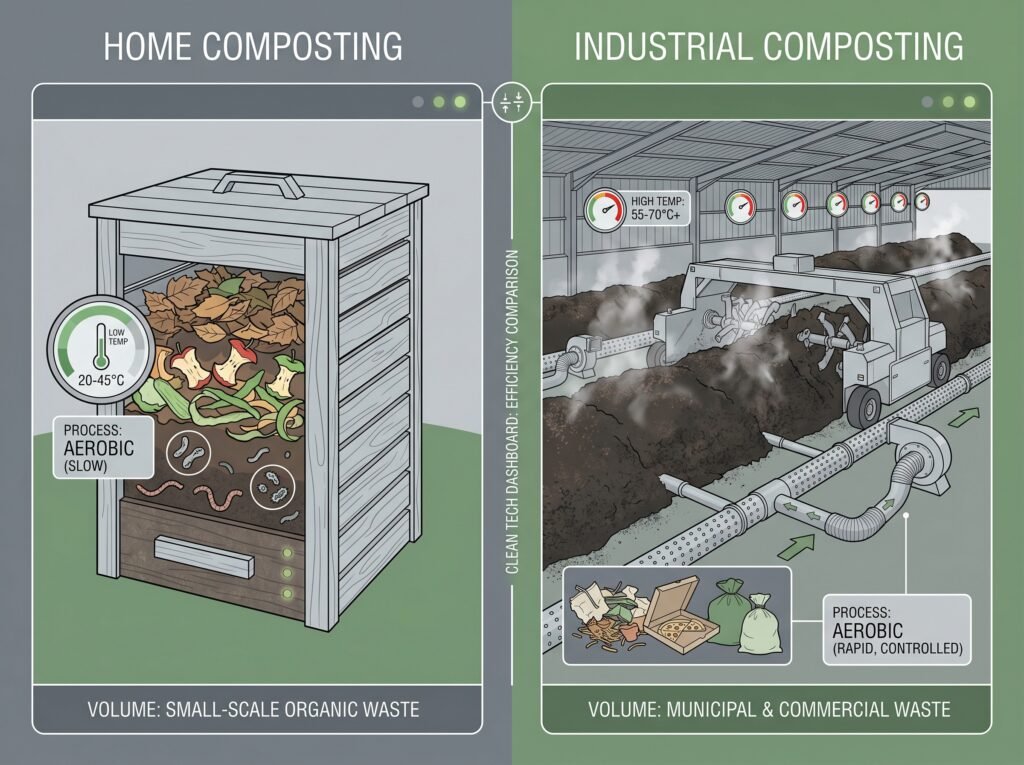
| Feature | Industrial Composting | Home Composting |
|---|---|---|
| Temperature | Controlled high heat (55–60°C) | Ambient (20–30°C), fluctuates |
| Processing control | Managed aeration, moisture, screening | Inconsistent moisture, turning, particle size |
| Degradation time | 90–180 days | 6–12 months or longer |
| Scale | Commercial facilities | Backyard compost bins |
| Certifications | EN 13432 / ASTM D6400 | OK Compost HOME |
| Accepted inputs | Wider range (thicker items, coated materials) | Narrower (mostly thin films, food scraps) |
| Access | Curbside organics collection | Individual backyards |
The biggest difference is temperature and scale. Industrial systems win on heat and consistency. Commercial composting facilities run managed aerobic processes that can hold temperatures high enough to accelerate biodegradation and disintegration in a way a backyard pile usually cannot.
Standards like
ASTM D6400 compostable plastics specification
and
European standard EN 13432 for compostable packaging
define the conditions for industrial compostability.
Home composting is slower, cooler, messier, and seasonal. A certified home‑compostable item has to keep degrading under less aggressive conditions. That's a tougher claim, not a softer one.
Industrial Composting: EN 13432 and ASTM D6400 Explained
What EN 13432 Requires
EN 13432 is the European gold standard for packaging recoverable through composting. To pass certification, materials must meet four criteria:
| Requirement | Standard | Testing Method |
|---|---|---|
| Biodegradation | ≥90% organic carbon converted to CO₂ within 6 months | EN 14046 / ISO 14855 |
| Disintegration | ≥90% of fragments pass through 2mm sieve within 12 weeks | Visual / sieving under lab conditions |
| Eco‑toxicity | No negative impact on plant growth | Plant germination / earthworm survival tests |
| Heavy metals | Below strict thresholds | ICP / AAS analysis |
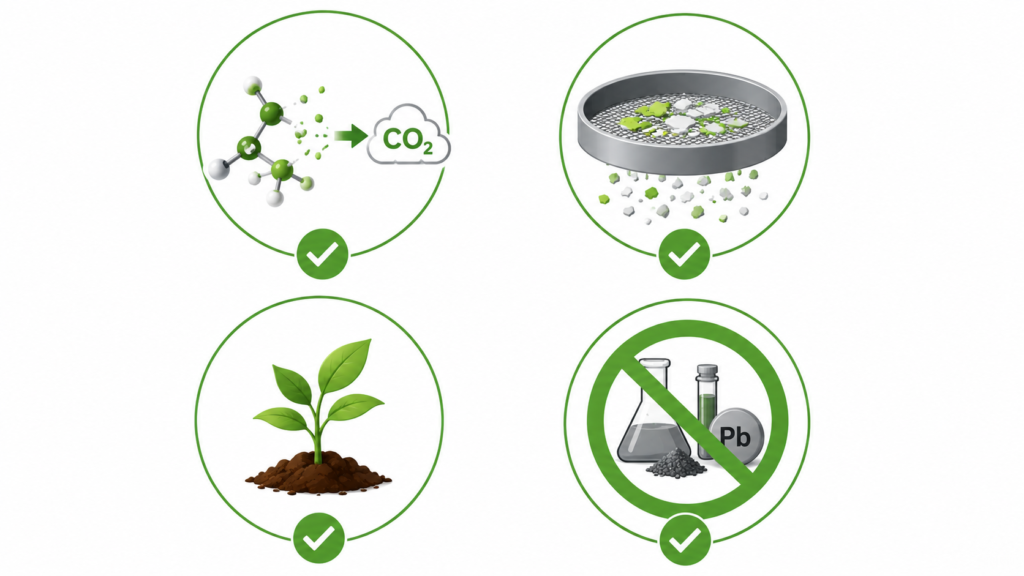
EN 13432 applies to the finished packaging, not just resin pellets. That means coatings, inks, adhesives, and all other components must meet the standard.
Further explanation is available via the
European Bioplastics EN 13432 overview
What ASTM D6400 Requires
ASTM D6400 is the equivalent compostability standard used in North America. It establishes a three‑in‑one testing system for plastics designed for aerobic composting in municipal or industrial facilities.
Key requirements include:
- Biodegradation rate — ≥90% within 180 days
- Disintegration — fragments break down during composting
- Eco‑toxicity — compost quality and plant toxicity
- Residuals — material limits for heavy metals
Products certified to ASTM D6400 can obtain
BPI Compostable Certification program
— one of the most recognized compostability marks in North America.
Home Composting: OK Compost HOME Certification
Home compostability is a quieter category — slower, lower‑tech, and accessible to anyone with a backyard bin.
The most recognized certification is OK Compost HOME, issued by
TÜV Austria OK Compost certification program.
Key requirements include:
- Decomposition at ambient temperatures of 20–30°C
- Full degradation within approximately 6 months
- Safe use in backyard compost systems
Analysts valued the global home compost market at $2.04 billion in 2025 and expect it to reach $2.78 billion by 2033, representing a CAGR of 3.96%.
Analysts project the household composters market to grow from $529.4 million in 2026 to $944.4 million by 2035, representing a CAGR of 6.6%.
Regulatory Deadlines That Matter (2026–2028)
Legislation is moving faster than infrastructure. Here are the deadlines you need to know.
EU PPWR (Packaging and Packaging Waste Regulation)
The key dates:
- 12 August 2026 — Full applicability; PFAS restriction in food contact packaging; Declaration of Conformity (DoC) required for all packaging
- 12 February 2028 — Mandatory industrial compostability for tea bags, coffee capsules, fruit and vegetable stickers, and very lightweight plastic carrier bags (must be certified to EN 13432)
- 2030 — All packaging must be recyclable; recycled content targets apply
These are the packaging items that must be compostable under industrially controlled conditions from February 2028 onwards:
- Single‑use coffee, tea and other beverage pads and sachets (soft, permeable versions, used in a machine or not)
- Fruit and vegetable stickers
In practice, these items are usually disposed of together with the content or product residues. Notably, pads, sachets and stickers are now considered packaging under the PPWR, which also impacts the declaration process.
Recyclability gets absolute priority under PPWR — compostable packaging is only allowed if it is recyclable and does not disrupt existing recycling streams. There are only two exceptions: coffee/tea/beverage pads/sachets and fruit/vegetable stickers.
Individual Member States may impose stricter requirements, including compostability for additional packaging types such as lightweight plastic bags, or compatibility with home composting.
United States
- California SB 54 — Requires that by 2032, all single‑use packaging sold in California must be recyclable or compostable. California AB 1201 prohibits labeling products as "compostable" or "home compostable" from January 1, 2026, unless they meet specific criteria. For products that contain synthetic substances but otherwise satisfy all requirements, the law postpones the labeling requirement until June 30, 2027.
- Oregon — Requires green coloration or compostability icons for consumer clarity. Generic "green" branding without verification is penalized
- Colorado — Ties producer responsibility fees to compostability verification; non‑compostable packaging faces higher compliance costs
United Kingdom
- ASA rulings — In April 2025, the ASA found that ads by Lavazza and Dualit describing coffee pods as "compostable eco capsules" were misleading. The ads gave consumers the impression that products could be composted in a home composter, while they are only certified for industrial composting under EN 13432
- CMA enforcement — The UK's Competition and Markets Authority now has powers to fine companies up to 10% of global turnover for misleading environmental claims
The Consumer Confusion Problem — And Why Clear Labelling Matters
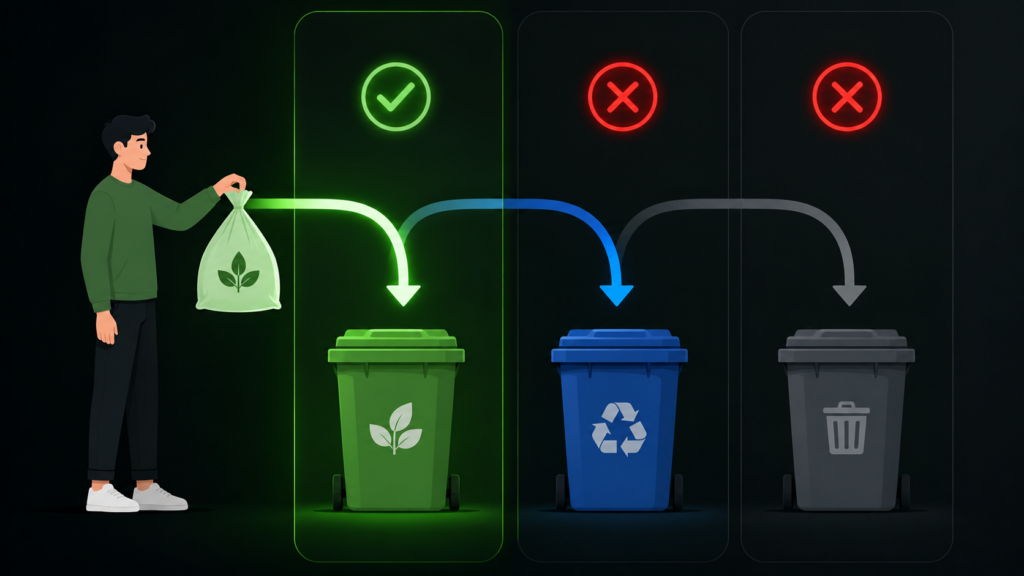
A 2025 behavioural intervention study in the UK found that after households received educational materials and clear bin labels, the number of consumers correctly disposing of compostable packaging in food waste bins increased five‑fold.
Common misconceptions include:
- Believing plant‑based materials automatically compost
- Placing compostable packaging into recycling bins
- Lacking access to clear disposal instructions
Three practical limits decide whether a compostable pack actually gets composted:
- Material format — films vs rigid containers vs coated fiber
- Contamination profile — heavy food residue vs light residue
- Facility acceptance policy — which overrules any generic claim
Certification proves a package can meet a standard under test conditions. It does NOT force a facility to accept it.
How ESINLE Helps Brands Navigate Composting Pathways
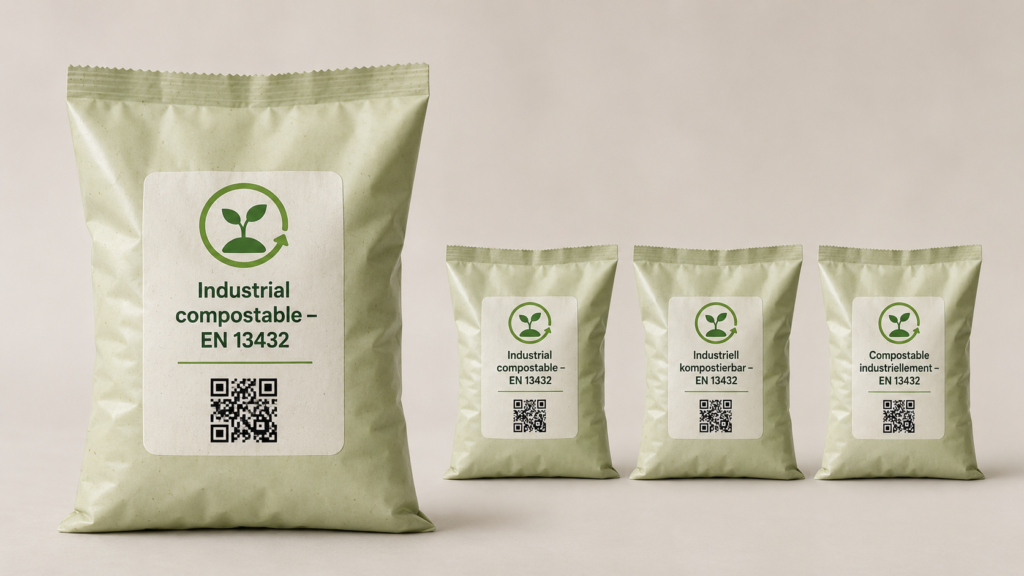
At ESINLE, we don't just manufacture certified compostable bags and films. We help you ensure they actually get composted.
Custom Label Design for Each Market's Disposal System
ESINLE's custom label service creates artwork that does four jobs at once:
- Aligns with certification (EN 13432, ASTM D6400, OK Compost HOME)
- Avoids overstated claims — no vague fluff
- Guides disposal correctly ("Industrial composting only" vs "Home compostable")
- Fits your brand design
For global rollouts, we provide modular artwork — so your pack speaks the right language in California, Germany, and Australia, without starting from scratch each time.
Oregon now requires green coloration or compostability icons for consumer clarity, and generic "green" branding without verification is penalized. We help you navigate these state‑specific requirements.
Consumer Education Materials
- QR codes linking to localized disposal guides
- Printable bin labels for industrial composting vs recycling
- Short‑form guides explaining the difference between home and industrial compostability
- Social media graphics for consumer education
Home Composting Best Practices
We provide guidance on:
- Carbon‑nitrogen ratio — balancing greens and browns for efficient decomposition
- Aeration — turning the pile to prevent compaction and speed up the process
- Moisture control — the fist test for proper moisture levels
- What to avoid — industrial‑only compostable items, meat, dairy, oils, fats
Industrial Composting Guidance for Commercial Partners
- Facility compatibility verification — not all commercial composters accept certified packaging
- Sorting protocols — clear signage for front‑of‑house and back‑of‑house waste separation
- Hauler coordination — ensuring certified items actually reach composting facilities
- Staff training materials — simple one‑page guides for quick reference
ESINLE's 10 Million Bottle Mission
Beyond the science and certifications, ESINLE offers a measurable environmental mission: every product you purchase recovers 4 plastic bottles from the environment — turning your packaging spend into a verifiable ESG outcome.
What to Ask Your Compostable Packaging Supplier First
Before you spec, ask these five questions:
- Which exact standard does the finished pack meet? — EN 13432 (EU), ASTM D6400 (US), OK Compost HOME?
- Is the claim for home composting, industrial composting, or both?
- Do inks, adhesives, labels, and coatings sit inside that approval scope?
- Which markets is the on‑pack claim designed for?
- What disposal wording do you recommend where organics collection is limited?
A supplier who answers these cleanly is worth continuing with. A supplier who stays vague about route, facility acceptance, or pack‑level certification is handing you future cleanup work.
FAQ: Quick Answers to Common Questions
Q: Can one package carry both home and industrial compostable claims?
A: Yes, if the finished package is actually certified for both routes. That is uncommon and should be documented, not implied. ESINLE can provide dual‑certified options upon request.
Q: What's the difference between EN 13432 and OK Compost HOME?
A: EN 13432 certifies industrial compostability under controlled high‑temperature conditions. OK Compost HOME certifies ambient‑temperature compostability in backyard bins — a different testing protocol with lower temperature requirements.
Q: Can I put industrial‑compostable packaging in my backyard bin?
A: No. Industrial‑compostable items require sustained high heat (55–60°C) that home bins rarely achieve. Only items with OK Compost HOME certification belong in home composting systems.
Q: How long does home composting take?
A: For OK Compost HOME certified items, complete breakdown occurs within approximately 6 months at 20–30°C. However, overall timeline depends on bin management — turning, moisture, and carbon‑to‑nitrogen balance all affect speed.
Q: Does ESINLE offer both industrial‑ and home‑compostable certification?
A: Yes. Our portfolio includes EN 13432 (industrial), ASTM D6400 / BPI (North America), and OK Compost HOME certified products. We help you choose the right certification for each market.
Q: Should I choose compostable packaging if my market has no compost collection?
A: Only with caution. If the end‑of‑life route is missing, the environmental claim may underperform — even if the pack is properly certified. ESINLE helps you assess local infrastructure before you commit.
Q: What happens if compostable packaging goes to landfill?
A: Degradation slows dramatically, and anaerobic conditions can generate methane. We lose the environmental benefit — which is why consumer education and local infrastructure access matter as much as the material itself.
Conclusion: Compostable Packaging Only Works With the Right Disposal Path
Compostable packaging is not confusing because the science is fuzzy. It's confusing because markets, facilities, labels, and buyer assumptions get tangled together.
Certified compostable packaging should not be treated as a landfill solution, a recycling substitute, or a vague "green" claim. It is a route‑specific product claim. Miss the route, and the claim starts to wobble.
When you choose ESINLE, you get:
- Certified materials — EN 13432, ASTM D6400, OK Compost HOME, BPI
- Custom label design — market‑specific instructions, regulatory‑compliant marks
- Consumer education resources — QR codes, bin labels, short‑form guides
- Disposal pathway guidance — facility verification, hauler coordination, training materials
- 10 Million Bottle Mission — every product you purchase recovers plastic waste from the environment
Keep the discipline tight:
- Match the pack to the disposal route
- Match the certification to the market
- Match the label to what a real person can do at the bin
That's usually where most compostable packaging programs either hold together — or quietly fall apart.
Ready to close the loop?
📧 Contact our compliance team: Lareinaliu183@gmail.com
📄 Request a custom label consultation | View certifications
This blog is part of ESINLE's commitment to radical transparency. Read our material & technology deep‑dive, policy & market tracker, and case studies & insights.