EU PPWR Compliance: Key Requirements and Declarations
Don’t treat packaging compliance as a late-2026 cleanup job. If you sell packaged goods into the EU, California, or other tightening markets, these zones are rolling out strict regulations. The EU’s PPWR applies August 12, 2026, while California’s SB 54 requires producer registration by June 1, 2026. These converging rules demand verifiable test data, technical documentation, and strict certification to avoid greenwashing allegations. To navigate these shifts and secure compliance, review our certifications page and policy & market tracker.
That matters now because the deadlines are stacking on top of each other. The EU’s PPWR starts applying on August 12, 2026. California’s SB 54 program is pulling producers into a statewide EPR system with a June 1, 2026 registration deadline. The United Kingdom is pushing pEPR. France keeps tightening AGEC. Canada is still enforcing its single-use plastics rules. Australia is moving again. Different jurisdictions, same direction, less tolerance for vague claims and sloppy documentation.
And yes, this reaches farther than the sustainability team. Procurement, legal, product design, sourcing, QA, sales, retail partners — everybody gets pulled in.
The Packaging Regulation Tipping Point
1 and Q2 of 2026 feel a bit like the moment before a storm where the sky looks weirdly calm and half the market decides they still have time. Some do. Most don’t.
The short version is simple: multiple jurisdictions are rolling out stricter packaging and EPR rules in tandem, and they are converging around the same pressure points:
- Verified recyclability and compostability
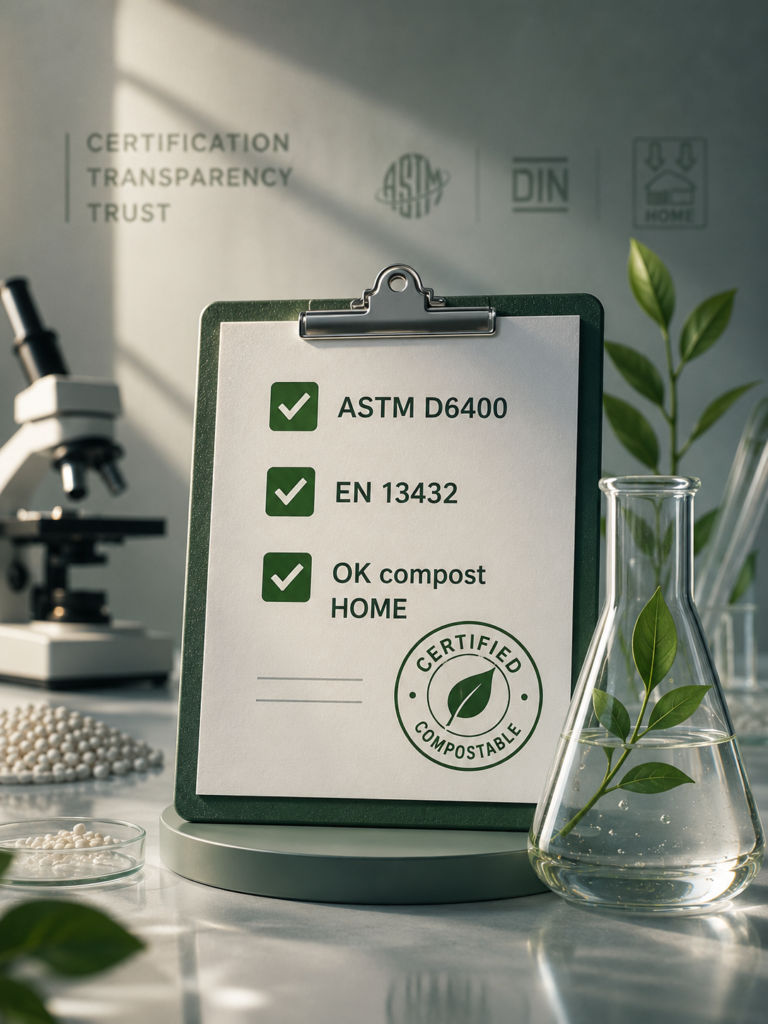
- Harder lines on compostable claims (EN 13432, ASTM D6400, OK compost HOME)
- Better technical documentation and batch traceability
- Producer responsibility (EPR registration, fee modulation)
- Less packaging waste
- Higher scrutiny on labels, recycled content, and end-of-life claims
| Jurisdiction | Core shift | Key 2026 pressure point | Business effect |
|---|---|---|---|
| EU | PPWR becomes the new rulebook | General application from Aug. 12, 2026 | Technical documentation, conformity support, EPR, PFAS restrictions |
| California | SB 54 packaging EPR system | Producer registration by June 1, 2026 | Reporting, funding obligations, packaging redesign pressure |
| United Kingdom | pEPR | Full net cost recovery rolls forward in 2026 | Fee exposure tied to recyclability |
| France | AGEC framework | Ongoing anti-waste and labeling controls | Claims, reuse, and packaging reduction scrutiny |
| Canada | Single-use plastics enforcement | Continued restrictions and legal pressure | Product packaging choices narrowed |
| Australia | National Plastics Plan updates | 2026 market tightening | More demand for verified recyclable material and compostability proof |
Oddly enough, the companies at the highest risk are often not the ones making plastic trays or bags. They’re the ones selling finished goods and assuming someone else has the paperwork.
Who this affects
If your company places packaged goods into a regulated market, this is your problem — usually sooner than you hoped.
- Manufacturers converting or filling packaging material for brand owners
- Brands selling under their own name, even when production is outsourced
- Importers placing finished products on the EU market or into California
- Retailers running private label lines or specifying packaging requirements to suppliers
That is the practical reach of PPWR and SB 54 — broad, commercially annoying, and very real.
And this is where ESINLE becomes useful, because compliance in 2026 is not just about sourcing a greener-looking bag or film. It is about end-to-end support: regulatory monitoring, certification review, test reports, Declaration of Conformity (DoC) readiness, and materials that can survive both legal scrutiny and buyer due diligence.
EU PPWR: The New Rulebook for Packaging – Compliance Documentation and DoC

Timeline and applicability
The EU Packaging and Packaging Waste Regulation (PPWR) entered into force on February 11, 2025, and starts applying from August 12, 2026. That date matters because PPWR replaces Directive 94/62/EC with a directly binding regulation across all 27 Member States. No waiting around for each country to transpose it in its own leisurely way. The direction is harmonization, even though national EPR systems and local enforcement details still matter.
As of May 2026, there are less than four months left before that general application date.
For many businesses, the biggest operational shift is not the headline itself. It is the evidence burden. Companies placing packaging on the EU market need technical documentation robust enough to support conformity, and they should be prepared to work from a Declaration of Conformity (DoC) framework rather than a loose chain of supplier emails and marketing PDFs. That old habit is dead.
Key requirements for your business
PPWR reaches into the parts of packaging teams usually prefer not to revisit until a retailer starts asking hard questions.
- PFAS restrictions for food-contact packaging kick in from August 12, 2026, subject to the thresholds and conditions in the regulation. That means food brands, converters, and sourcing teams need a clean handle on additives, coatings, barrier layers, and supplier declarations. “PFAS‑free” slapped onto a sales sheet without supporting data is how people get embarrassed.
- EPR does not disappear under harmonization. It gets sharper. Businesses still need registration in the Member States where they place packaging on the market, usually through producer responsibility organizations (PROs) or local registers. Packaging EPR remains a market‑entry issue, not a side quest for finance at quarter end.
- All packaging has to move toward recyclability by 2030, with design‑for‑recycling criteria and performance grades driving the real meaning of that word. Recyclability is no longer just a nice line in a brand deck. It is becoming a regulated packaging attribute that will shape fee modulation, retailer acceptance, and eventually the cost structure of the pack itself.
- Some items must be compostable by law, not by preference, from February 12, 2028. Tea bags, coffee capsules, sticky labels on fruit and vegetables, very lightweight plastic carrier bags in specific use cases — these are the categories that keep coming up. If you are still fuzzy on the certification side, it helps to understand how EN 13432 works in practice, because Europe is moving toward proof, not poetry.
And yes, this has design consequences. Material choice, inks, adhesives, barriers, transport efficiency, reuse models, recycled materials, batch traceability — even label coverage — they all start feeding the same compliance file.
California SB 54: North America’s Most Ambitious Packaging Law
The Extended Producer Responsibility (EPR) Program
California’s SB 54 is the loudest signal in North America right now — partly because California has scale, partly because U.S. recycling systems are fragmented, and partly because big brands rarely build one packaging system for California and another for everyone else unless they absolutely have to.
The law requires covered single‑use packaging and plastic food service ware sold into California to be recyclable or compostable by 2032. It also sets reduction and recycling targets:
- 25% reduction in covered plastic packaging and food service ware
- 65% recycling rate by 2032
So when people talk about SB 54 as “just another EPR bill,” they are missing the point. This is a packaging redesign law wearing an EPR jacket.
According to CalRecycle’s SB 54 program guidance, producers needed to move toward registration through the approved producer responsibility organization (PRO), with June 1, 2026 sitting there like a brick in the road. Miss that kind of deadline and the rest of your compliance calendar gets ugly fast.
Compostable labelling rules, AB 1201
California is also unusually hostile to fuzzy environmental claims — which frankly is healthy. Under AB 1201, products generally cannot be labeled “compostable” unless they meet specific criteria. That usually points you back to recognized standards such as ASTM D6400 or ASTM D6868, plus certification support that a retailer or regulator can actually verify.
The state has extended certain labeling requirements for products containing synthetic substances until June 30, 2027. After that, stricter certification and labeling expectations bite harder. The practical lesson is blunt: if your claim depends on consumers guessing what your packaging does in the environment, the claim is weak. If your claim depends on test reports, certification, and correct market‑specific labeling, you are in better shape.
No greenwash. No soft‑focus “eco” wording. Just evidence.
Global packaging regulatory landscape, what’s coming
United Kingdom’s pEPR
The UK’s pEPR framework pushes producers toward paying the full net cost of collecting, sorting, recycling, and disposing of household packaging waste. From 2026 onward, those economics matter more. Fees are expected to be modulated over time, which means easier‑to‑recycle packaging should cost less and awkward formats should cost more. That turns packaging design into a finance decision. Finally.
Other jurisdictions
- France’s AGEC framework keeps tightening around anti‑waste measures, reuse, repair, sorting labels, and single‑use reduction.
- Australia’s National Plastics Plan keeps nudging the market toward packaging reduction, recycled content, and stronger design rules.
- Canada’s single‑use plastics regime remains messy because some measures are being challenged, but enforcement pressure and market expectations have not gone away.
The Common Thread
| Trend | Implication |
|---|---|
| Extended Producer Responsibility (EPR) is spreading | Even when each market names it differently, you must register and pay fees. |
| Verified recyclability or compostability is replacing broad sustainability language | You need test reports, not just marketing claims. |
| Labels are being regulated more tightly | Because consumer claims drive disposal behavior. |
| Traceable, data‑backed circular economy systems are becoming the norm | Supply chain documentation is no longer optional. |
This is why smart businesses are building one internal compliance spine that can flex across Europe, North America, and other regulated markets — instead of improvising market by market.
How ESINLE Helps You Stay Compliant – End‑to‑End Compliance Support
Regulatory monitoring and market readiness
This is where most companies stumble. Not on the grand theory. On the updates. Delegated acts. Implementing guidance. Local register changes. What a retailer suddenly starts demanding two quarters before a deadline.
ESINLE tracks PPWR, SB 54, and the wider packaging policy shift so your team is not blindsided by enforcement dates or new documentation requirements. If you want the broader market view, the shift laid out in our policy‑focused PPWR and EPR guide captures the direction clearly: regulation is moving faster than most sourcing calendars.
Documentation to keep you compliant
The hard part is usually not getting a sample made. The hard part is proving what it is.
ESINLE supports the document stack companies actually need in 2026:
- Declaration of Conformity (DoC) readiness for PPWR
- Technical Data Sheets (TDS)
- Test reports (biodegradation, disintegration, ecotoxicity)
- Batch traceability records
- Certification files (EN 13432, ASTM D6400, OK compost HOME, BPI)
That matters for customs. It matters for retailers. It matters for internal legal review. It matters when a customer asks whether the packaging can enter a composting or recycling stream in a specific market instead of some imaginary global waste system that doesn’t exist.
Certified materials, no surprises
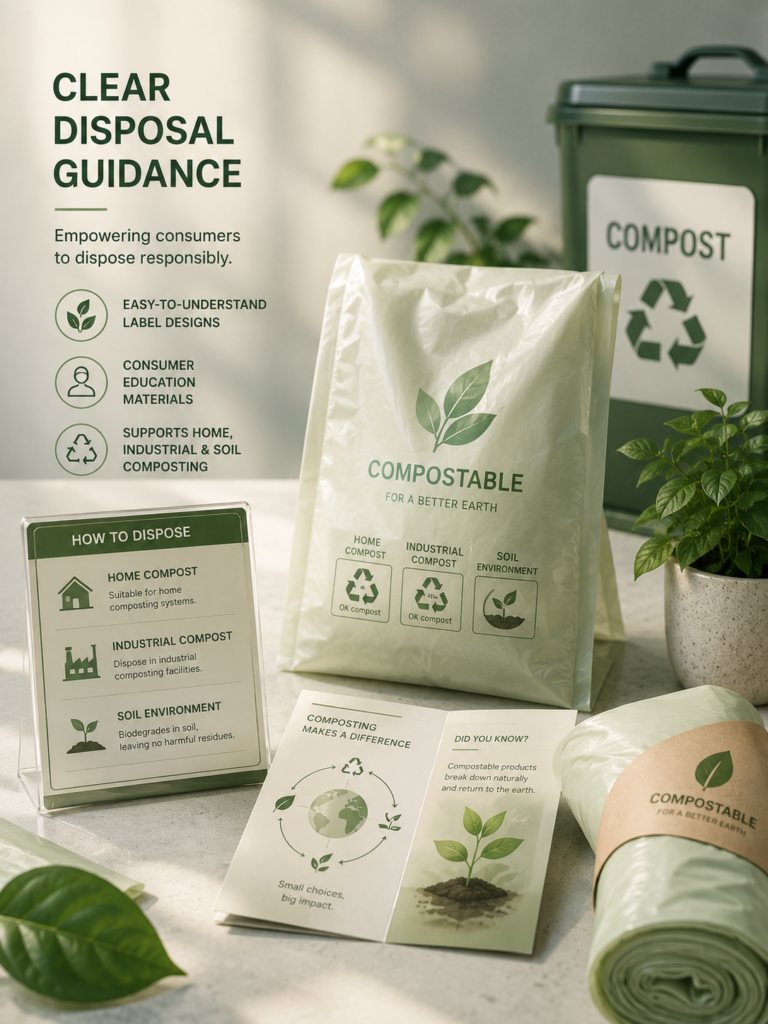
For compostable and specialty packaging, certification is the difference between a marketable story and a defensible product. ESINLE works with material and product pathways aligned to EN 13432, ASTM D6400, OK compost HOME, and BPI expectations, depending on the jurisdiction and use case.
- For EU markets: PPWR‑ready compostable packaging with DoC support
- For the U.S., especially California: materials and labels that can stand up to SB 54 and AB 1201 scrutiny
Quietly, this is becoming a supply‑chain advantage. Retailers and importers do not want surprises in 2026. They want cleaner documentation, more predictable lead times, and fewer compliance arguments.
Beyond compliance, brand advantage
There is a commercial angle here that people love to downplay until a buyer meeting goes sideways. Early adopters usually lock in supply sooner, reduce rework, and gain credibility with retailers who are tired of unsupported environmental claims.
A simple action grid helps:
| Right now | Why it matters before 2026 closes |
|---|---|
| Audit every packaging format by market | You need to know which items fall under PPWR, SB 54, or both |
| Match claims to certifications and test data | Compostable and recyclable labels are getting policed harder |
| Confirm EPR registrations and reporting owners | Missed obligations become sales and import problems fast |
| Review food-contact materials for PFAS risk | August 2026 is not far away |
| Build one compliance file per product packaging line | Sales, legal, QA, and customers all end up asking for the same proof |
Don’t let regulations catch you off guard
2026 is the convergence year.
- PPWR starts applying in August 2026.
- California SB 54 is pulling producers into a serious EPR system with a June 1, 2026 registration deadline.
- The UK, France, Canada, and Australia are all pushing the same broad agenda: less packaging waste, more accountability, stronger recyclability, tighter labels, better data.
You can wait until a customer asks for proof. Plenty of companies will. They will spend more, move slower, and call the situation “unexpected.”
A better move is simpler: treat ESINLE as a strategic compliance partner — not just a supplier.