A costume can survive a bad photograph. A badly fitted rain poncho, a table cover that hides its own design, or a cookie bag that will not close creates a problem the customer has to solve while the party is already starting.
That is where a useful Halloween product range begins: with the moment someone needs the product to work.
The National Retail Federation’s September 2026 survey puts expected US Halloween spending at $13.5 billion, with 49% of consumers planning to shop in September or earlier. Those are consumer spending intentions across the holiday, not recorded sales of rainwear, table covers or compostable packaging. For buyers, the useful question is which part of a celebration their range can serve reliably.
This guide follows that question from product selection through sample approval and supplier comparison. It is written for party-supply buyers, packaging distributors, bakery brands and event procurement teams planning a seasonal range.
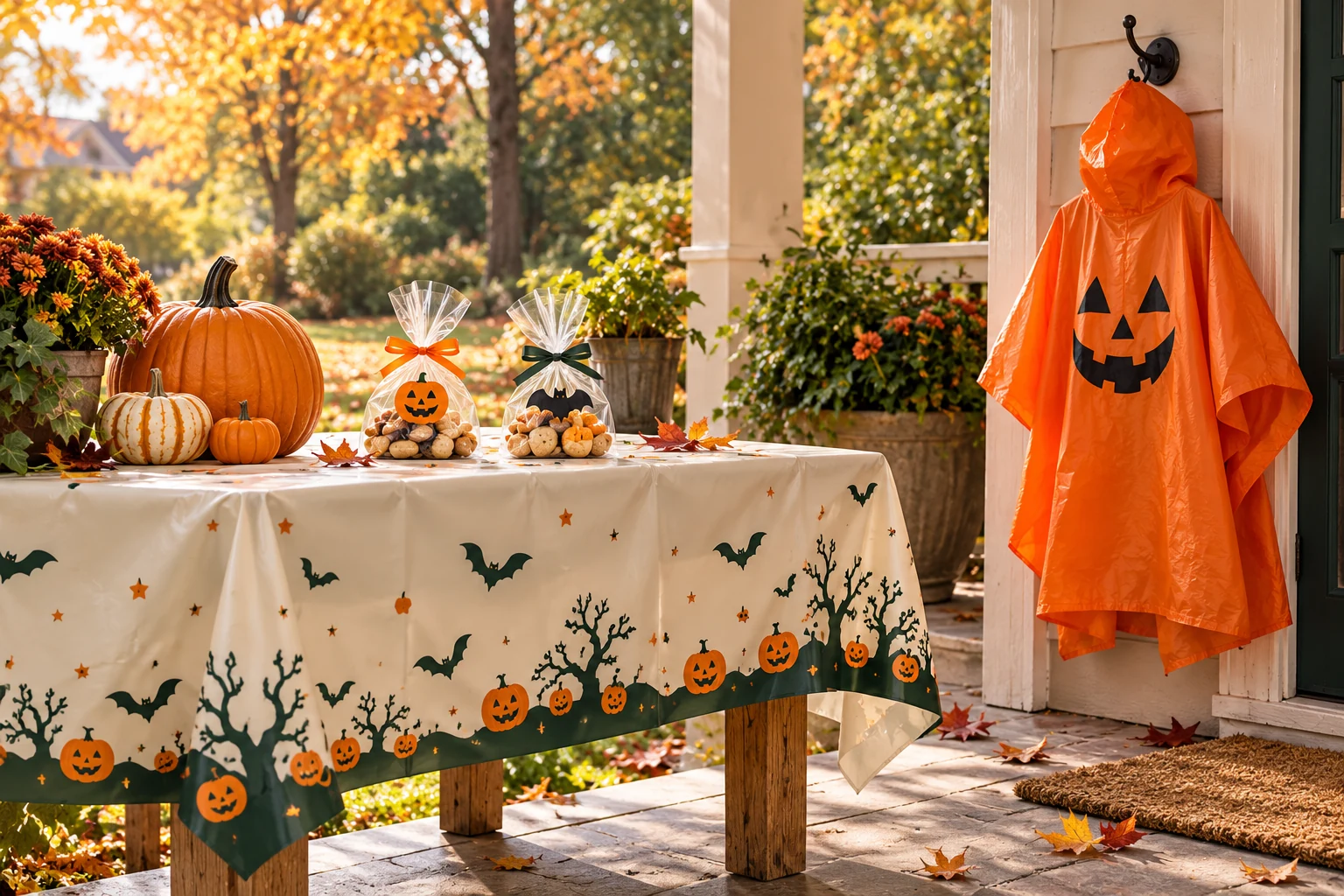
What should I include in a Halloween party supplies range if I want people to actually use it?
Start with one customer and one occasion. A neighbourhood bakery handing out cookie gifts needs a different range from a venue running several outdoor Halloween evenings.
Map the occasion in order: arriving outdoors, setting the table, packing treats, then clearing up. Each step gives a product a specific job. That is a stronger starting point for a custom Halloween party supplies brief than choosing a pumpkin print and putting it on every available format.
| Customer or occasion | Product to investigate | The buying question that matters |
|---|---|---|
| Outdoor attraction or event | Hooded rain poncho | Can guests put it on over what they are already wearing? |
| Party retailer or event caterer | Printed table cover | Does the design still show once the food and plates are on the table? |
| Bakery or gifting brand | Clear treat bag | Will the actual food fit, close neatly and remain suitable for its intended storage? |
| Garden or seasonal home retailer | Pumpkin-print yard bag | Does it work for the intended leaf load and collection route? |
A coordinated collection can share two or three colours without sharing every graphic. Give the rain poncho a recognisable motif, the table cover a readable border and the treat bag enough clear space to show the food. Let the product’s job decide where the artwork goes.
How do I choose a Halloween rain poncho that will fit over a costume?
Ask for a dimensioned sample, then try it over the intended outfit. “One size” is not enough information when a customer is wearing a bulky jacket, carrying a bag or trying to keep a costume visible.
Specify the finished body length, the measurement convention for width, the hood opening and the side or sleeve construction. A flat width is not the same thing as a body circumference. Ask the supplier to mark the measurement points on a drawing so two quotes describe the same garment.
For sample review, have an adult wearer put the poncho on over the relevant layers, turn their head, reach forward and walk normally. Look for a neckline that is hard to pass over the outfit, a hood that slips into the wearer’s view and side openings that expose the area the buyer intended to cover. These are proposed fit checks, not a substitute for product safety or performance testing.
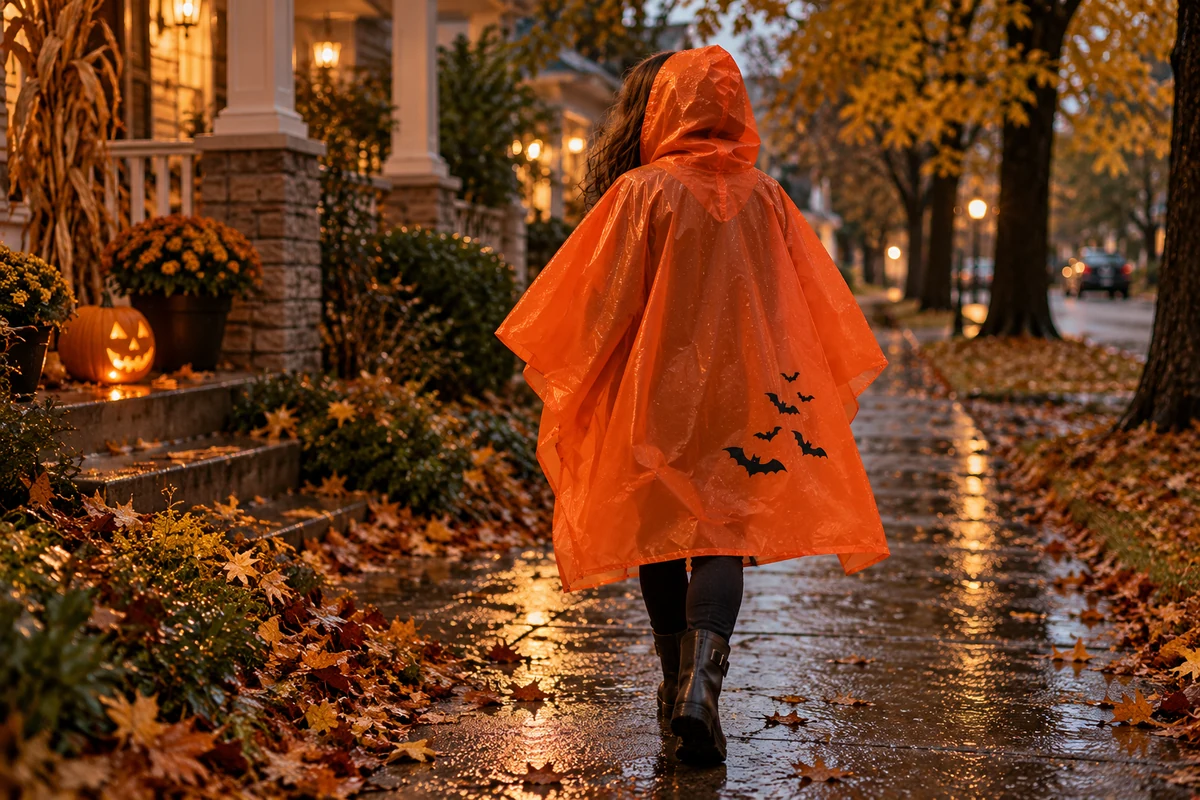
The artwork decision depends on the customer. A clear or lightly tinted version can preserve costume visibility; an orange printed version makes the rainwear part of the look. Put the sample on a person before approving the print position: a graphic that is centred on a flat sheet can land in a fold when worn.
For custom printed rain ponchos, request the intended rain exposure, seam construction and supporting performance information alongside the artwork. Keep adult and children’s specifications separate; a children’s version needs its own safety review rather than a scaled-down adult pattern. ESINLE’s protective-wear formats are a starting point for a configuration discussion.
What size Halloween tablecloth do I need, and where will the print sit when I put it on the table?
Measure the table first, then choose the drop on each edge. For a rectangular table with equal drops, cover length = table length + twice the drop, and the same calculation applies to width. This is the sizing approach used in WebstaurantStore’s table-linen guide.
Worked example: a 72 × 30 inch table with a chosen 12 inch drop needs a 96 × 54 inch cover. A 108 × 54 inch cover on the same table gives an 18 inch drop at each end and a 12 inch drop along each side. Neither is automatically wrong; they create different layouts. These dimensions are an illustration, not an ESINLE stock specification.
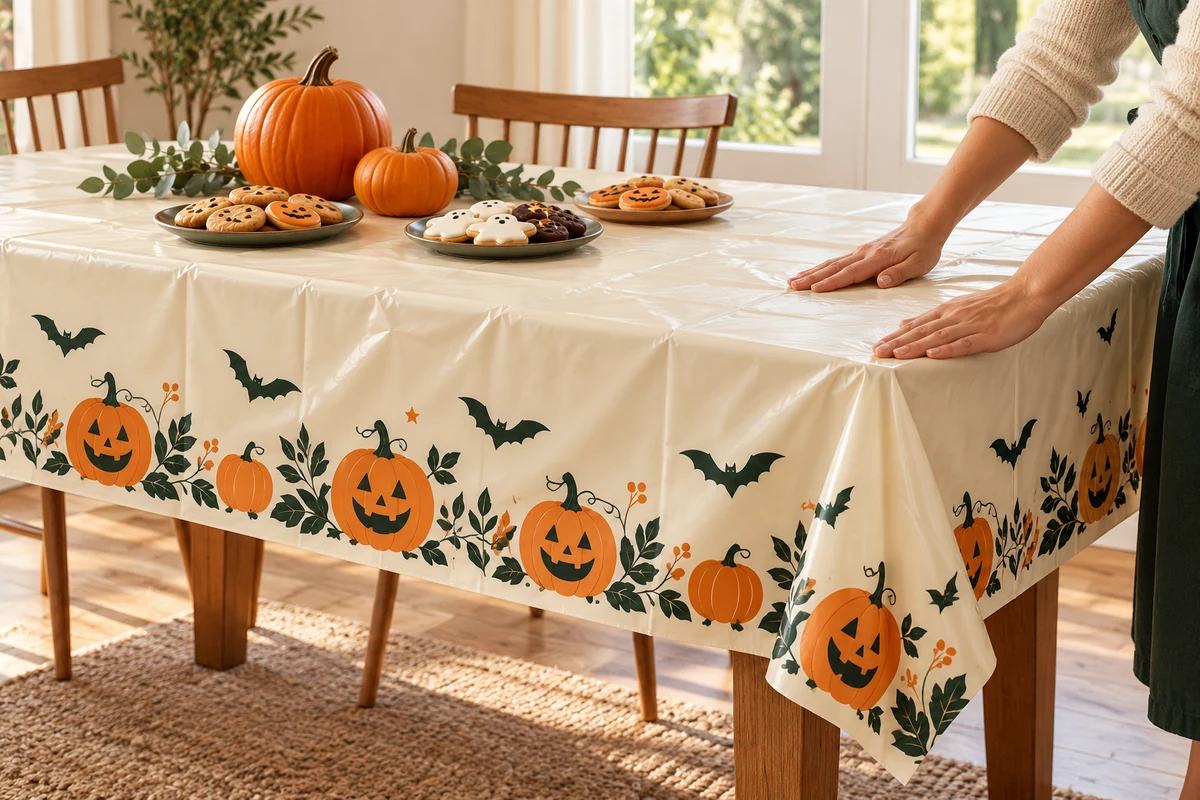
Now draw the tabletop boundary on the artwork proof. Anything outside that rectangle becomes a hanging panel. A pumpkin near the wrong fold may disappear under the table edge, and a large centre graphic may spend the entire evening beneath a serving tray.
Approve a photograph with the cover on the actual table size and the planned plates or trays in place. Check the short ends too. For repeated motifs, ask how cutting and print alignment are controlled; do not assume that every cut sheet will position a large centre image identically.
A Halloween table cover sample should also be checked over the expected tabletop colour. A pale cover that looks opaque on white can look different on dark wood. Use the proposed service conditions to review spills, wiping and edge handling. Direct contact between unwrapped food and a printed table surface requires a separately supported intended use. Compare the available table-cover formats before finalising the print.
How big should Halloween treat bags be if I am packing cookies instead of wrapped candy?
Size the bag around the finished pack, including the closure. A decorated cookie, its backing card and a bow need more usable space than the cookie’s face measurement suggests.
Ask whether the quoted dimensions are external, internal or measured flat. Identify any gusset, bottom seal, zipper or adhesive flap. Then pack the actual contents. For a tied bag, the neck above the food must be long enough for the planned tie without pressing into the decoration. For a self-seal bag, the flap must close without pulling the pack out of shape.
Compare the fullest and smallest planned pack. A bag that just closes around three cookies may look empty around one. That is a range decision: one universal bag can simplify purchasing, while separate sizes can improve presentation. Test both before adding another SKU.
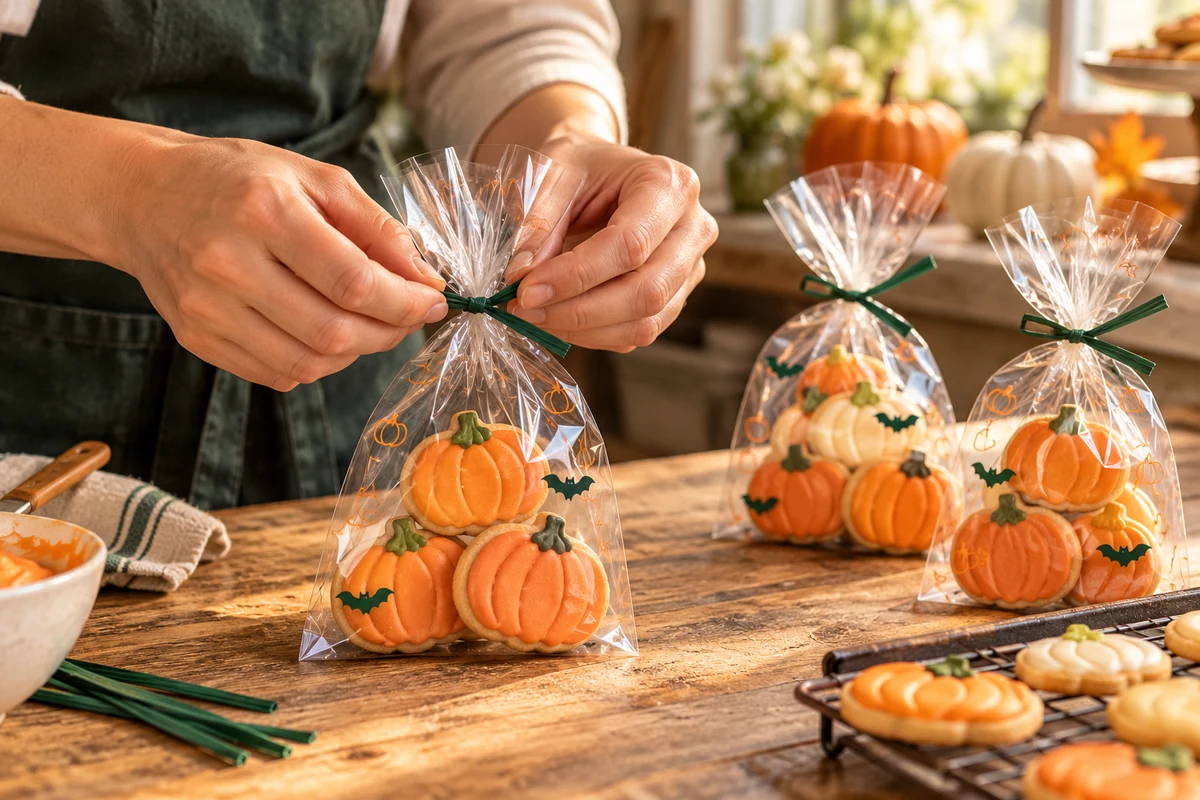
Try the complete packing sequence with the person who will do the work: separate the bags, open one, insert the contents, close it and place it in the selling or transport pack. A difficult opening or fiddly tie can create a labour problem that a low unit price does not reveal.
For custom Halloween treat bags, describe the food, contact time, temperature and storage conditions. A clear appearance or a compostability certificate does not establish food-contact suitability. The FDA explains that food-contact assessments depend on intended use and migration exposure; the European Commission describes supporting documentation and declarations of compliance for plastic food-contact materials.
Ask how the evidence relates to the finished bag, including its printing and closure. A room-temperature filled-sample check can reveal presentation problems, but it cannot establish shelf life or replace the necessary testing. ESINLE’s food-bag range can help narrow the format before a use-specific review.
Can pumpkin leaf bags work for garden clean-up, or are they just Halloween decorations?
They can be developed around either job, but the acceptance criteria should say which one the buyer means. A decorative bag filled once with dry leaves has a different duty from a collection bag lifted, carried and set down while full.
Define the contents, expected load and handling route. Dry leaves, damp leaves and sharp garden debris are different challenges. Review the opening while wearing the gloves likely to be used, leave enough unfilled neck to close the bag and examine the bottom seal after the agreed handling sequence.
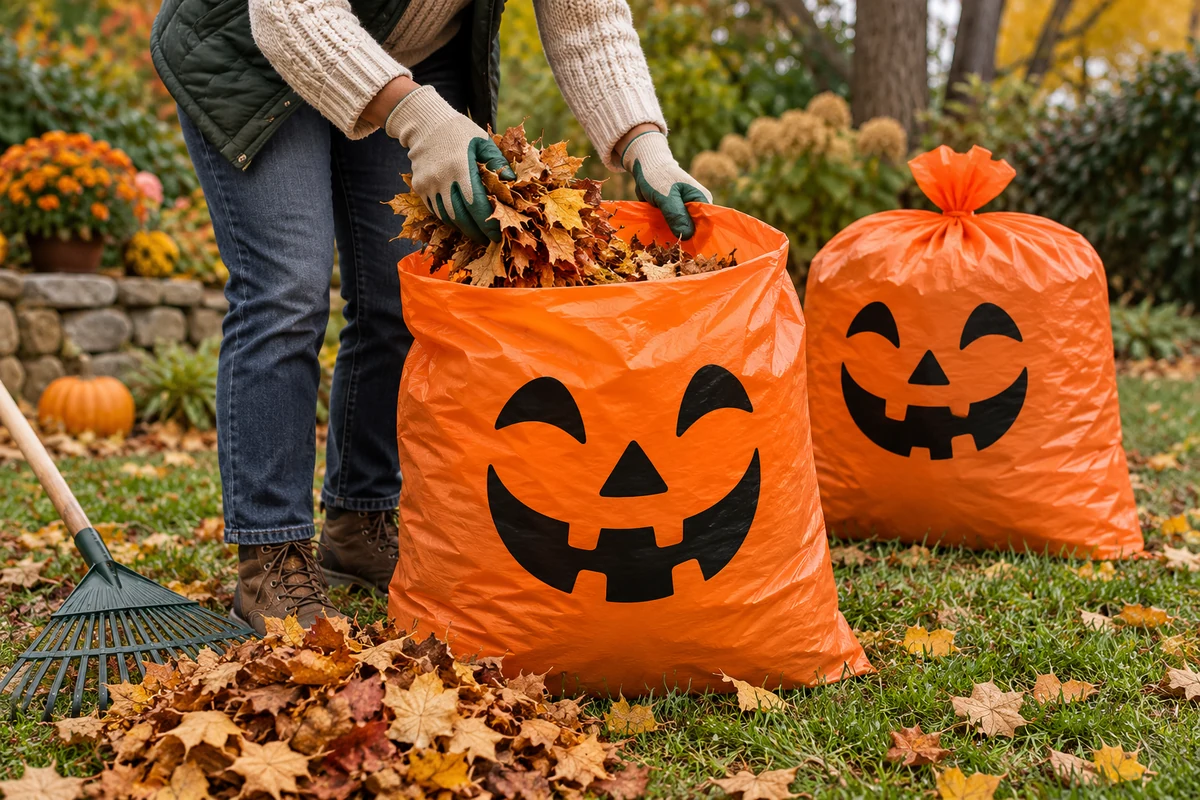
Film thickness alone cannot settle that decision. The selected construction, seams, bag dimensions and sharp contents all affect the result. Ask for a sample review against the actual task, with written pass and fail criteria agreed before production.
For a compostable option, confirm what the local collector accepts. US EPA guidance distinguishes commercial from home composting and explains that compostable plastics should not be placed in conventional plastic recycling. A pumpkin face is a seasonal design, not a disposal instruction. Review general-bag formats and the intended collection route together.
What should I check on a sample before I approve custom Halloween supplies?
Approve the product in use, then record exactly what passed. A beautiful sample on an empty desk leaves too many questions unanswered.
The following is a practical buyer-review plan. It does not replace laboratory testing, formal inspection plans or the requirements that apply in the destination market.
| Sample check | What to do | What to record before approval |
|---|---|---|
| Rain poncho fit | Wear it over the intended layers and check movement and hood position | Measurement points, wearer context, coverage and agreed rain-performance evidence |
| Table-cover presentation | Fit it to the specified table and add the planned serving items | Drop on each edge, artwork orientation, cutting tolerance and acceptable print position |
| Treat-bag packing | Pack the actual food, backing and closure using the intended workflow | Usable dimensions, closure allowance, packing observations and required contact-use evidence |
| Yard-bag handling | Fill and handle it under the agreed contents and load conditions | Contents, load, closure, seam observations and accepted collection route |
Keep an approved physical reference with the drawing, artwork revision, colour reference, packing specification and agreed tolerances. Record who approved it and when. If the sample uses a different material or print process from production, identify what still needs approval before releasing the order.
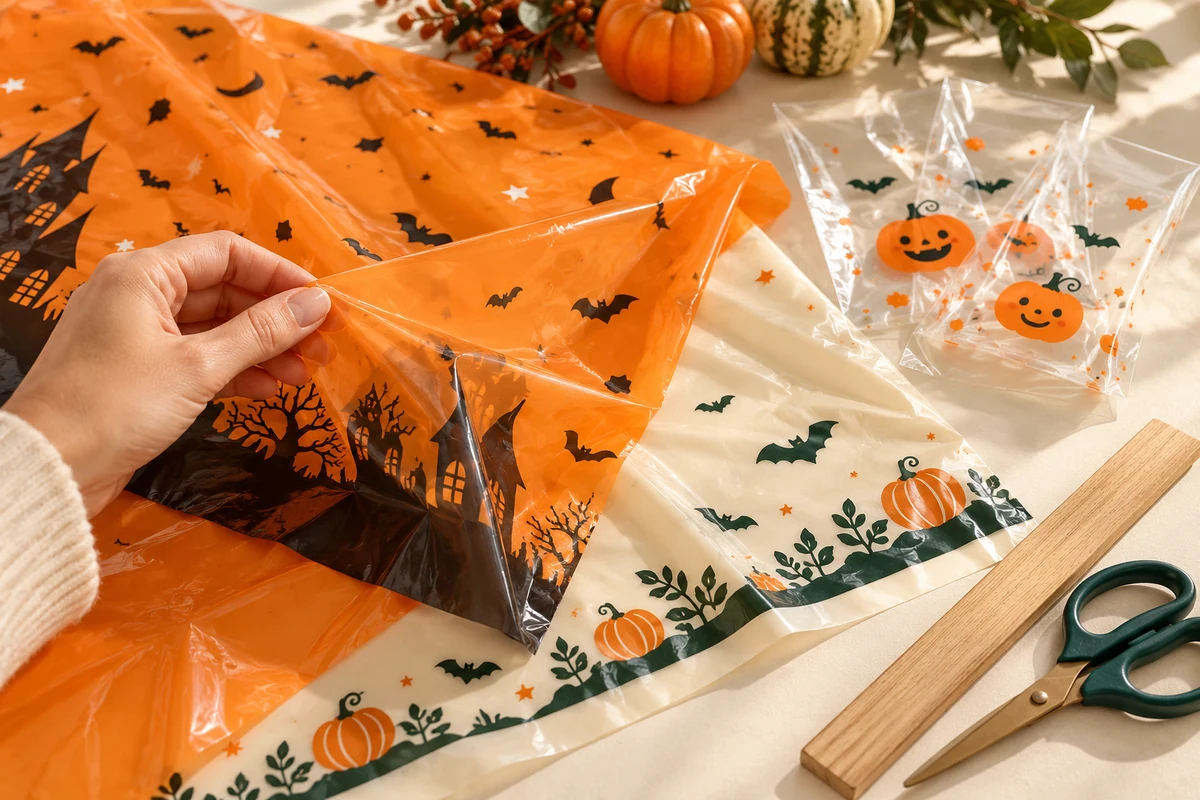
A useful question for the supplier is: “Which parts of this sample represent the final order, and which parts are still provisional?” It prevents a stock sample from quietly becoming the approval reference for a substantially different custom product.
Should I buy ready-made Halloween supplies or order custom prints for next season?
Choose according to the demand you can support and the date you need stock ready to sell. A custom design creates more decisions to approve. A ready-made design reduces those decisions but may not meet the required fit, packing format or brand presentation.
| Buying route | When it is worth considering | What still needs checking |
|---|---|---|
| Verified stock design | Time is short and the existing product already meets the use case | Actual availability, finished dimensions, documents, packing and arrival date |
| Custom seasonal print | The buyer has a defined channel, artwork and a sufficiently clear demand plan | Setup cost, minimums by variant, approval stages and residual stock exposure |
| Standard product with a seasonal paper band or outer pack | The buyer wants to separate the seasonal message from the underlying product | Assembly work, labelling, additional materials and whether leftover stock really can be repacked |
Ask for the minimum order by size, design and packing format, not just a single headline MOQ. Four artworks can create four separate inventory commitments even if the overall quantity sounds manageable.
For leftover stock, ask a concrete question: can this exact product still be used or sold after 31 October? A plain orange item and a neutral outer pack leave different options from a date-specific design. Repacking is an option only if the labour, labels and storage make sense for the business.
This guide is prepared on 29 October 2026. For an immediate 2026 need, confirm local stock and an achievable delivery commitment. A new custom import programme is better planned backwards from next season’s warehouse-ready date: allow for receiving checks, transit and clearance, production, approvals and any required testing. Obtain project-specific durations rather than assuming a universal lead time.
Are compostable Halloween bags and table covers the right choice for my customers?
Start with where the product will go after use. A staffed venue with a confirmed organics collection arrangement can evaluate a controlled route. A treat bag handed to households needs instructions that make sense for different local services. The same environmental message may not work in both situations.
Separate three decisions: performance during use, food-contact suitability where relevant, and the disposal claim. Passing one does not answer the others.
EPA notes that a commercially compostable label generally relates to industrial conditions, and that home composting requires an appropriate indication. Facility acceptance must be checked. A certificate is one part of the decision; it does not create a collection service at the event or in the customer’s neighbourhood.
For the finished configuration, request the current certificate and scope, the applicable formulation and thickness range, and confirmation of how printing, labels and ties are addressed. Plan instructions for components that follow different routes. ESINLE’s home-versus-industrial composting guide can help frame those questions; final wording should match the product and destination.
How do I compare supplier quotes when the cheapest unit price leaves out packing and handling?
Compare the cost of an order ready for your channel. Align the dimensions, material, artwork, retail count, carton packing, delivery basis and evidence requirements before comparing totals.
Here is a deliberately simple illustration, not an ESINLE quotation or a forecast. Both options supply 10,000 units to the same destination on the same assumed landed basis. Supplier A’s landed amount is $1,000, but its bulk packing requires an estimated $200 of local repacking. Supplier B’s retail-ready amount is $1,120 with no additional repacking assumed.
| Illustrative comparison | Supplier A | Supplier B |
|---|---|---|
| Landed order amount before local repacking | $1,000 | $1,120 |
| Assumed local repacking cost | $200 | $0 |
| Cost ready for the intended channel | $1,200 | $1,120 |
| Cost per unit, at 10,000 units | $0.120 | $0.112 |
The initially cheaper option becomes $80 more expensive under those assumptions. The lesson is to expose the missing work. On a real order, replace every assumption with your own figures, confirm what the delivery basis includes and compare the cost of delays, damage or unsold variants separately rather than hiding them in a speculative margin claim.
Ask for a written breakdown of artwork or tooling charges, samples, production packing, transport responsibilities and destination costs. Then ask what would change the price. A quote that can explain its assumptions is easier to approve and easier to compare.
What should I send a supplier to get an accurate quote for custom Halloween supplies?
Send the product in context. Include the buyer or channel, destination market, finished dimensions, actual contents or use conditions, proposed artwork, quantity by variant, retail packing, required documents and the date the goods must be ready at your warehouse.
A useful opening brief sounds like this: “We are developing Halloween treat bags for independent bakeries. They need to hold our finished cookie pack with a backing card and a paper tie. Please review the attached filled-pack photos, confirm usable dimensions and propose the appropriate food-contact documentation for our market. Quote the two artwork variants separately and show retail packing and delivery assumptions.”
For ESINLE, start with the relevant format and the change you need. The OEM/ODM process provides a route for discussing dimensions, printing, packing and evidence requirements before the final specification is agreed.
A better Halloween range begins with a product that works when the customer needs it.
Send your intended use, dimensions, artwork, quantity and warehouse-ready date. Include the certification or food-contact documents your market requires so the proposal can address the actual project.
All six images are AI-generated concept scenes illustrating possible seasonal applications, not photographs of customer projects or approved production samples. Dimensions, costs and sample-review examples in this guide are illustrative unless explicitly attributed.
Sources and scope: NRF’s 2026 consumer survey supplies the spending forecast and early-shopping figure; it does not establish demand for any individual ESINLE product. The linked FDA, European Commission and EPA resources support the food-contact and disposal distinctions. The table-cover example applies the sizing method linked above. Product-selection and sample-review recommendations are ESINLE editorial guidance. Research checked 29 October 2026.