"Can a dog poop bag really be compostable?" It is the question behind every skeptical product review, every retail buyer's due-diligence checklist, and every honest conversation about pet waste. The short answer: only when a certification says so. This guide explains the polymer science, the certification ladder, and the practical realities — so you can tell a genuinely compostable bag from a greenwashed one in about five minutes.
"Biodegradable" Is a Claim Without a Deadline
The single most important distinction in this category is the gap between two words: biodegradable and compostable.
"Biodegradable" carries no legal definition in most markets. It does not specify where degradation happens (soil? marine? landfill?), how fast it happens, or what is left behind. Under the updated FTC Green Guides, an unqualified "biodegradable" claim must be backed by evidence of complete decomposition within a reasonably short period in the environment where the product is customarily disposed — a bar most plastic bags, including many labeled "biodegradable," cannot clear. The EU went further: oxo-degradable plastics, which simply fragment faster into smaller plastic pieces, have been banned under the Single-Use Plastics Directive since 2021.
"Compostable" is different because it points to a test standard: 90%+ of the material converted into CO₂, water, and biomass within a defined time window, plus disintegration and ecotoxicity limits. When a bag carries OK Compost HOME or EN 13432, an independent certifier has verified those numbers in a laboratory. That is the difference between a marketing adjective and a measured fact.
What These Bags Are Actually Made Of
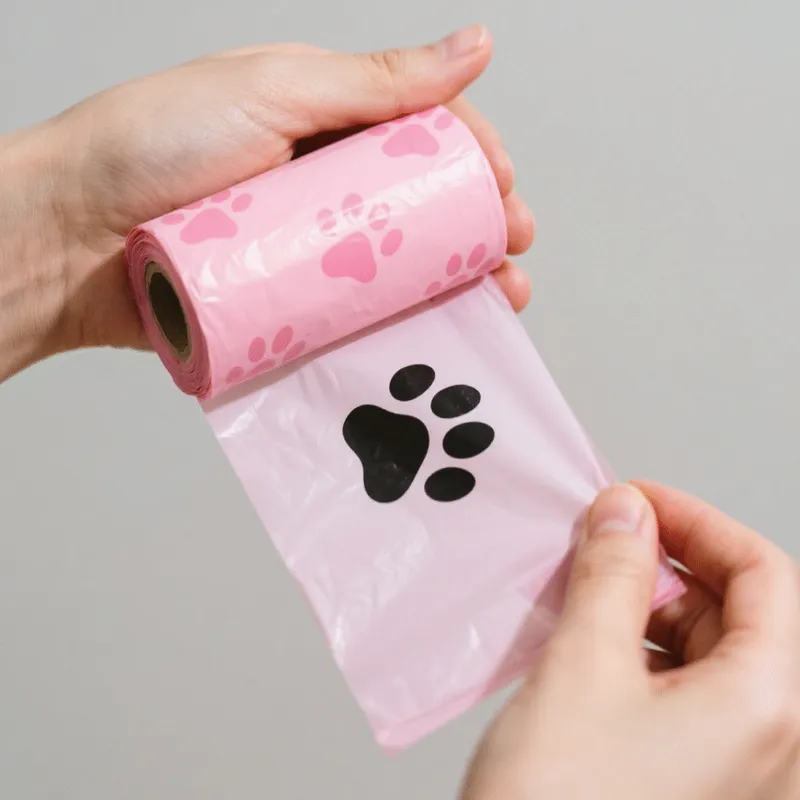
A certified compostable dog bag is a three-polymer formulation, and each ingredient has a job:
- PLA (polylactic acid) — fermented from corn starch or sugarcane. PLA brings stiffness and tensile strength, but on its own it is too brittle for thin films, especially in cold weather.
- PBAT (polybutylene adipate terephthalate) — a flexible, tough polyester. Technically derived from petrochemical feedstock, PBAT is nonetheless fully biodegradable and supplies the elasticity that lets a bag stretch without tearing.
- Plant starch — accelerates biodegradation onset and improves the film's hand-feel.
The art is in the ratio. ESINLE's home-compostable grade (ES-GB-09) extrudes a 15 μm blown film — thin enough to be cost-effective per roll, tough enough for a 9×13 inch star-seal bag that holds up on a walk. The formulation is certified under OK Compost HOME, EN 13432, and ASTM D6400, so the same bag is verified for both backyard and industrial routes.
Home Compost: 12 Months at Ambient Temperature
Here is what OK Compost HOME — the strictest end-of-life standard a bag can carry — actually verifies: at ambient temperatures of 20–30°C, in a managed backyard-style compost environment, 90%+ of the material biodegrades within 12 months. No industrial heat, no 58°C facility. The standard also requires the finished bag to disintegrate into fragments below 2 mm and to leave no ecotoxic residue in the resulting compost.
Industrial certification (EN 13432, ASTM D6400) works faster — 90%+ biodegradation within 6 months at sustained temperatures around 58°C — because a commercial facility actively manages heat, moisture, and aeration. A home pile reaches those conditions only intermittently, which is why the 12-month window exists. The practical takeaway: a bag with both certifications biodegrades whether it reaches a municipal facility or a backyard pile — the route only changes the timeline.
The Pathogen Question: What to Actually Do With the Waste
An honest discussion of dog waste bags has to separate two things: the bag and what is inside it.
Dog feces can contain E. coli, salmonella, and parasites such as roundworm. A backyard compost pile used for edible plants rarely sustains the sustained high temperatures needed to sanitize those pathogens — so we do not recommend composting dog waste in compost intended for food crops, even with a certified compostable bag. This is not a limitation of the bag; it is the reality of the waste stream.
Best practice, in order of preference:
- Municipal pet-waste collection — where your city explicitly accepts certified compostable bags with pet waste (acceptance varies by city; check local rules).
- A dedicated pet-waste composter — enclosed systems designed to reach sanitization temperatures.
- Landfill as a last resort — the bag still beats conventional plastic: no persistent microplastics, and its carbon is renewable rather than fossil.
Microplastics: The Real Failure Mode of Fake "Biodegradable" Bags
Roughly 90 million dogs live in the United States, and each produces about 320 pounds of waste per year — most of it picked up in conventional plastic bags. A conventional polyethylene bag does not disappear; over decades it fragments into microplastics that enter soil, waterways, and eventually food chains.
The quiet scandal of this category is that many "biodegradable" bags make the problem worse: they are conventional plastic blended with oxo-degradable additives that accelerate fragmentation — creating microplastics faster without ever achieving true biodegradation. The EU banned exactly these additives in 2021. A certified compostable bag is the opposite: 90%+ of the polymer is converted into CO₂, water, and biomass, leaving no microplastic residue. When the claim is verified, the failure mode disappears.
How to Verify a Compostability Claim in Five Minutes
Buyers — and retail customers — can check any claim without trusting the label:
- Look up the certificate. OK Compost HOME certificates are searchable on TÜV Austria's public database by certificate number. If the seller cannot give you a number, the claim is unverified.
- Check the level. Certification can cover a material or a finished product. Ask which. A bag certified as a finished product is verified including inks, adhesives, and construction.
- Ask for the DoC. A Declaration of Conformity and the test report should name the exact product, the standard, and the testing laboratory.
ESINLE supplies the full documentation pack — certificate numbers, test reports, and DoC — with every order, precisely so compliance teams can run this checklist without friction.
For Retailers and Distributors: What to Check Before You Stock
If you are buying wholesale, the decision criteria are concrete:
- Certification depth — OK Compost HOME + EN 13432 + ASTM D6400 covers the US, EU, and AU/NZ markets in one product.
- Specification — 15 μm gauge, star-seal base (flat bottom seals far better than a straight seam), standard 9×13 inch size, 15/30/60 bags per roll.
- Shelf life — 12+ months stored at 20–25°C and 40–60% humidity, in sealed packaging. Thin compostable film is slightly more humidity-sensitive than conventional plastic; keep rolls sealed until display.
- Private-label terms — custom production typically starts at 500 kg (about 60 cartons), with custom roll counts, core diameters for proprietary dispensers, and retail-ready packaging at 15–25 day lead times.
The economics are honest too: certified compostable bags run roughly 10–15% above conventional brands per bag at retail volumes. The certification difference is categorical, not incremental — and for a growing share of consumers, it is the reason they choose the brand at all. Our 2026 pet bag buying guide walks through the full comparison.
FAQ: Quick Answers on Compostable Dog Bags
Q: Are home-compostable bags strong enough for daily use?
A: Yes. The 15 μm PLA/PBAT/starch film is engineered for the same stretch-and-hold behavior as conventional bags, and the star-seal base eliminates the straight-seam weak point where most leaks happen.
Q: What happens if the bag goes to landfill instead?
A: Degradation slows in anaerobic landfill conditions, but unlike conventional plastic the bag leaves no persistent microplastics, and its carbon is renewable. Composting remains the preferred route — the certification guarantees the bag can biodegrade; disposal behavior decides whether it does.
Q: Can these bags go in municipal green bins?
A: Only where your municipality explicitly accepts certified compostable bags with pet waste — acceptance varies by city. The bag itself will biodegrade in a properly managed compost environment; the waste inside depends on local collection rules.
Q: How do I compare ESINLE bags against popular retail brands?
A: Check the certification, not the packaging. Most popular dog bag brands are conventional plastic and will never biodegrade; some "plant-based" lines contain bio-based content but carry no compostability certification. ESINLE bags are TÜV Austria verified, and the certificate number is supplied with every order.
Conclusion: The Science Is Settled — the Labeling Isn't
The science of compostable dog waste bags is no longer in question. PLA/PBAT/starch formulations certified to OK Compost HOME biodegrade 90%+ within 12 months in a backyard pile, and the certificates are verifiable in a public database. What remains in question is labeling discipline — and that is exactly what certifications exist to solve.
For buyers, the rule collapses to one line: no certificate number, no claim. For manufacturers, the bar is the same: publish the test report, name the standard, and let the certificate do the talking.
👉 Request free samples of our OK Compost HOME certified dog poop bags — full documentation pack included.
RELATED ESINLE PRODUCTS & GUIDES