Measure the actual bin
Share rim width, depth, corner shape, usable height and desired foldover. A nominal 13-gallon label does not standardize bin geometry.
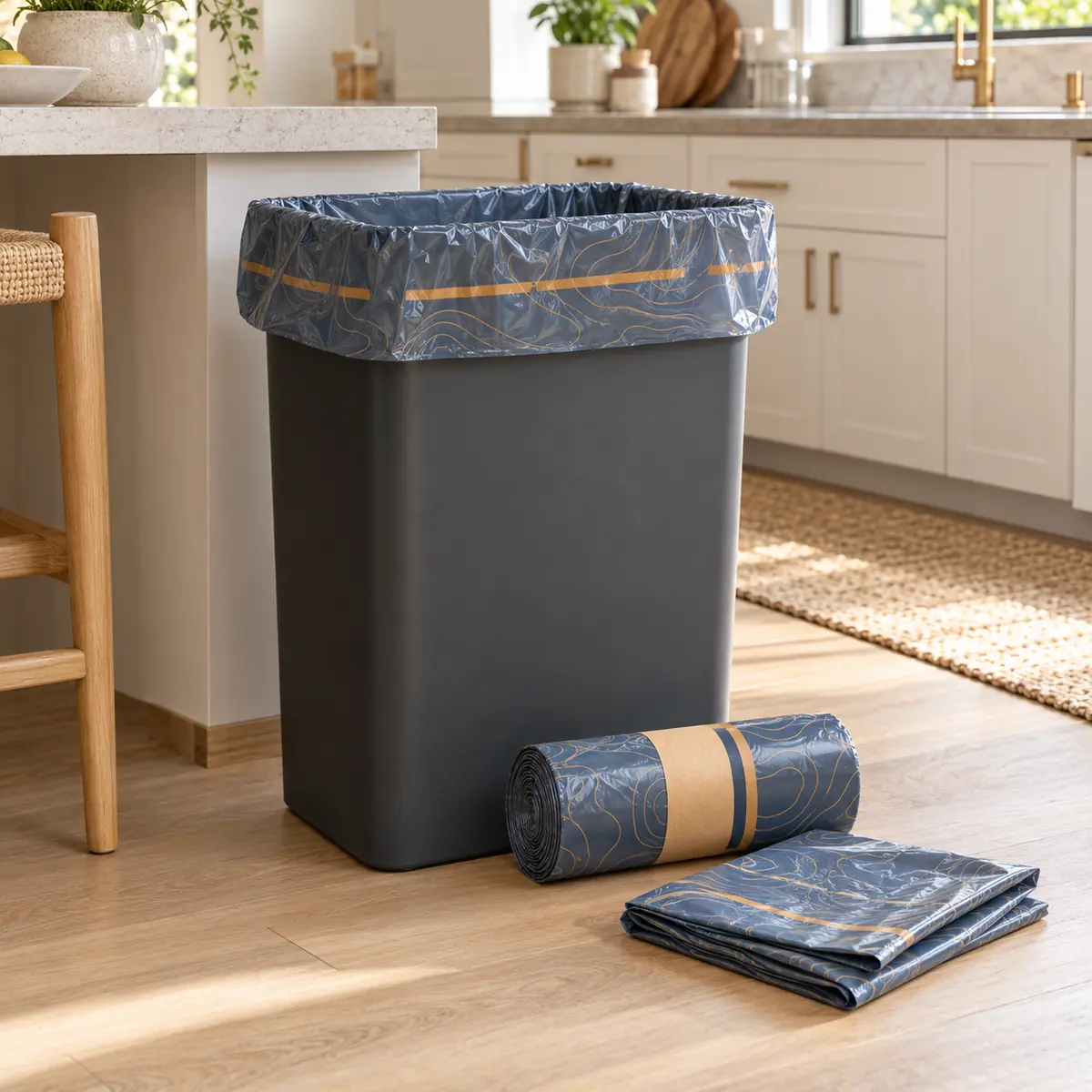
Extra-thick 13-gallon flat-top liners for demanding kitchen and organics programs, specified by actual bin, waste stream and finished-SKU evidence
Certification names shown here are a starting reference. Request the current certificate and confirm that its scope covers the selected formulation, printing and finished pack.
| Material | PLA + PBAT + plant-starch compostable film; heavy-duty formulation and oriented-film reference subject to finished-SKU verification |
| Thickness | 35–70 μm available; 35 μm standard starting point selected after waste, moisture, service time and handling review |
| Dimensions | 24 × 27 in sourcing reference; confirm flat width, usable length, side gusset and cuff allowance against the actual bin |
| MOQ | Confirmed after dimensions, gauge, colour, printing, pack-out, document route and annual forecast are reviewed |
| Lead Time | Confirmed after material, production sample, document, artwork and packing approval |
Request a production-representative 24 × 27 in sample for bin fit, cuff retention, bottom-gusset, wet-load, perforation and supported-removal checks · Dimensions, gauge, tolerances, storage, shelf life, pack-out and performance criteria are confirmed in the signed order specification
PRODUCT OVERVIEW
“Heavy duty” is not a universal test result. Start with the actual tall-kitchen bin, contents, moisture, service interval and removal method, then select a gauge and gusset construction that passes an agreed validation plan.
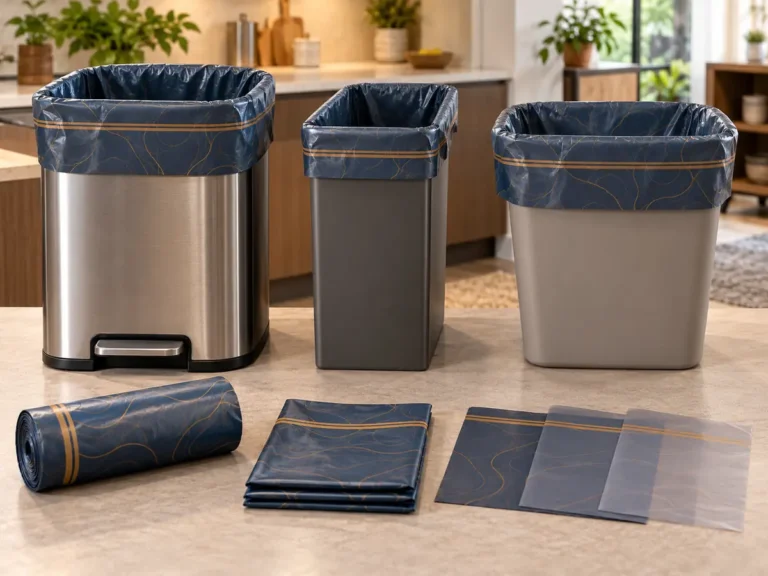
Share rim width, depth, corner shape, usable height and desired foldover. A nominal 13-gallon label does not standardize bin geometry.
Define typical and peak contents, moisture, sharp-edge exposure, service time and whether organics are drained before collection.
Review film gauge, cuff retention, bottom gusset, heat seals, perforation and supported removal on one production-representative sample.
Match the finished bag and custom artwork to current documents, permitted marks and the receiving collector or composting facility.
Complete inputs reduce back-and-forth and help us match the sample, evidence and commercial quote to one defined construction.
WHY CHOOSE THIS PRODUCT

Thirty-five microns is the standard starting point, not a universal load rating. Select the final gauge after testing the actual waste density, moisture, service time, temperature, rim geometry and removal method.
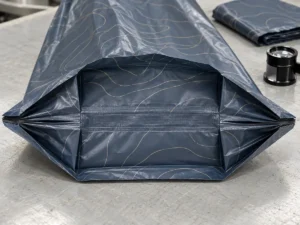
The reference construction uses a broad heat-seal area and layered bottom gusset to spread the filled bag across its base. Approve gusset depth, layer alignment, weld consistency and filled-bag handling on production-representative samples.
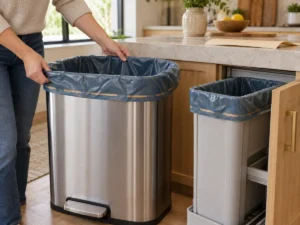
The 24 × 27 in reference is intended for many tall kitchen bins, but round, rectangular, tapered and pull-out containers differ. Check usable depth, rim retention and the foldover needed for the buyer’s actual bin.

Use well-drained representative contents to define an agreed wet-holding, lift, carry or drop method. The approved result applies only to that construction and test—it is not a blanket leakproof or kilogram claim.
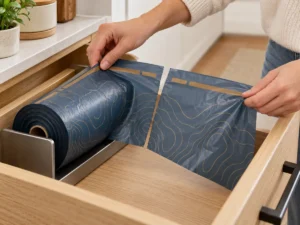
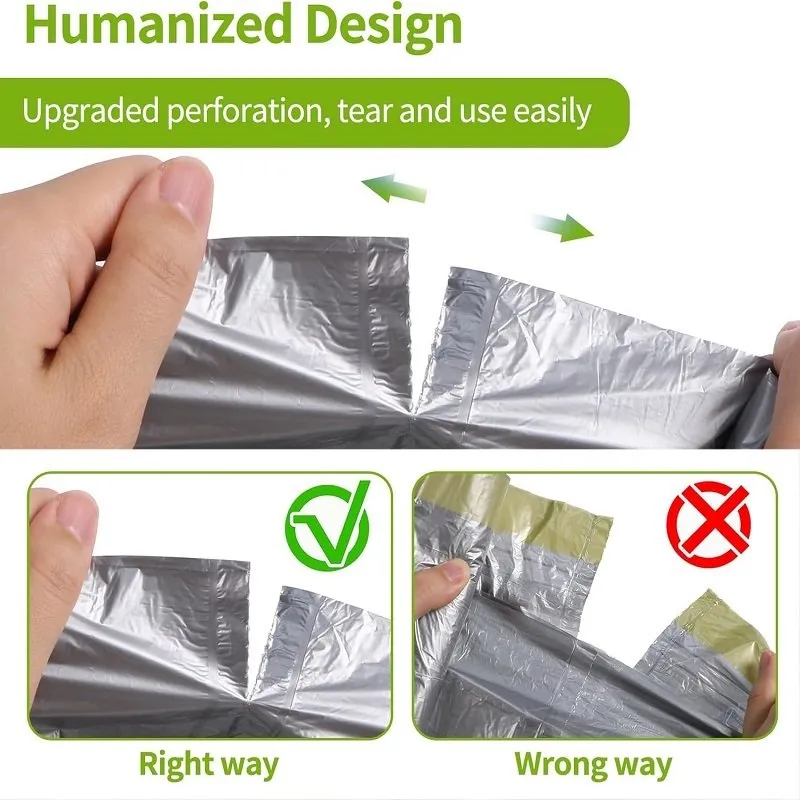
Controlled perforation and roll tension support quick changes in kitchens, cafés and collection rooms. Confirm bag count, roll diameter, core format, storage location and tear direction before approving the pack-out.

Coordinate bag colour, repeating artwork, opening guide, roll count, retail carton and export marks. Custom pigment, ink, printing or gauge changes require a fresh finished-SKU document review before compostability marks are released.
TECHNICAL SPECIFICATIONS
| Material | PLA + PBAT + plant-starch compostable film; heavy-duty formulation and oriented-film reference subject to finished-SKU verification |
| Thickness | 35–70 μm available; 35 μm standard starting point selected after waste, moisture, service time and handling review |
| Dimensions | 24 × 27 in sourcing reference; confirm flat width, usable length, side gusset and cuff allowance against the actual bin |
| Color | Smoky mineral blue with a warm-sand broken contour pattern and muted amber opening guide; natural and custom colours available after artwork and evidence review |
| Capacity | 13 gal / approximately 49 L nominal tall-kitchen format; capacity is a fit reference, not a carrying-weight rating |
| Pack Count | Perforated rolls, coreless rolls or flat packs with buyer-defined bag count; final retail pack, master-carton quantity and pallet plan confirmed on the packing list |
| MOQ | Confirmed after dimensions, gauge, colour, printing, pack-out, document route and annual forecast are reviewed |
| Lead Time | Confirmed after material, production sample, document, artwork and packing approval |
| Carton Dimensions | Confirmed on the final packing list after bag size, gauge, roll count and case quantity are locked |
| Certifications | EN 13432, BPI / ASTM D6400, OK compost INDUSTRIAL, OK compost HOME |
| Packaging | Perforated rolls with paper cores, coreless rolls or flat packs; natural kraft retail cartons, bulk institutional packs and private-label master cartons available after review |
CERTIFICATIONS
These four names are procurement checkpoints, not blanket proof for the illustrated custom bag. Match the certificate holder, product identity, formulation, maximum thickness, colour, printing, validity and permitted mark to the exact finished SKU.
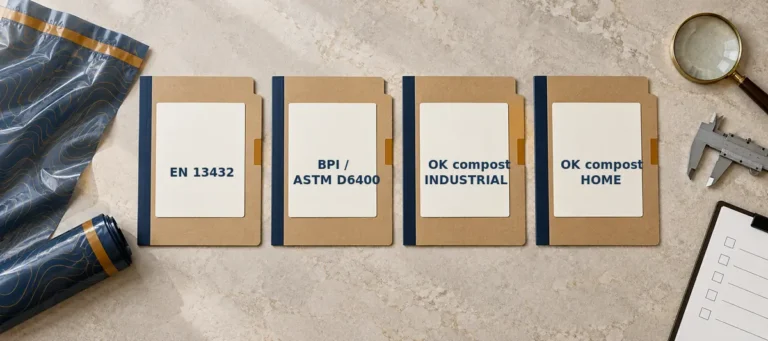
European packaging requirements for recovery through controlled composting and biodegradation. Confirm that current evidence covers the complete converted liner, selected heavy gauge, seams, pigment and printing.
BPI is a third-party certification program using applicable ASTM criteria, including ASTM D6400 for plastics designed for aerobic composting in municipal or industrial facilities. Check the current public listing, certificate holder, exact product and artwork-mark permission.
A TÜV AUSTRIA conformity route for controlled industrial composting. Verify the current certificate number, validity, product family, maximum gauge, colour and print coverage, then confirm acceptance with the destination facility.
A separate conformity route for home-compost conditions. Do not infer it from industrial evidence; request the current certificate and verify that the exact 35–70 μm construction, pigment, printing and bottom gusset remain within scope.
OEM / ODM
Choose final dimensions, 35–70 μm gauge, body colour, repeating artwork, opening guide, print coverage, roll count, retail carton and export-carton marks. Flat-top construction is the reference; a drawstring or handle version requires a separate construction, quotation, production sample and evidence review.
FACTORY CAPABILITIES
The selected format can be reviewed against these Guangzhou manufacturing capabilities. Final feasibility, tolerances and MOQ are confirmed in the approved specification.
Width, gusset depth and length can be reviewed against your packaging-line requirements and converting limits.
Flexographic artwork, colour count, print coverage and plate requirements are checked before MOQ and pricing are confirmed.
PLA, PBAT and starch blend options are selected around flexibility, strength, processing and the documented claim required for the SKU.
BEHIND EVERY PRODUCT
The workflow covers compounding, film blowing, printing and bag conversion, with the order specification used as the reference for in-process and final checks.

USE CASES

Use a right-sized 13-gallon liner for well-drained peelings, coffee grounds and other locally accepted food scraps generated during family cooking or batch preparation. Validate service interval, cuff retention and supported removal with the actual bin.

Collect coffee filters, fruit peelings, bakery prep scraps and other accepted organics at compact back-of-house stations. Match gauge and change frequency to the real moisture, daily volume and carrying distance.
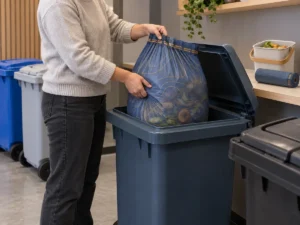
Configure a consistent 13-gallon liner for apartment-building organics rooms or residential pickup programs. Obtain written acceptance from the receiving collector because a compostability document does not guarantee local program acceptance.
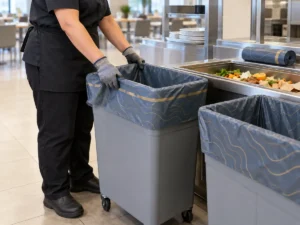
Standardize a heavier-gauge kitchen format for hotel staff dining, workplace break rooms and shared food-prep areas. Define what belongs in the organics stream, how contamination is controlled and when the liner is changed.
HONEST TRANSPARENCY
Heavy duty does not mean puncture-proof. Do not use for nails, broken glass, exposed metal, rigid bones, construction debris, medical, hazardous, hot or free-liquid waste. Support the bag body during removal and do not publish a universal load or leak-time claim without a defined repeatable test. Home and industrial composting are separate routes, and no certificate guarantees acceptance by every local collection or composting program. Keep unused stock sealed, cool and dry away from direct sunlight, heat and excess humidity; confirm shelf life in the signed order specification.
FAQ
Its sourcing reference combines a 35–70 μm gauge range with a wide flat-top cuff and reinforced layered bottom gusset. Real performance still depends on formulation, dimensions, seal settings, contents and handling, so approve an agreed test before volume production.
No. Nominal capacity does not standardize rim shape, corner radius, taper or usable depth. Send the actual bin dimensions and required foldover, then test the sample on the intended container.
ES-GB-06 uses a 22 μm standard drawstring construction for routine tall-kitchen service. ES-GB-08 starts at 35 μm and uses a flat-top, reinforced-gusset reference for more demanding waste streams. Choose by tested need rather than assuming thicker is always better.
They can be evaluated for well-drained food scraps using an agreed contents, moisture, fill, service-time and handling method. They are not intended for free liquid, and a sample result should not be generalized into a universal leakproof claim.
Do not treat the legacy 15 kg statement as a universal finished-product rating. If a carrying-weight claim is required, define the exact construction, fill medium, conditioning, lift method, dwell time and pass criteria, then document the result.
Only when a current OK compost HOME certificate or equivalent finished-product evidence covers the exact formulation, maximum gauge, colour, print and construction. Industrial certification does not automatically establish home-compost suitability.
Not where nails, screws, glass, wire, sharp branches or rigid building offcuts are present. Use rigid containment or a separately approved contractor-bag system for puncture hazards.
Provide actual bin dimensions, intended contents, moisture, service interval, handling method, target gauge, bottom construction, colour, artwork, bag count, pack-out, destination market, required documents, annual forecast, delivery point and sample deadline.
DEEPER READING
GET A QUOTE
Send your bin dimensions, waste profile, moisture, service interval, handling method, target gauge, roll or flat-pack format, artwork, destination market, requested documents and annual forecast. ESINLE will align the sample, validation plan, finished-SKU evidence review and commercial quote to one defined construction.
Request samples, documents & quoteRELATED PRODUCTS