Will switching to PLA/PBAT make your packaging budget more predictable? A buyer’s guide to material exposure, usable roll yield and purchase terms.
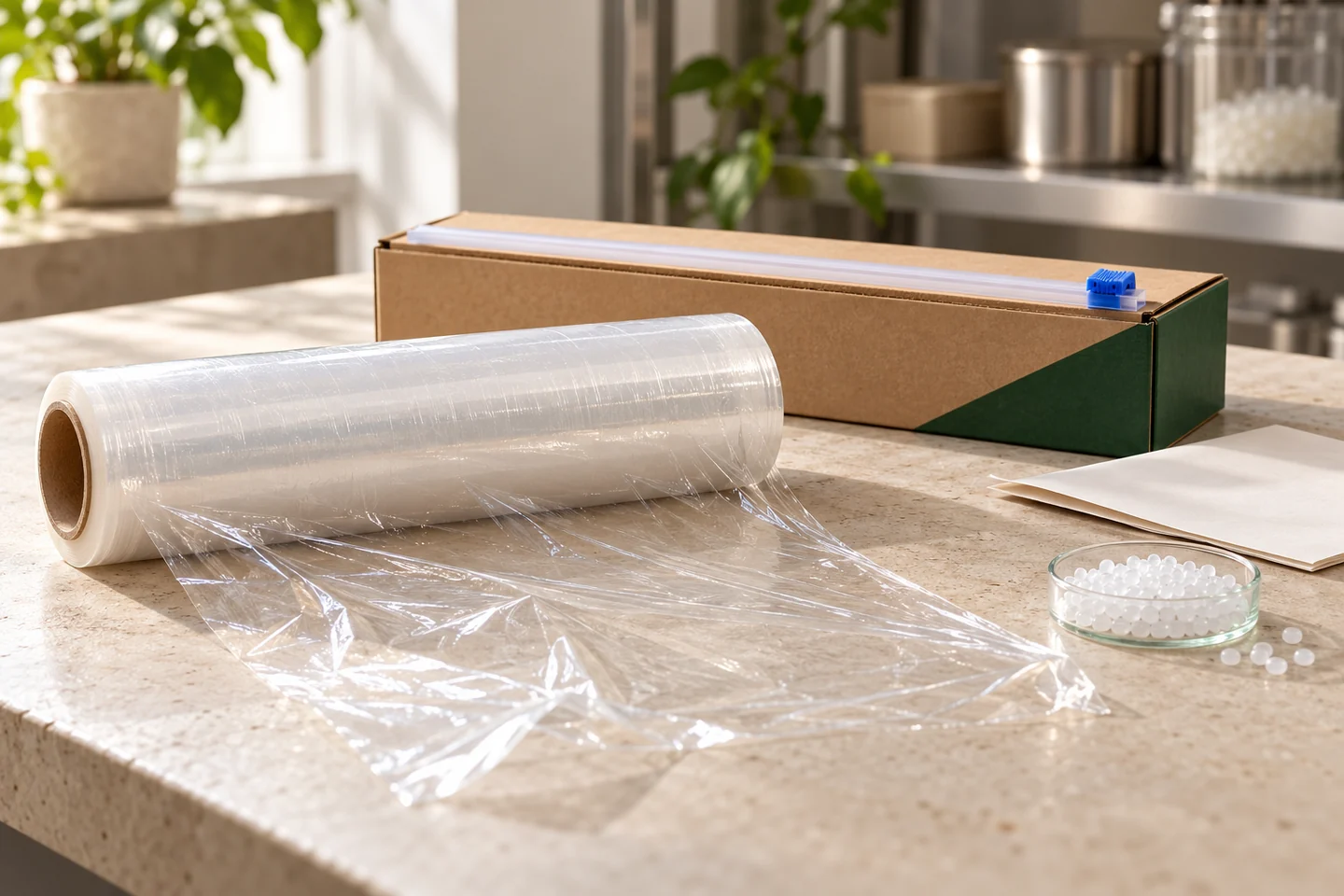
Two suppliers quote for a 300 mm × 300 m roll. One price is lower. The product photos look similar. Both mention compostability. Before choosing, you still need to establish whether the quotations buy the same amount of usable film, the same supply format and evidence for the same application.
Then comes the larger question: if conventional plastics face resin-price pressure, will moving to PLA/PBAT make the next packaging budget easier to predict?
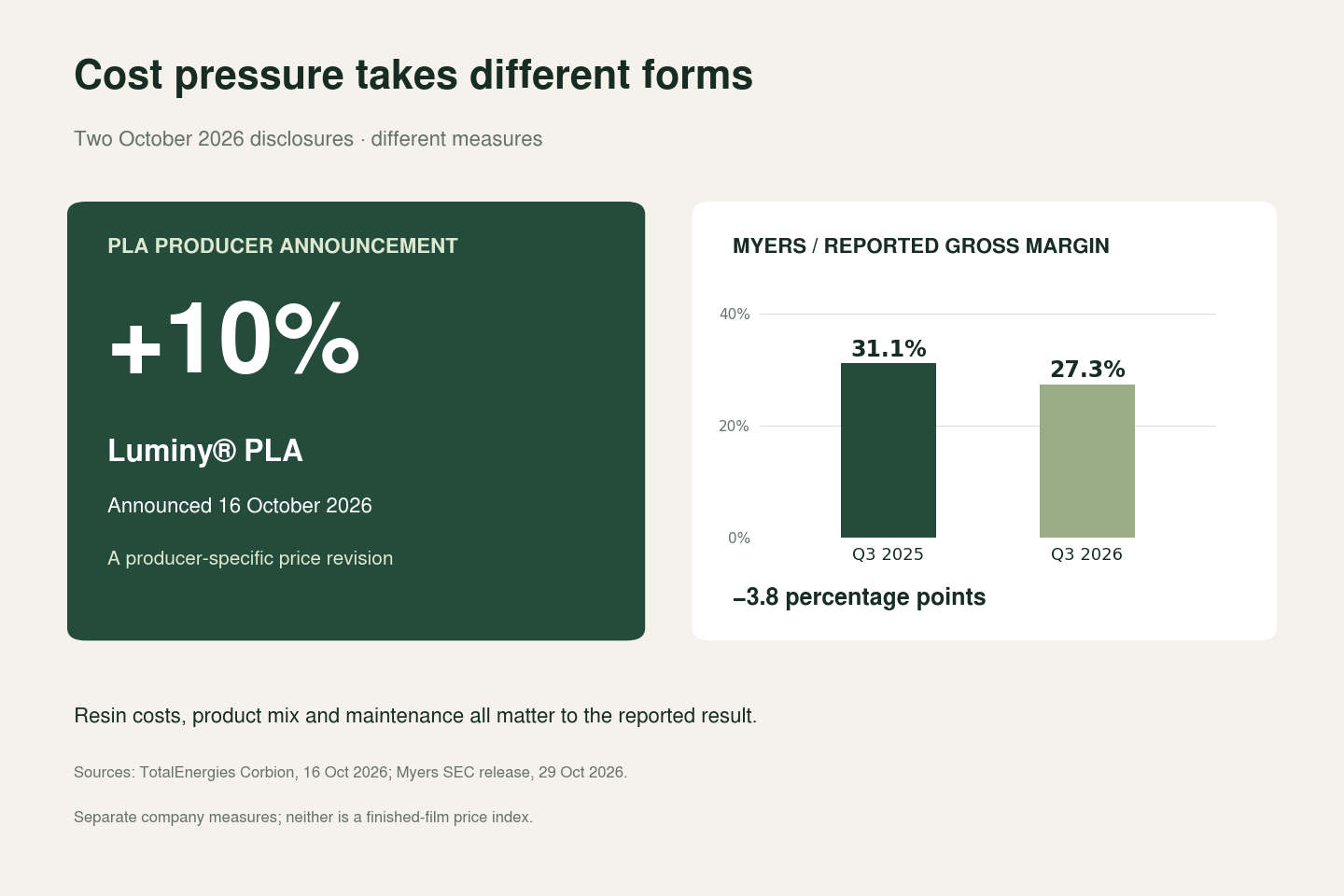
An October announcement provides a useful starting point. TotalEnergies Corbion announced a 10% increase for its Luminy PLA products, effective 16 October 2026, citing operating-cost pressures including raw materials, energy, packaging and logistics. This is a producer-specific announcement; a finished-film quotation requires a separate calculation. 1
For buyers, the practical task is to identify which costs can change and agree how those changes reach an order. Start with the roll specification, measure the usable output, and make the quotation’s commercial conditions explicit.
Why are packaging costs still changing when the material has changed?
A resin purchase is only one part of a converted roll. Film manufacture, converting, a paper core, a cutter box, cartons, transport and commercial terms also enter the quotation. The balance varies by product and order.
The same pressure can reach companies differently. Myers Industries reported third-quarter 2026 revenue growth of 8.1% while gross margin fell from 31.1% to 27.3%. Its explanation included resin costs, product mix and unplanned maintenance. That is evidence of several pressures acting together, rather than a measurement of any particular cling-film grade. 3
An announced resin increase also differs from the price on an existing contract. In its July 2026 PLA announcement, TotalEnergies Corbion distinguished active fixed-term agreements from other orders and referred to contract-specific pricing clauses. 2
When a quote changes, ask for the affected cost, the effective date and the orders covered. A clear answer should let you distinguish a material-price revision from a change in quantity, specification, packaging or delivery basis.
Will switching to PLA/PBAT actually stabilize my purchasing budget?
The material names alone cannot establish that. Specify the intended film and its performance, then examine its cost exposure and purchase terms.
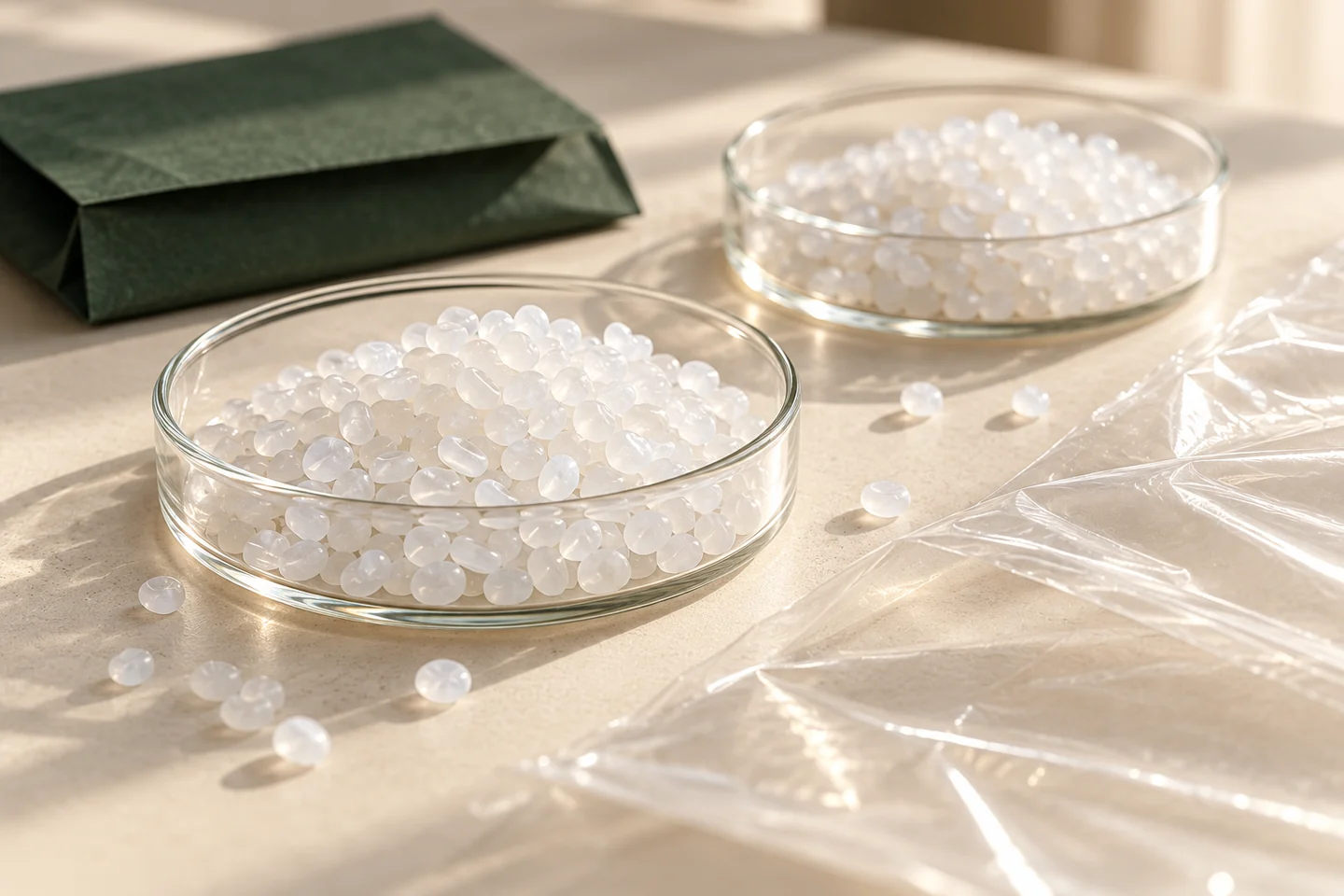
Bio-based content describes feedstock origin. Compostability concerns performance under defined treatment conditions. BASF, for example, describes conventional ecoflex PBAT on a fossil basis and also offers other feedstock approaches. Its material information explains that blend partners can be selected to adjust the application’s property profile. 5
A PLA/PBAT designation therefore leaves important questions unanswered: which grades are involved, what specification will be supplied, what changes require approval, and which documents cover the resulting film?
Price sensitivity needs the same specificity. In a hypothetical cost model, suppose the affected PLA component accounts for 20% of the baseline converted-film cost. A 10% increase in that component would add 2% to total cost if every other input stayed unchanged. That is arithmetic for an illustration—not an estimate of a supplier’s formulation, margin or selling price.
For a more predictable budget, ask for a defined quotation validity period, an agreed specification and written rules for any subsequent adjustment. A fixed price should identify the quantity, delivery period and conditions it covers.
Why can two rolls with the same nominal dimensions have different quotations?
The printed size is the beginning of a comparison. Build a shared specification before comparing the final number.
| Check | What to agree with the supplier | Why it matters to the comparison |
|---|---|---|
| Film width | Finished width and acceptance tolerance | Establishes the coverage being purchased |
| Roll length | Nominal length, tolerance and verification method | Determines the denominator for a price-per-metre calculation |
| Thickness | Target, tolerance and measurement method | Makes the specification reproducible |
| Net film weight | Film mass separated from core and packaging | Avoids comparing gross roll weight as though it were film yield |
| Product specification | Grade or controlled product reference, with a change-approval process | Keeps repeat orders tied to an agreed product |
| Use conditions | Food type, contact temperature, duration and storage | Defines the application to be evaluated |
| Supply format | Refill roll, cutter box, core size and dispenser fit | Separates film cost from the complete dispensing format |
| Evidence | Applicable product documents, scope and validity | Supports the claims and intended market |
| Order basis | Quantity, packing, delivery term, currency and validity | Makes the commercial comparison consistent |
You may not need a supplier’s confidential recipe. You do need a product reference and acceptance criteria that can be checked on the sample and repeated on production orders.
Refill rolls and cutter-box rolls should also be compared as complete purchasing options. Identify which accessories and packaging are included, then evaluate the dispensing process your customer actually uses.
Should I compare price per roll, per kilogram or per usable wrap?
Use a unit that reflects the purchase decision. Price per roll is helpful once dimensions and contents match. Price per area is useful when widths differ. Net film weight supports verification, but converting mass into coverage also requires thickness and density.
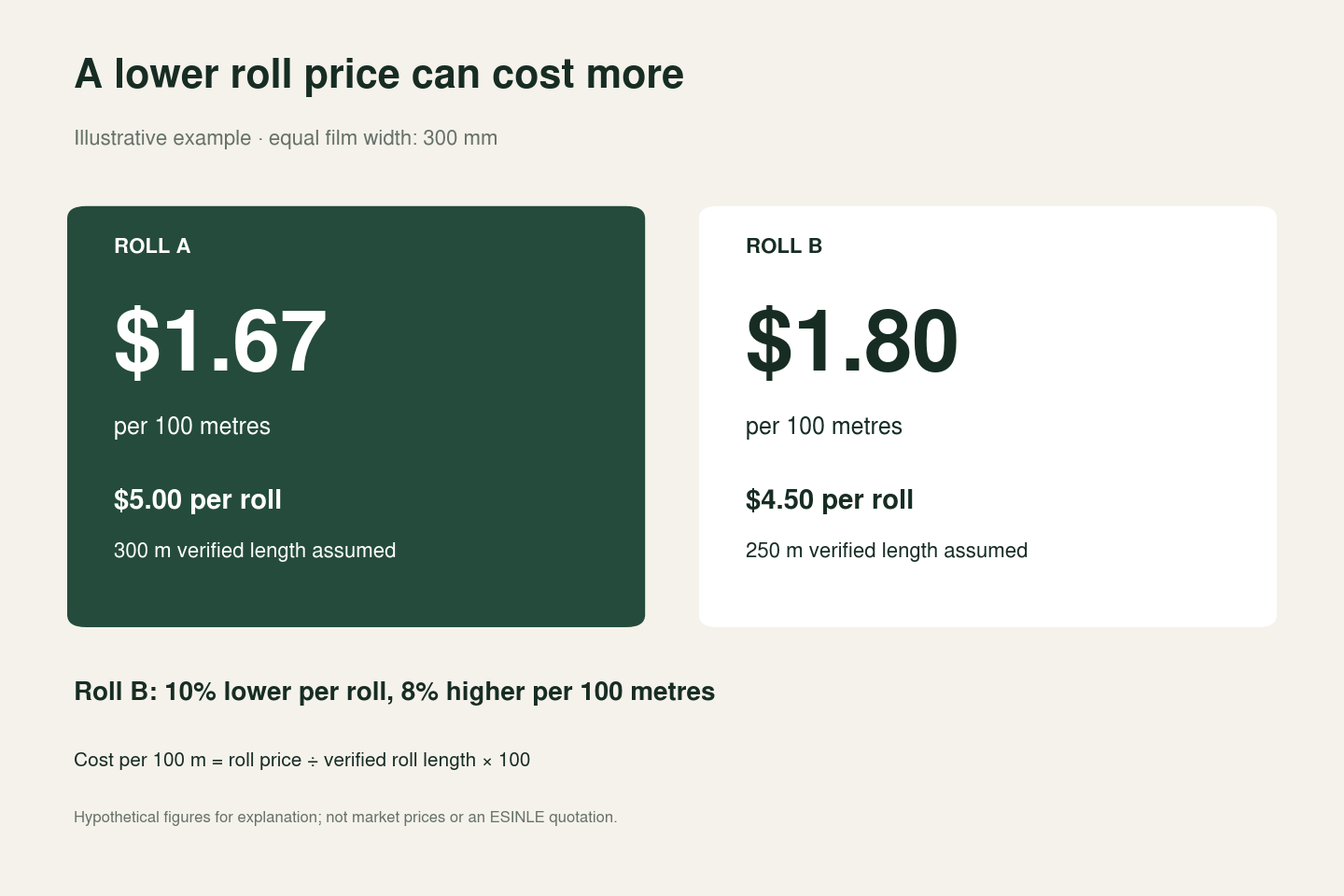
The following example is hypothetical. It is not an ESINLE quotation, a market benchmark or a product-performance claim.
| Measure | Roll A | Roll B |
|---|---|---|
| Roll price | $5.00 | $4.50 |
| Width | 300 mm | 300 mm |
| Verified length assumed for the example | 300 m | 250 m |
| Cost per 100 m | $1.67 | $1.80 |
| Total area | 90 m² | 75 m² |
Roll B costs 10% less per roll, but about 8% more per 100 metres. The same result follows from an area comparison because both widths are equal.
For an application trial, extend the calculation to successful wrapping tasks. Suppose each attempt uses 0.5 m of film. Assume Roll A produces 570 accepted wraps from 600 attempts and Roll B produces 450 from 500. Those assumed outcomes put film cost at approximately $8.77 and $10.00 per 1,000 accepted wraps, respectively.
Film cost per 1,000 accepted wraps = roll price ÷ accepted wraps per roll × 1,000.
Measure the trial outcomes using your dispenser, food or container, storage conditions and acceptance criteria. Add labour or food-loss costs only when you have relevant observations; keep unmeasured assumptions visible.
Could a cheaper bio-based filler solve the cost problem?
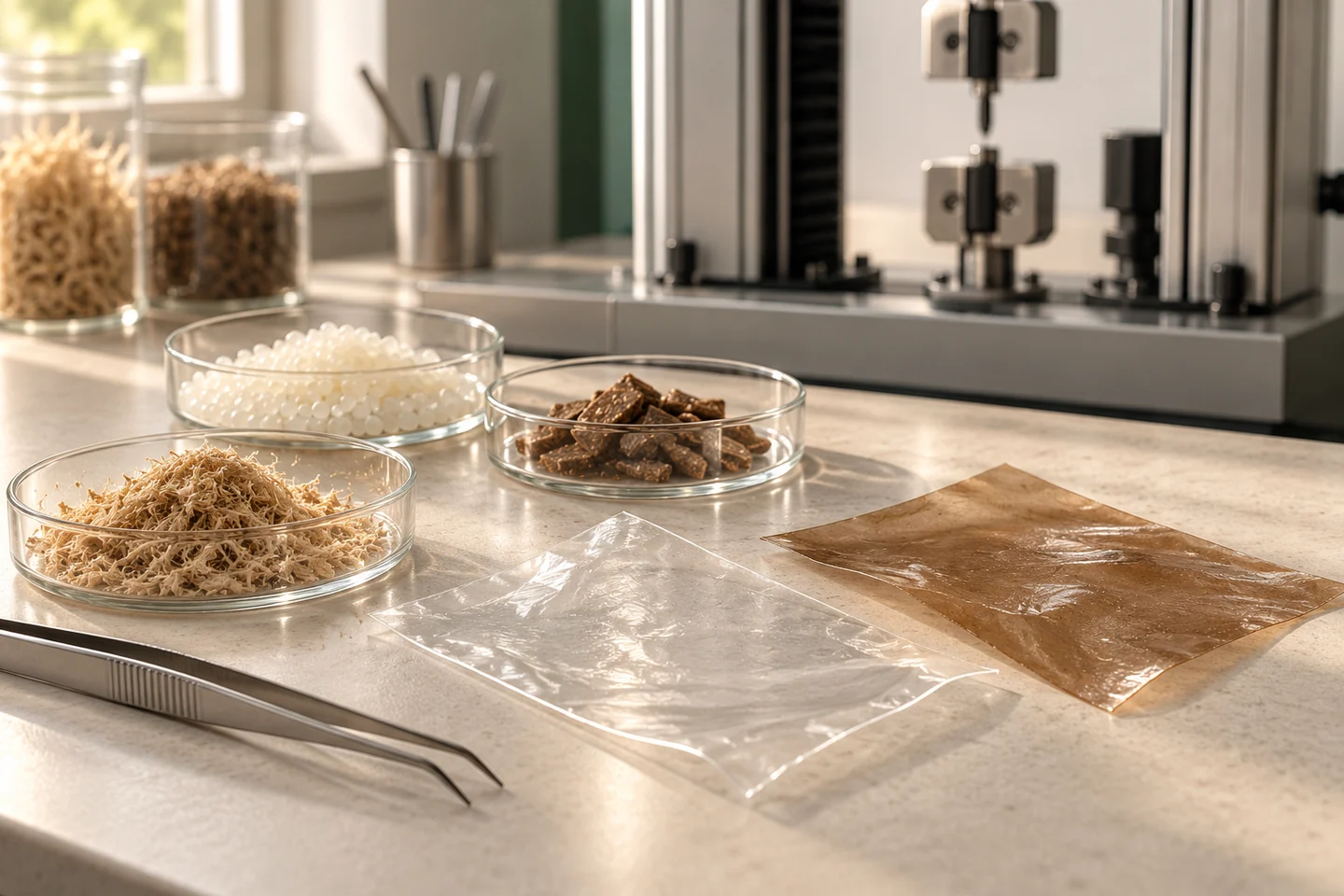
Research shows why the answer depends on formulation and processing.
A 2026 study of phenolated lignin in PBAT reported improved compatibility at a 20 wt% loading. Its techno-economic model indicated a roughly 12% lower product price on the study’s functional-unit basis, and its life-cycle assessment found a lower global-warming potential. The material also provided light shielding. These findings concern a specific composite and assessment framework; they do not establish the cost, clarity or food-contact suitability of a commercial cling film. 6
A separate 2026 study used moisture conditioning and surface treatment to prepare hemp-derived cellulose for TPS/PBAT film. At the tested 10 wt% loading, tensile strength improved by 26.2% relative to the base film. The processing route was central to the result. 7
For purchasing, the useful question is how a proposed change performs against your complete specification. Request evidence for the intended article, including optical and dispensing requirements where relevant. A tensile-strength improvement on a research formulation does not establish an equivalent thickness reduction for another product.
These are research examples, not claims that ESINLE supplies either formulation. Their value is to show why a familiar polymer name or a low filler price is insufficient to predict finished-film economics.
Does policy support make bio-based packaging cheaper or easier to approve?
Policy can influence demand and investment while leaving product-specific requirements in place.
The European Commission launched the voluntary Bio-based Europe Alliance on 21 October 2026 to connect buyers and suppliers and improve demand visibility. Its stated rationale includes helping bio-based businesses move toward commercial scale. That supports a discussion of longer-term supply development, rather than an immediate price reduction on a particular roll. 8
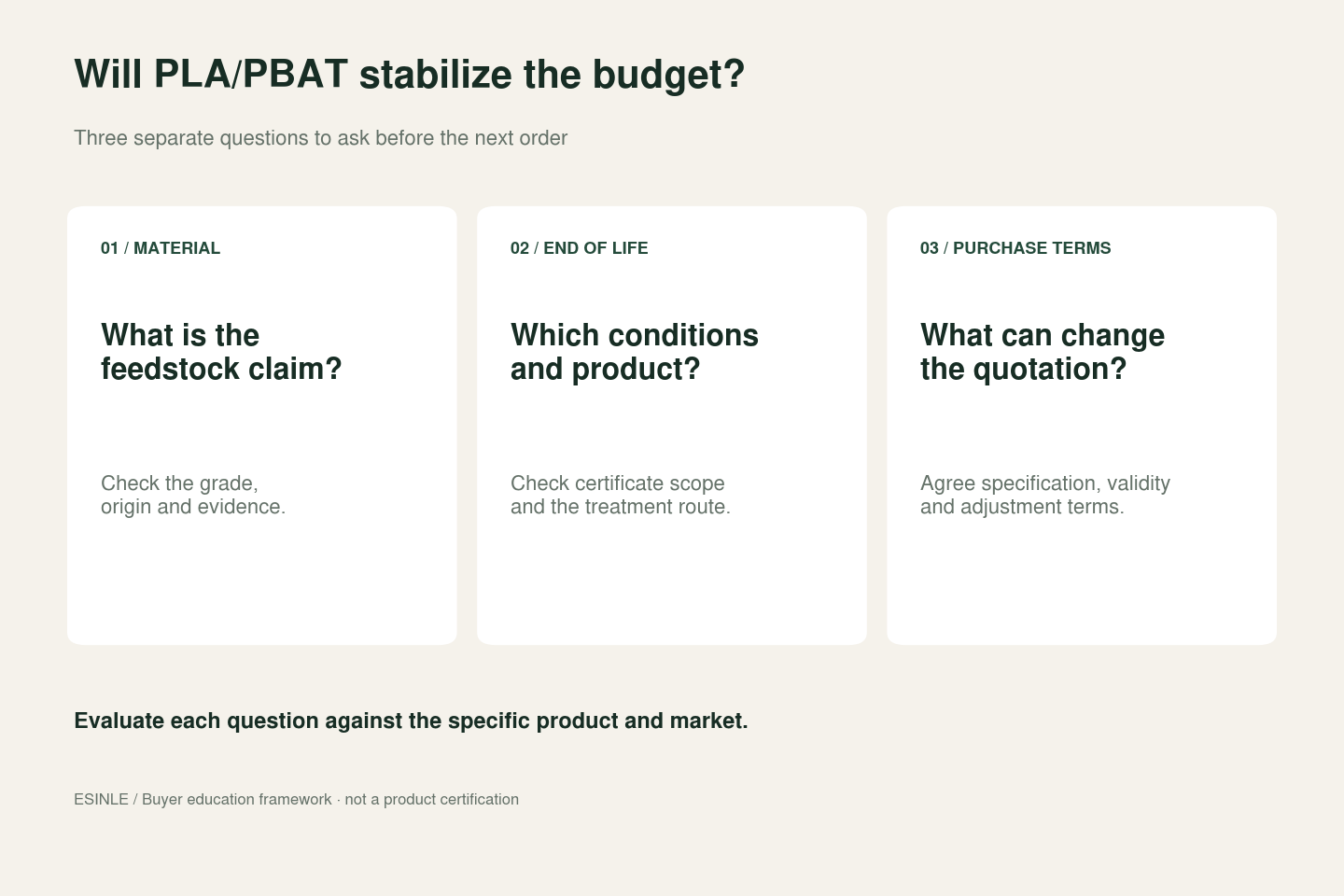
Three checks belong in a purchasing brief:
European food-contact packaging. PPWR began applying on 12 August 2026, including PFAS limits for food-contact packaging. Article 9 sets format-specific compostability provisions; it is not a blanket approval for all compostable films. 9, 10 Food-contact assessment also has its own requirements, including migration testing for representative food uses, time and temperature conditions, and supporting compliance documentation. 11
California sales claims. CalRecycle lists requirements covering compostability standards, fluorine, identification and intended association with organic-waste recovery. Its published transition arrangement for a particular NOP requirement expires on 30 June 2027. Identify the exact product and claim before treating a certificate as sufficient for sale. 12
PBAT/PBSeT trade measures. The EU opened a named investigation in June 2026 and introduced import registration in July. Those measures have defined product scope and classification. Buyers should establish how the specific imported article is treated before adding a supposed duty to every PBAT-based film or bag. 13, 14
Include the destination market and claims in the initial request. That lets both sides identify the relevant specification and evidence before artwork, samples and purchase terms are finalized.
Should I lock the price now or purchase more stock?
Begin with the demand you can reasonably plan and the storage conditions confirmed for the proposed product. A bulk purchase uses cash and storage capacity; it also commits you to a specification and sales claim for a period of time.
A practical discussion can cover a defined quantity with scheduled deliveries, a shorter pilot order, or an adjustment clause linked to an agreed reference. These are options to negotiate, not standard terms promised by every supplier.
For any price-adjustment mechanism, record:
- The cost reference, grade, region, currency and delivery basis.
- The share of the price affected by the mechanism.
- The review frequency, trigger and notice period.
- Whether upward and downward movements are treated consistently.
- The treatment of confirmed orders and any exceptional clauses.
- The approved specification and the process for changes.
Where an index is unavailable or unsuitable, an agreed evidence-and-review procedure may be clearer than a vague reference to raw-material inflation. Keep resin prices, currency changes and freight adjustments identifiable so they can be reconciled.
What should I test before choosing the lower quotation?
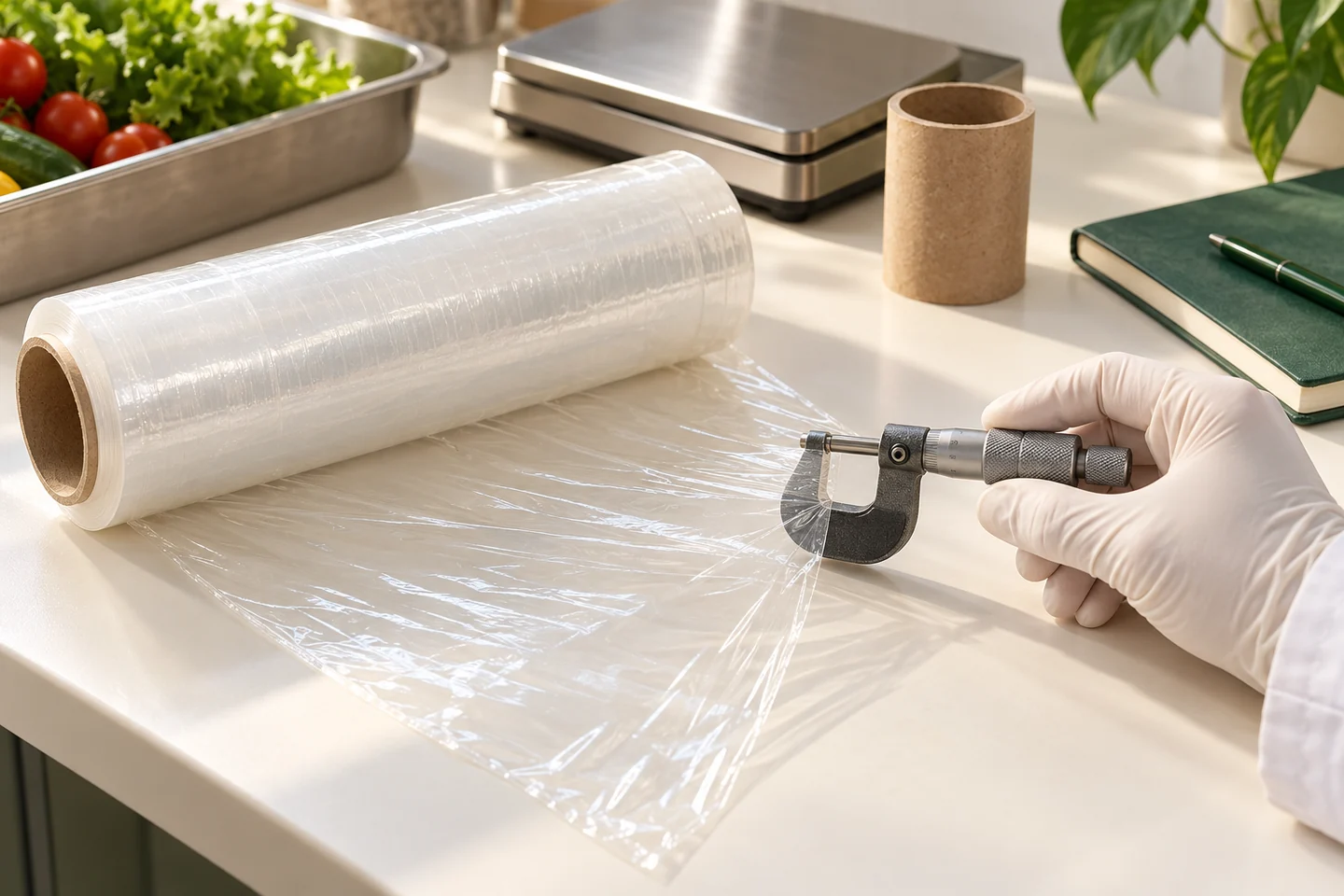
Start with a documented sample and the conditions in which the film will be used. Record roll dimensions and net film weight, then check dispenser compatibility and the outcome of a representative wrapping task.
Set the criteria before the trial: the container or food, the amount of film used, acceptable closure, appearance, tearing or cutting behaviour, and the relevant storage period. Use the same procedure for each candidate and retain the sample reference with the results.
Ask the supplier to connect the accepted sample with the production specification. The link between an approved sample, a purchase order and a delivered batch is what makes repeat-order comparison useful.
Keep a research result, a resin data sheet, a product certificate and a finished-film trial in their proper roles. Together they can inform a decision; each answers a different question.
What should I send to get a useful wholesale quotation?
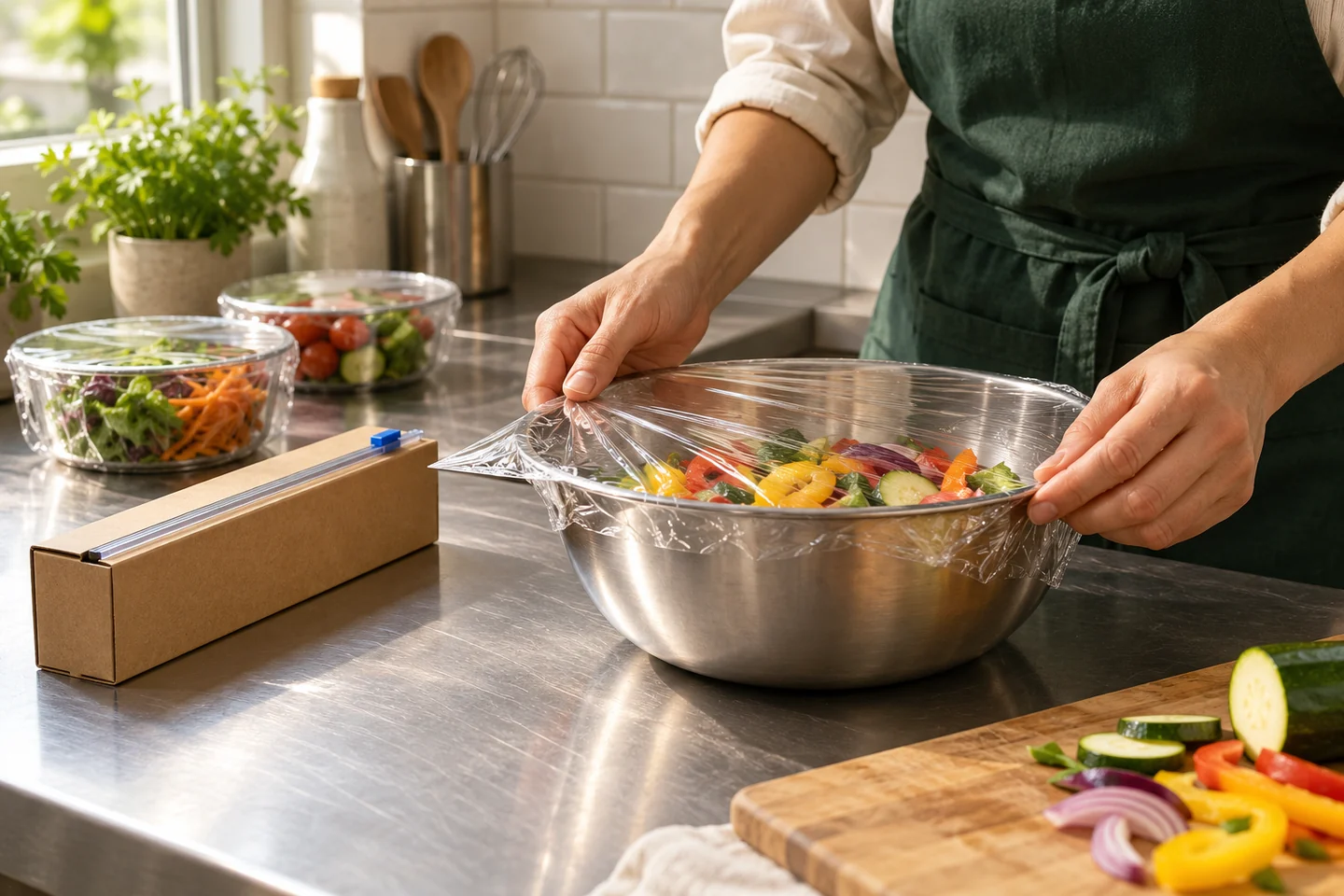
A concise purchasing brief can include:
- Your current product reference or a photograph of its specification label.
- Film width, length, thickness and any known tolerances.
- Refill-roll or cutter-box format, core size and dispenser details.
- The food or container, contact conditions and intended storage.
- The destination country and state, where relevant.
- The compostability or other claims you intend to make.
- Trial quantity, expected order quantity and required delivery period.
- Packing and artwork requirements, plus delivery term and destination.
Browse ESINLE’s cling-film range to identify a starting format. For a quotation discussion, send your current roll specification and application so the proposed supply can be compared on a consistent basis.
The useful outcome is an offer that states what you will receive, the evidence supporting its intended use and the period for which the commercial terms apply.
Questions buyers ask before the next order
Does a 10% PLA resin announcement mean finished film should cost 10% more?
The finished price depends on the affected material’s share of cost, the other inputs and the order’s terms. Ask the supplier to identify the relevant change and the orders it covers. Use the announcement as a prompt for a specific discussion, rather than a universal finished-film adjustment.
Is a heavier roll automatically better value?
Compare net film mass separately from the core and packaging. Then evaluate coverage and accepted output under a common specification. A weight measurement alone leaves width, thickness, density and usable length unresolved.
Can one compostability certificate cover any use or thickness?
Check the actual scope, product reference and conditions with the certificate holder or issuer. For food use, request the applicable food-contact documentation as well. Match those documents to the article and application being ordered. 11, 12
Can ESINLE confirm a price or certification from this article?
This guide provides a comparison method. A quotation and any product-specific claims must be established for the selected specification, order and destination market. Send those details to begin the discussion.
News and policy sources checked through 2 November 2026. Numerical purchasing examples are illustrative. Research findings are attributed to their original studies and are not ESINLE product-performance results.
Sources and further reading
- Luminy PLA producer price announcement · 16 October 2026
- Luminy PLA contract and pricing announcement · July 2026
- Myers Industries Q3 2026 SEC release
- Dow Q3 2026 results
- BASF ecoflex product information
- PBAT–phenolated lignin study · DOI
- TPS/PBAT hemp-cellulose study · DOI
- European Commission · Bio-based Europe Alliance
- European Commission · PPWR application and PFAS
- Regulation (EU) 2025/40 · Article 9
- European Commission · Food-contact legislation
- CalRecycle · Compostable product labelling
- EU PBAT/PBSeT investigation notice
- EU import-registration measure