A sample roll can look flawless on a desk and still fail at the only moment that matters: in your customer’s hands. This guide shows procurement and QA teams how to expose that failure before it arrives by the pallet.

The expensive failure rarely appears when a sample first comes out of the courier box. It appears on the 600th pull during lunch service: the roll walks sideways, the cutter chews the edge, or yesterday’s chilled tray has lifted open at one corner.
Multiply that small irritation by every kitchen, customer and case in the order. A “pretty good” sample becomes a commercial problem.
For a bulk-order decision, compostable cling film has to pass three gates:
- Operational fit: it loads, unwinds and cuts cleanly in the intended dispenser.
- Use-condition performance: it clings, recovers and stays clear on the actual containers, foods and temperature cycle.
- Evidence alignment: the technical, food-contact and compostability documents relate to the finished SKU you will buy—not merely to a raw resin or a similar roll.
Everything else—brand story, sample video, even a genuine certificate—sits behind those three gates.
The 15-minute screen before a full trial
If a new roll cannot survive this first screen, there is little value in debating certificates or price per metre yet.
- Load it into the dispenser your customer already uses. Check side clearance, core fit and free rotation.
- Pull at slow, normal and hurried working speeds. Cut repeatedly from both the centre and the edges.
- Wrap the same stainless-steel, glass and polypropylene containers you use with your current film.
- Label the sample with the SKU, nominal gauge, roll format, batch or sample reference and receipt date.
- Put one wrapped container into the real refrigerator and keep an identical control at room temperature.
- Run the same actions with your incumbent film. Without a control, “good cling” is only an impression.
This is a rejection screen, not approval. A passing roll earns a structured trial; it does not earn a purchase order.The buyer’s rule
Approve the exact combination of film construction, gauge, roll, core, dispenser format and evidence set. If one of those changes, decide whether the approval still holds.
1. Freeze the sample identity before you test it
A test result without a sample identity is a photograph with no date: interesting, but hard to use later. Create a one-page sample record before anyone opens the roll.
Record the construction, gauge and batch
Capture the supplier’s product code, material construction, nominal thickness and tolerance, colour, additive or anti-fog option, production date, lot reference, storage guidance and stated shelf life. If the formulation description is only “plant based” or “biodegradable,” ask for a usable technical definition.
PLA, PBAT and starch-containing blends can be engineered for different balances of clarity, stretch and handling. The practical differences are explained in ESINLE’s PLA vs. PBAT vs. starch comparison, but the supplier still needs to identify the construction offered for your order.
Measure gauge at several positions across and along the web. You are looking for variation, not trying to replace a laboratory. If tensile strength and elongation are purchase-order requirements, commission controlled testing under an agreed method such as ASTM D882 for thin plastic sheeting. Record specimen orientation and conditioning with the result; a lone strength number is not comparable evidence.
Measure the finished roll, not the label
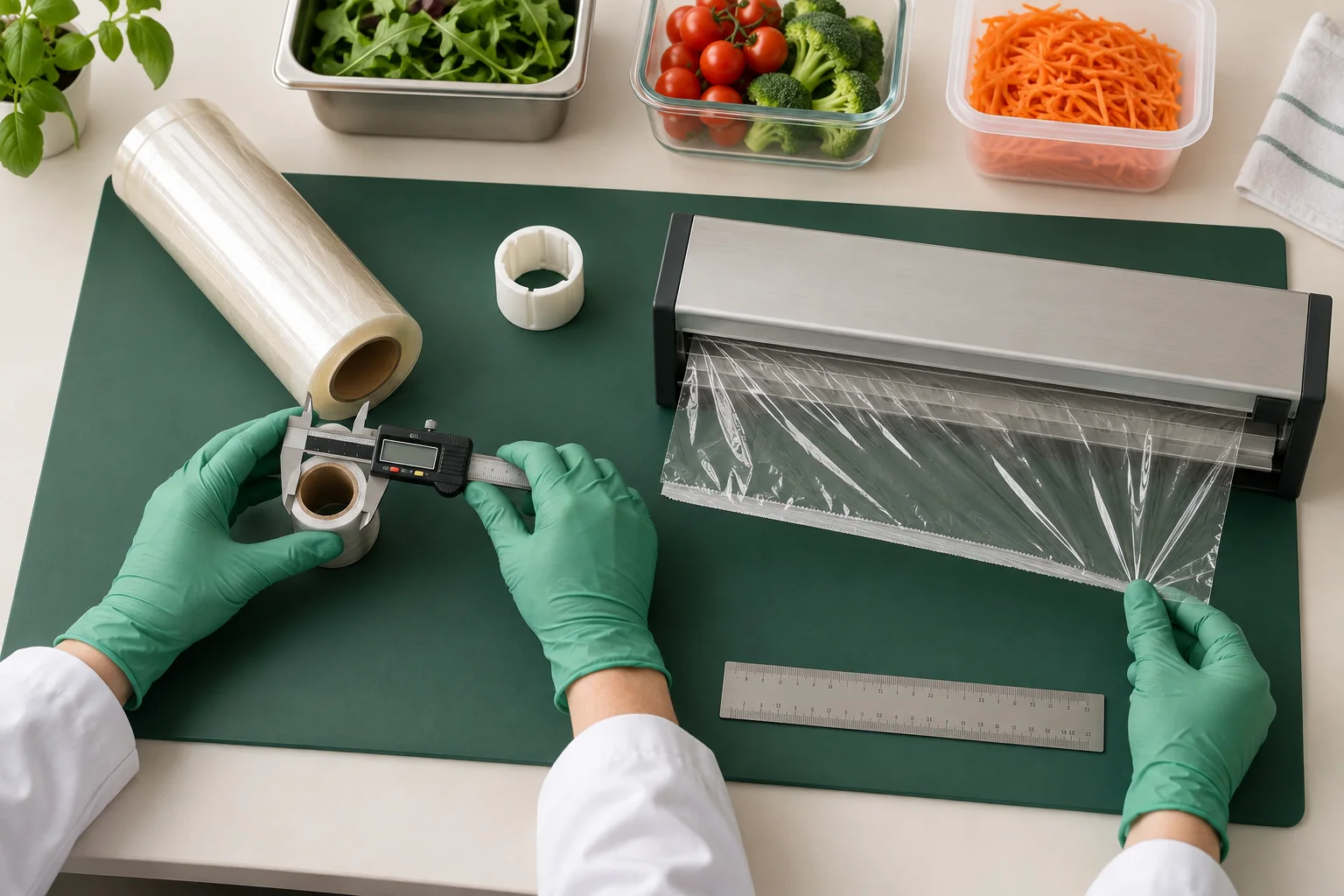
Record actual roll width, wound length or verified roll weight, core inside diameter, maximum outside diameter and total roll weight. Then compare them with:
- the dispenser’s usable width and spindle or adaptor;
- the clearance available as the roll turns;
- the cutter-box dimensions and blade position;
- the case count, case dimensions and pallet plan in the quotation.
A slightly wide roll can rub against the box. A loose core can wobble. A larger-than-expected outside diameter may fit on paper and bind in use. These are inexpensive discoveries at sample stage.
Treat refill rolls and cutter boxes as different products
A naked refill roll, a catering box, a slide-cutter pack and a private-label retail carton do not share the same user experience. If you intend to buy a finished cutter box, test that finished format. Include board strength, box deformation, cutter retention, opening tabs, print rub, barcode quality and case packing.
Film that behaves perfectly on a laboratory spindle can still be miserable inside a weak carton.
2. Test the workflow, not a single perfect pull
The goal is to reproduce ordinary use—including the rushed, slightly untidy moments a sales demonstration leaves out.
Dispenser fit, unwind and cutting
Load the sample exactly as an operator would. Watch for binding, telescoping, lateral movement and crushed core ends. Pull short and long sheets at several speeds. Does the film release in a predictable line, or does it neck down, block, snap back or fold onto itself?
Choose a repeat count that reflects the intended traffic and write it into your protocol. For an internal screening trial, 20–30 pulls and cuts per dispenser is far more revealing than one immaculate cut; it is still an internal test, not an industry standard. Record clean cuts, stretched edges, bunching and blade skips.
Test more than one operator. If the film works only for the person who already knows its quirks, the customer will discover those quirks for you.
Cling, recovery and repeated handling
Cling depends on the surface. Use clean, identical containers made from the materials in the actual operation—often stainless steel, glass and polypropylene—then add realistic challenges such as a cool rim, light condensation or a trace of oil.
Apply the same sheet length and approximate stretch each time. Check:
- initial edge grip and tension across the opening;
- sag, edge lift or leakage after the planned holding period;
- recovery after the film is stretched and released;
- tear propagation from a small nick or tray corner;
- removal and reapplication during normal access;
- coverage of a deep bowl, square pan and one awkward shape.
Write observations in operational language. “Edge remained sealed after the chilled holding period” is useful. “Cling felt nice” is not.
Clarity, fogging and label visibility
Use the same food, lighting, camera position and background for each candidate. Look through the wrap at fine label text, product colour and a barcode. Note haze, specks, optical distortion, droplets and any loss of visibility.
Room-temperature clarity does not predict anti-fog performance. Moist food, cold surfaces and temperature changes can produce a very different result, so keep clarity and refrigerated fogging as separate scorecard lines.
3. Run the room-to-cold-to-room test
Cold performance is where a convincing desktop sample often loses its composure. The test does not need to imitate a laboratory; it does need to imitate the customer.
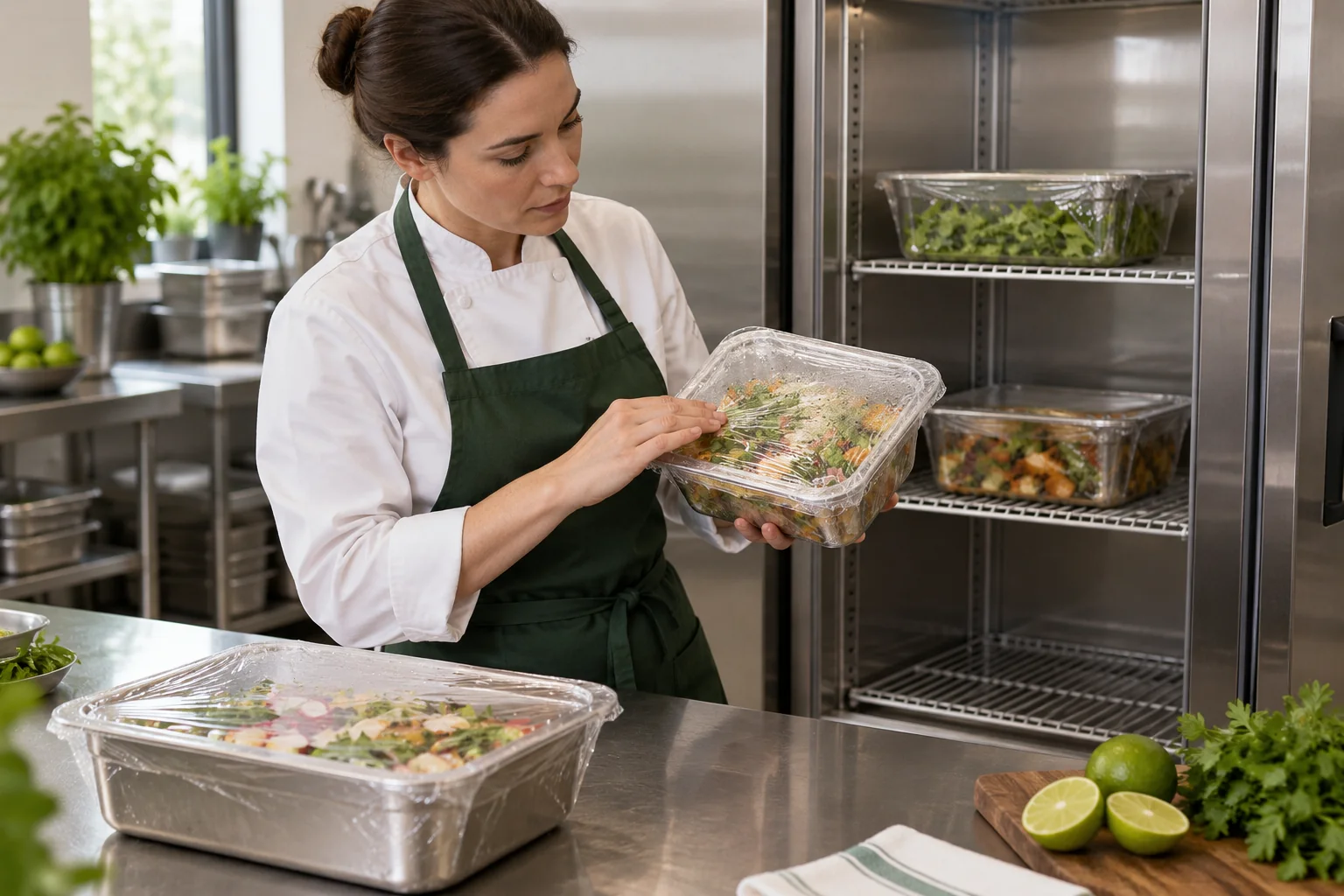
Prepare matched containers and record the refrigerator set point and actual reading. Include representative wet, dry, fatty and acidic foods where those conditions are part of the intended use. Check the samples at the start, at a meaningful midpoint and at the end of the normal storage period.
Score edge lift, seal continuity, sag, leakage, puncture behaviour, odour transfer, clarity and condensation. Then return a sealed sample to room temperature and inspect it again. Warming can create condensation and pressure changes that expose a weak edge seal. Repeat the opening-and-resealing action after the transition.
Do not extend the result beyond the conditions tested. A refrigerator trial says nothing about freezer, microwave, oven, hot-fill or heated-food use. Those applications need defined supplier limits, relevant food-contact evidence and their own validation.
4. Use a gate-based buyer scorecard
A weighted average can hide a serious defect: excellent clarity should never cancel out missing food-contact evidence. Treat the following as gates and add numerical scoring only for comparing products that have cleared them.
| Gate | Pass evidence | Review trigger | Fail trigger |
|---|---|---|---|
| Dispenser & cut | Stable tracking; repeatable pull; clean cut in the intended format | Occasional drag, bunching or operator sensitivity | Binding, repeated jams, unsafe cutting or frequent tearing |
| Cling & recovery | Seal remains functional for the stated use period | Minor edge lift with no loss of function | Seal opens, sags into food or leaks in normal use |
| Cold & clarity | Food and labels remain inspectable; seal survives the temperature cycle | Haze or condensation needs an agreed limit | Visibility or closure becomes unacceptable for the application |
| Durability | Survives routine stretch, corners and reopening | Needs a gauge, cutter or handling adjustment | Splits or punctures during ordinary use |
| Evidence scope | SKU, construction, conditions and intended claims align | Written clarification or additional report is required | Missing, expired, unrelated or contradictory evidence |
| Supply consistency | Samples and later production-intent rolls stay within agreed tolerances | Usable variation needs a tighter specification | Rolls or lots behave materially differently |
Define the decision before results arrive:
- Pass: the operational gates clear, documents align and the commercial offer describes the tested format.
- Review: the issue has a plausible correction—different gauge, core, cutter, winding tension or evidence file—and requires a revised sample.
- Fail: there is a safety concern, repeatable functional failure, material evidence mismatch or supplier response that cannot be made specific.
Testing your own dispenser?
Request a sample matched to your roll format
Send the roll width, length, gauge, core, dispenser photo or model, use temperature and target market. ESINLE can use that brief to separate a suitable stock sample from a production-intent custom sample.Request film samples →
5. Match document scope before making claims
The sentence that causes the most trouble is also the shortest: “The material is certified.”
Which material? Which finished product? Which thickness? Which certification program? Which mark? Which market?
A certificate can be authentic and still be irrelevant to the roll in your quotation. The safest approach is to build one evidence chain from the claim on the artwork back to the exact product and forward to the shipped batch.

Start with the claim you intend to make
Write the proposed wording first: for example, an industrial-compostability claim for a named market, or a statement about food-contact suitability under defined use conditions. Then ask what evidence and qualification that exact sentence requires.
Avoid turning “compostable” into a promise that the film breaks down in soil, seawater, landfill or litter. Industrial and home composting are different environments; ESINLE’s home vs. industrial composting guide explains the practical distinction. In the United States, the FTC Green Guides summary is a useful starting point for understanding why compostable claims may need clear qualification.
Connect the technical specification to the purchase order
The controlled specification should identify the product code, construction, gauge and tolerance, width, length, core, roll weight, appearance, winding, storage, shelf life and any validated temperature limits. Put critical tolerances into the purchase order or quality agreement rather than leaving them in a brochure.
If the sample and quotation use different names, resolve that before approval. “Equivalent” is not a product identity.
Keep food-contact and compostability evidence separate
Compostability testing addresses a product’s behaviour under stated composting conditions. Food-contact review addresses safe use with particular foods, times and temperatures. One does not establish the other.
For U.S. projects, use the FDA’s food-contact substances and packaging portal to frame the relevant status and conditions of use. For EU projects, start with the European Commission’s food-contact materials overview, then determine which harmonised and national rules apply to the exact construction.
Ask whether the evidence covers the finished film, including relevant additives, colour, printing, adhesive or multilayer components. A resin document may be useful input; it is not automatically proof for every converted roll made from that resin.
Verify listing, scope and artwork permission
Request the current certificate or test basis, certificate holder, issuer, product code, covered construction or thickness range, valid status and permitted certification marks. If a public directory exists, search it independently. The BPI certified-products catalogue, for example, lets buyers check listed products and licensees rather than relying only on a badge image.
For private label, confirm in writing whether the proposed artwork and certification mark are allowed. A supplier’s authority to use a mark does not necessarily transfer unchanged to every buyer, pack design or SKU.
ESINLE’s certification standards guide and certification-scope page can help organise the questions. For the order itself, request current product-specific evidence.
Close the loop with batch records
Ask how the supplier links incoming materials, extrusion or converting records, in-process checks and finished-goods release to the lot printed on the case. Review a sample COA or release record and agree which measured values will appear.
The evidence chain should read cleanly:
approved claim → controlled finished-SKU specification → applicable evidence → approved sample → production batch → shipment record
If a link is missing, label it as an open item. Do not smooth it over with a logo strip.
6. Know when a stock sample is no longer representative
A stock roll is excellent for eliminating poor candidates quickly. It can also support approval when the construction, gauge, width, core, winding, cutter format and evidence scope all match the proposed order.
Move to a production-intent sample when you change anything likely to affect performance, claims or use:
- formulation, gauge, pigment or anti-fog option;
- roll width, length, core or maximum outside diameter;
- winding tension, perforation, blade or cutter-box structure;
- print, label, adhesive or private-label artwork;
- food-contact conditions, destination market or compostability claim.
For a significant order, ask for samples linked to more than one production lot when practical. This is where gauge control, winding consistency and surface behaviour stop being one-roll anecdotes.
Once the final sample passes, sign and retain a golden sample. Its job is not to replace measurable tolerances; it gives both teams a physical reference when colour, feel, unwind or appearance is disputed.
7. Turn the test result into a quote-ready brief
Factories solve specific problems faster than vague ones. Replace “cling is weak” with “the edge lifted after six hours on our polypropylene tray at the recorded refrigerator temperature.” Attach a photo, video and sample ID.
Your request should cover:
- Application, customer channel and expected operator workflow.
- Film construction, width, length, gauge and tolerance.
- Core inside diameter, maximum roll diameter, dispenser and cutter format.
- Containers, food types, contact time and temperature cycle.
- Target market and exact environmental or certification claim.
- Retail or catering pack, artwork, barcode, case and pallet requirements.
- Forecast, trial quantity, target order quantity and delivery location.
- Required technical, food-contact, compostability and batch documents.
- Sample, production and shipping lead times; price-validity and freight assumptions.
- Golden-sample approval, change notification, inspection and defect remedy.
For an off-the-shelf starting point, review ESINLE’s compostable cling-film range and the ES-CF-04 PLA+PBAT reference format. Treat published dimensions and construction as a starting specification; confirm the chosen gauge, core, cutter, packaging and evidence for your project.
The decision you should be able to defend
At the end of the trial, a colleague who never touched the sample should be able to answer five questions from your file:
- What exact roll did we test?
- In which dispenser, containers and temperature cycle?
- What failed, what passed and against which control?
- Which documents apply to the finished SKU and intended claims?
- What must the supplier reproduce in the bulk order?
If the file answers all five, procurement can negotiate from evidence instead of optimism. That is the real purpose of sample testing.Build the production brief
Send ESINLE the conditions your film must survive
Share the dispenser, roll dimensions, food-contact conditions, target market, annual volume and intended claim. We will use them to discuss a sample route, applicable documents, MOQ and quotation basis.
Get pricing & MOQ →Check documents for my order
Frequently asked questions
What specifications should I send first?
Send the width, roll length, nominal gauge and tolerance, core inside diameter, maximum roll diameter, dispenser photo or model, cutter format, food types, contact time, temperature range, destination market, intended claim and expected volume. Those details are enough to identify obvious mismatches before sampling.
Can a resin certificate cover the finished cling film?
Do not assume it does. Converting, thickness, additives, colour, print, adhesive and multilayer components can change the finished product and the scope of relevant evidence. Ask the issuer or supplier to show how the exact finished SKU is covered.
Does compostability certification prove food-contact suitability?
No. They answer different questions and require separate evidence. Review food-contact status for the intended market, food types, contact duration and temperature, then review compostability and claim scope independently.
How should refrigerated performance be tested?
Use the real refrigerator set point, containers, foods and storage duration. Compare a matched control, inspect at meaningful intervals, and repeat the seal and handling checks when the container returns to room temperature. Record actual conditions with the result.
When should I request a custom sample?
Request a production-intent sample whenever the order changes formulation, gauge, width, length, core, winding, additive, print, cutter box or any certification-relevant component. A stock roll cannot approve a materially different bulk format.