The most expensive word in a cling-film RFQ might be “standard.”
Standard width. Standard core. Standard thickness. Those shortcuts make a quote easy to send—and difficult to compare.
Imagine a delivery of 300 m rolls that match the approved material description. The film looks clear. The paperwork is available. Then the kitchen loads the first roll: the core will not engage, the lid will not close, or the web scrapes the sidewall.
Nothing on the “300 m” label warned you. Length describes how much film is wound onto the core. It does not describe the finished roll’s fit.
Good compostable cling film specifications connect the film, roll, dispenser, use conditions and evidence in one controlled document. This guide shows how to build that document, sanity-check the numbers and compare quotes without mistaking a heavier roll for a better deal.
On this page
- The fields a useful specification needs
- Width: start with the job, not the catalogue
- Gauge: the average is not the whole story
- Roll length: what the weight can actually tell you
- Core and roll diameter: where fit goes wrong
- Compare usable film, not just roll price
- When a specification change becomes an evidence change
- A quote-ready specification you can copy
- Frequently asked questions
1. The fields a useful specification needs
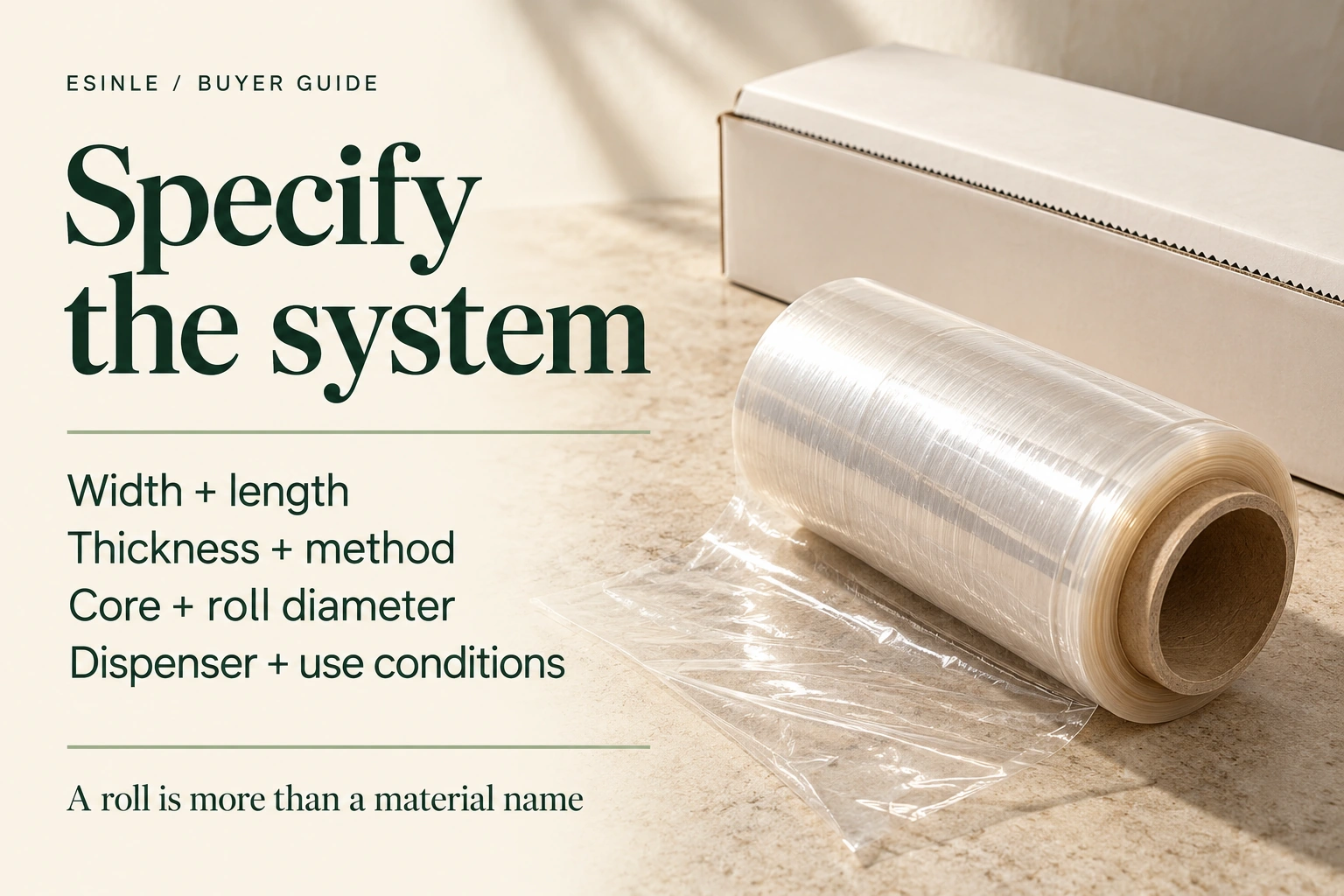
“PLA+PBAT, 300 mm × 300 m” is a product description. It is not yet an acceptance specification.
Use this structure before you ask suppliers to quote:
| Field | What to write down | What it prevents |
|---|---|---|
| Film construction | Product code, material description and controlled formulation reference | A different blend arriving under the same generic name |
| Width | Nominal web width, units and tolerance | Sidewall rubbing or insufficient coverage |
| Thickness | Nominal thickness in µm, local/average limits and measurement method | An acceptable mean hiding unacceptable thin spots |
| Wound length | Declared length, acceptance rule and verification method | Disputes over nominal versus supplied quantity |
| Core | Inside/outside diameter, length, material and end geometry | Spindle, adaptor or locking-system mismatch |
| Finished roll | Maximum outside diameter, axial dimensions and winding requirements | A roll that fits on the spindle but not under the lid |
| Use conditions | Containers, foods, contact duration, temperature and operator workflow | Approving a sample for the wrong job |
| Pack and evidence | Cutter, case count, labels, document references and revision | A film approval being mistaken for approval of the entire pack |
Add the sample ID, revision number and approval date. A document without a revision becomes surprisingly ambiguous after one artwork change or another round of sampling.
2. Width: start with the job, not the catalogue
Commercial cling film often appears in familiar widths, but familiar is not universal. Wrapmaster, for example, identifies its 3000 dispenser with 30 cm refills and its 4500 with 45 cm refills. Those are manufacturer-specific system descriptions, not an industry guarantee that any roll of the same width will work. S1S2
For compostable cling film sizes, work backwards from the wrapping task:
- Measure the container’s outside dimensions, including the lip.
- Reproduce how the operator pulls, stretches and secures the film.
- Find the width that provides adequate coverage without an unnecessary second sheet.
- Check that width against the actual dispenser and cutting arrangement.
Do not substitute the container’s inside dimensions for the surface you need to cover. And do not assume that additional stretch compensates for insufficient width: the result still has to retain the coverage and integrity your operation requires.
| Buying context | First decision | What must be confirmed |
|---|---|---|
| Commercial kitchen refill | Existing dispenser and frequently used containers | Refill interface, web width, core and maximum roll diameter |
| Deli or fresh-food counter | Tray coverage and presentation | Width, handling, visibility and the intended food-contact conditions |
| Retail cutter box | Consumer workflow and shelf format | Film width, blade/slider geometry, roll clearance and box structure |
| Private-label programme | Channel requirements and the approved pack | Film, cutter, artwork, case configuration and evidence scope together |
ESINLE’s compostable cling-film range is a starting point for format comparison. Treat a catalogue size as a candidate specification, not automatic approval for your equipment.
3. Gauge: the average is not the whole story
A nominal thickness of 12 µm tells you the target. It does not tell you how the thickness varies across the web or along the roll.
Use micrometres in the purchase specification. If someone quotes “gauge,” ask for the explicit conversion they mean. For reference, 1 mil equals 25.4 µm; do not assume an unexplained gauge number carries the same meaning in every quotation.
Agree the measurement before the tolerance
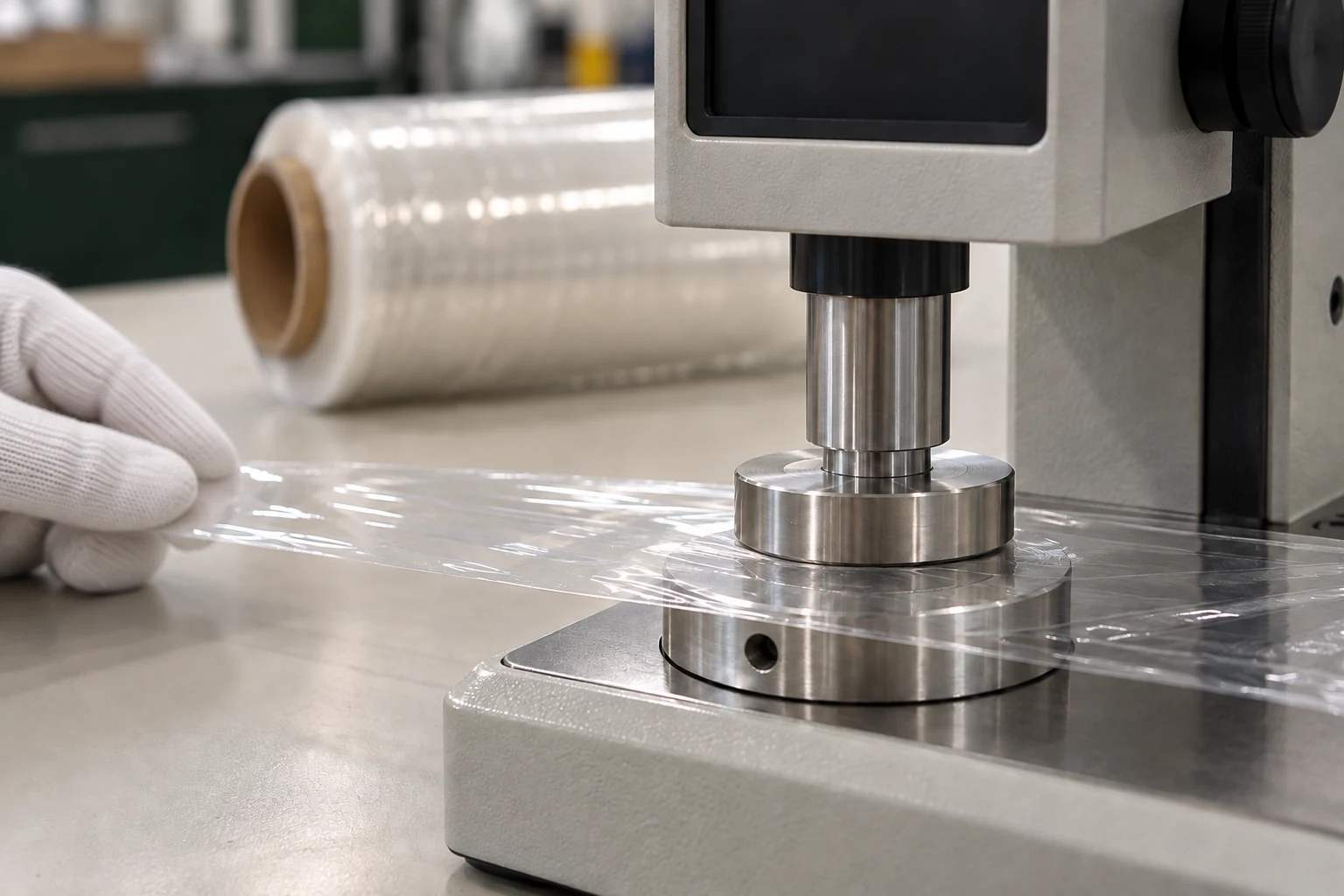
ISO 4593 describes mechanical thickness measurement for plastic film and sheeting; its published scope excludes embossed material. S3
ASTM D6988-26, updated in August 2026, concerns thickness determination for film test specimens. Its public scope explicitly excludes commercial-classification and quality-control sampling. A reference to D6988 therefore does not supply your incoming-inspection sampling plan. S4
The practical consequence: agree both the measurement method and the commercial acceptance procedure. Specify the instrument, calibration status, measurement locations, sample preparation and how readings will be reported.
Then separate three decisions:
- Nominal target: the thickness the supplier is aiming to produce.
- Local limits: what individual measured locations may be.
- Lot acceptance: which readings, statistics and sampling rules determine acceptance or rejection.
As an arithmetic example only, 12 µm ±10% gives a range of 10.8–13.2 µm. That is not a recommended industry tolerance. Nor does it establish whether every location, the roll average or an agreed lot statistic must fall within the range. Your specification must say which.
Thicker is not a complete performance specification
Gauge is one variable; it is not a substitute for testing the selected formulation and format.
If tensile properties matter, ASTM D882-26 is a thin-film tensile method. ASTM cautions that thickness, specimen preparation, testing speed, grips and extension measurement affect comparisons. Ask for the method, direction, conditioning and specimen dimensions alongside the result. S5
A large elongation-at-break number is not evidence that the film clings to your tray or cuts cleanly. Use the compostable cling-film sample-test checklist for those operating checks; this article’s job is to define what gets tested.
4. Roll length: what the weight can actually tell you
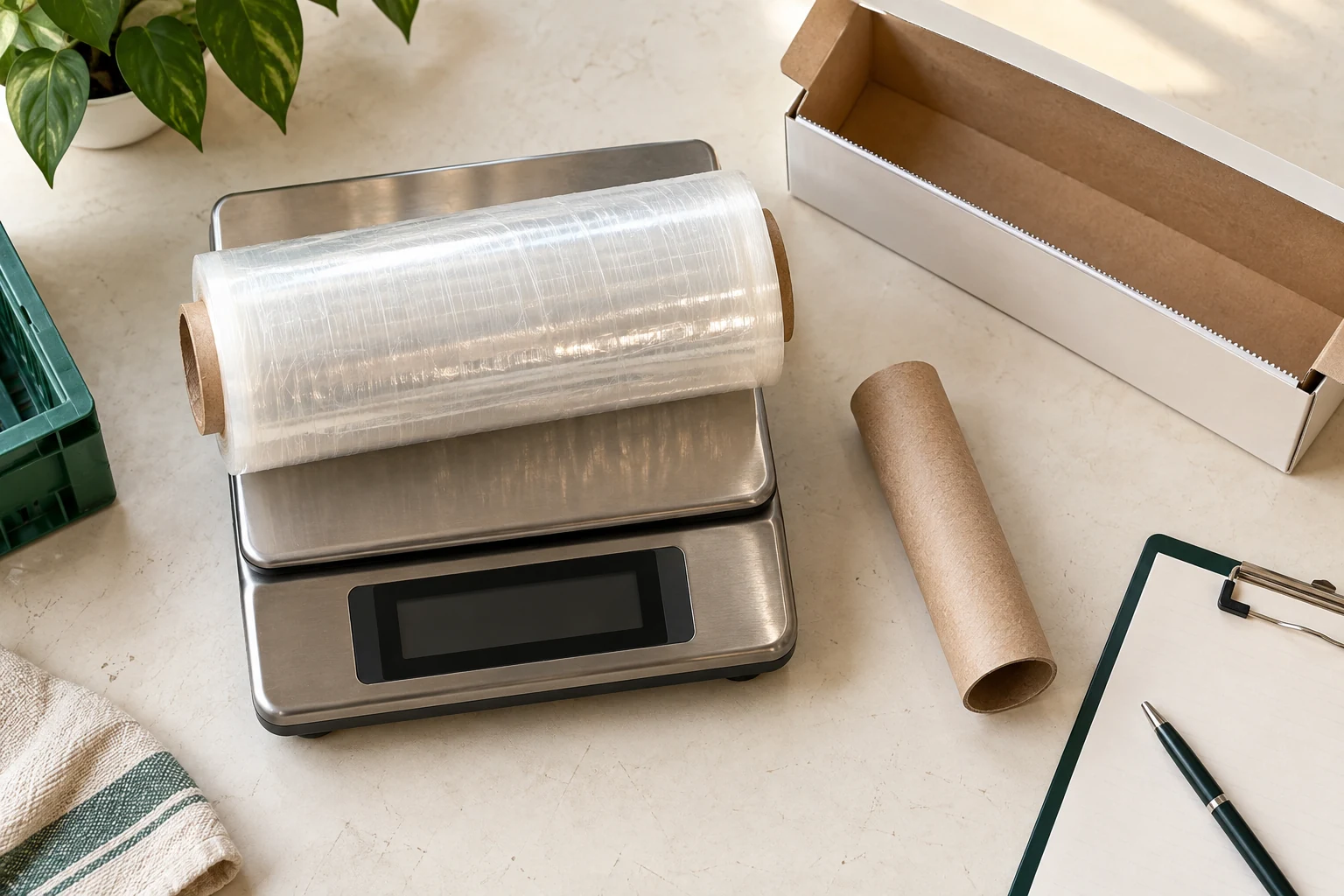
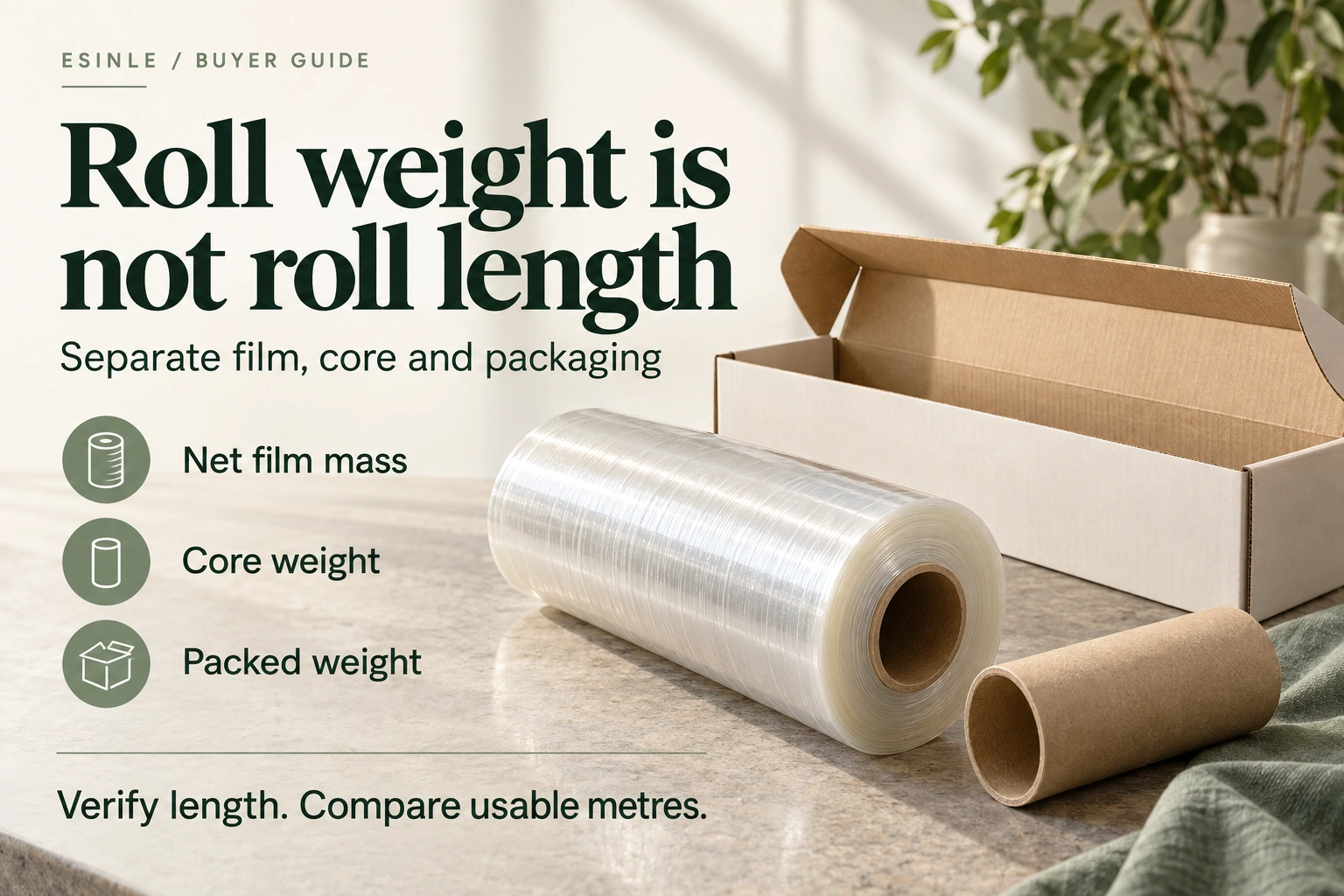
Two rolls can have the same gross weight and different quantities of film. One may have a heavier core. Another may have a different thickness or density.
Start by separating:
- Net film mass: film only.
- Total roll mass: film plus core and any other non-film roll components.
- Packed/shipping mass: roll plus box, outer packaging and other included materials.
For a uniform film, the basic mass-balance estimate is:
Net film mass (kg) ≈ width (m) × length (m) × average thickness (m) × density (kg/m³)
Worked example: a 300 mm × 300 m roll
Assume a 12 µm film and a hypothetical density of 1,250 kg/m³. This is an educational assumption—not a measured ESINLE density or product specification.
- Width: 0.300 m
- Length: 300 m
- Average thickness: 0.000012 m
- Film area: 90 m²
- Estimated net film mass: 0.300 × 300 × 0.000012 × 1,250 = 1.35 kg
Keep width, length and assumed density unchanged, but use 10 µm instead: the estimate becomes 1.125 kg.
The thinner roll is lighter despite containing the same nominal length. Conversely, extra weight is not proof of extra metres.
Can you reverse the calculation?
Yes, as a screening estimate:
Estimated length (m) ≈ net film mass (kg) ÷ [density × width × average thickness]
But the inputs must represent the actual film. Using a generic resin density, nominal thickness or gross roll weight can create a convincing-looking answer that is wrong.
Ask how the supplier verifies wound length, what tolerance is agreed, and how counter calibration or independent verification is documented. If the mass estimate and declared length disagree, investigate the inputs before alleging a shortage. The calculation is a cross-check, not a replacement for an agreed length-verification method.
5. Core and roll diameter: where fit goes wrong
“Same core size” can mean several different things.
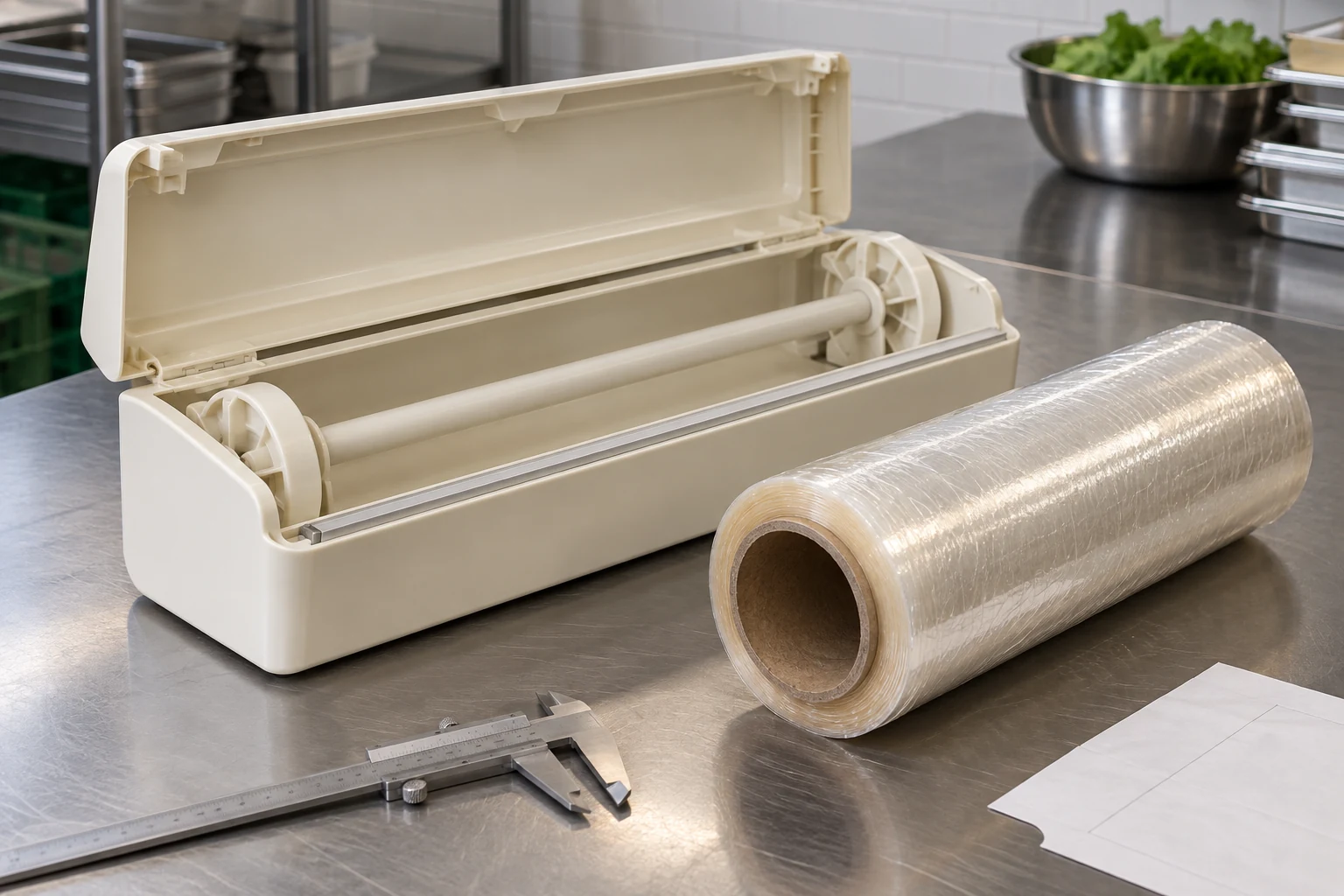
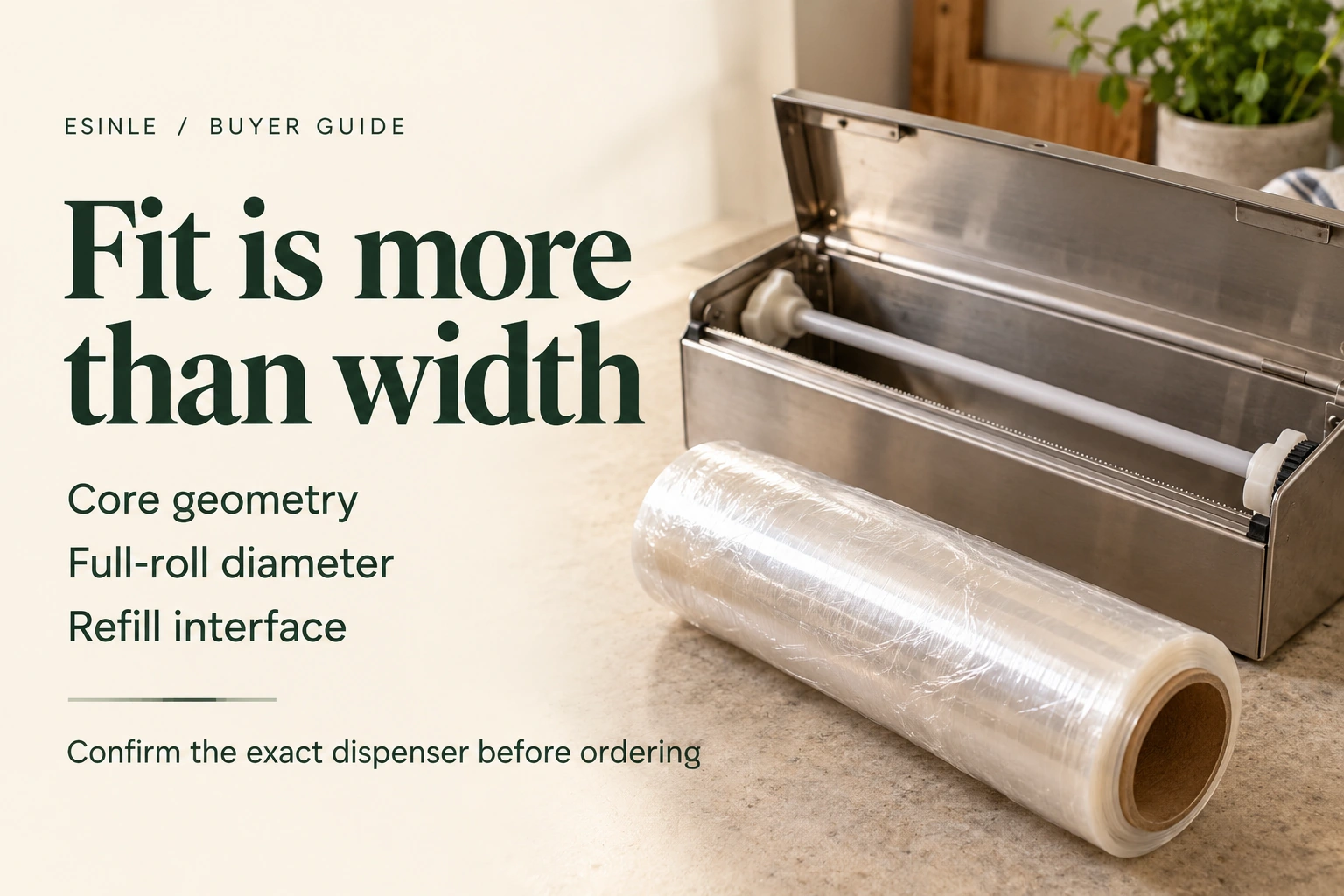
Core inside diameter concerns the spindle or adaptor interface. Core outside diameter is the surface around which film is wound. Core length and end geometry affect axial positioning and engagement. The finished-roll outside diameter determines whether the full roll clears the housing.
Record all of them.
A longer roll can become a larger roll
For an ideal, tightly wound roll of uniform thickness, area conservation gives this estimate:
Finished OD ≈ √[core OD² + (4 × length × thickness ÷ π)]
Use consistent units. In metres, with an assumed core outside diameter of 0.040 m and a 300 m film length:
| Assumed thickness | Ideal estimated finished OD |
|---|---|
| 10 µm | 73.6 mm |
| 12 µm | 78.6 mm |
| 15 µm | 85.6 mm |
These are geometric estimates, not fit guarantees. Real winding, thickness variation, compression and trapped air affect the actual roll. Measure production-intent samples and agree the maximum finished diameter; do not design the clearance around a rounded theoretical number.
Increasing the core diameter, thickness or wound length changes this geometry. That is why “please make the same roll, but longer” can require another dispenser-fit check.
The hidden trap: proprietary refill systems
Matching dimensions may still be insufficient. Wrapmaster states that its patented locking system works only with genuine Wrapmaster refill rolls. Do not promise third-party compatibility from width and core measurements alone. S1
Obtain the equipment manufacturer’s requirements, check any proprietary interface, and validate the intended refill system. For cutter boxes, check free rotation, side clearance, lid closure, film exit and cutter action with a full roll—not just a nearly empty sample.
An ESINLE cutter-box format can be reviewed as a complete pack option. Its listing is not evidence of compatibility with another manufacturer’s dispenser.
6. Compare usable film, not just roll price
After the films meet the same safety and operating requirements, compare what reaches a successfully wrapped container.
For matched widths and comparable wrapping tasks:
Film cost per 100 usable metres = landed roll cost ÷ usable metres × 100
Here is a hypothetical example, not an ESINLE quotation or performance result:
| Item | Roll A | Roll B |
|---|---|---|
| Landed cost per roll | US$8.40 | US$9.00 |
| Verified supplied length | 300 m | 300 m |
| Unusable length recorded in a matched trial | 30 m | 6 m |
| Usable length | 270 m | 294 m |
| Film cost per 100 usable metres | US$3.11 | US$3.06 |
Roll B costs more to buy but slightly less per usable metre under those assumptions. Different observed waste would change the result.
Define waste consistently: startup damage, unusable cuts and handling rejects should be recorded without double-counting. Repeat the trial across representative operators and rolls before adopting a purchasing conclusion.
If widths differ, compare usable area or successful wrapping tasks instead. If the operator needs two sheets with one format, cost per metre alone will miss the difference.
This is a film-consumption comparison, not a full total-cost model. Labour, dispenser cost, downtime, freight assumptions and food protection need their own assessment. A cheap usable metre is not a win if it fails the required application.
7. When a specification change becomes an evidence change
Physical changes are not always confined to fit. A revised gauge, formulation, colour or print may also require review of the supporting evidence.
Food contact: write the use conditions into the brief
For EU plastic food-contact materials, the European Commission describes migration testing under representative time/temperature conditions and a Declaration of Compliance supported by documentation. S6
The FDA separately identifies food types and use conditions, including refrigerated storage, frozen storage and reheating scenarios. These are not interchangeable permissions. S7 Where an effective Food Contact Notification is the basis relied upon, its manufacturer, substance and use limitations matter; it is not generic authorisation for any similar film. S8
Your brief should identify the foods, contact duration, temperature sequence and whether the film is used during heating. Ask the supplier to connect that use to the applicable evidence. Neither “PLA+PBAT” nor “compostable” answers the food-contact question.
Compostability: thickness can be part of the scope
BPI explains that resins and finished products are certified up to a maximum thickness established through disintegration testing. It also distinguishes a supplier’s certification from the buyer’s right to use its certification mark. S9
Do not increase gauge or change artwork and simply carry the previous claims forward. Ask what remains covered and what needs additional review. The certification-selection guide provides a starting framework; the final evidence must relate to the proposed product and claim.
The purchasing rule is straightforward: approve the specification and evidence as a linked revision. A certificate in one folder and an unrelated quotation in another are not a controlled approval.
8. A quote-ready specification you can copy
Send a brief that leaves fewer important decisions to interpretation:
Application and market: [food-service / deli / retail; destination country].
Operating conditions: [containers and foods; contact time; temperature sequence; heating use, if any].
Film: [product/formulation reference; width in mm; nominal thickness in µm; local and average acceptance limits].
Quantity per roll: [wound length in m; tolerance and verification method; net film mass reported separately].
Core: [inside diameter; outside diameter; length; end geometry; material].
Finished roll: [maximum outside diameter; axial dimensions; winding and edge requirements].
Dispensing system: [model and photographs, or approved cutter-box drawing; interface requirements].
Pack: [rolls per case; dimensions; artwork revision; labels and barcode requirements].
Evidence: [technical, food-contact and compostability documents applicable to the exact proposed SKU and use].
Commercial basis: [trial quantity; expected order volume; delivery destination; MOQ, lead time and quotation basis requested].
Acceptance: [inspection method and sampling plan; approved sample ID; document revision; change-notification requirement].
For a custom programme, align this brief with the OEM/ODM workflow before artwork and tooling decisions become expensive to change.
Retain an approved physical sample, but do not let it replace measurable limits. A golden sample can settle a discussion about appearance; it cannot define an unwritten roll-length tolerance.
Make the next response specific
You do not need to have every dimension solved before contacting a supplier. Send what you know and identify what still needs confirmation.
Share your dispenser model or photographs, container sizes, target width and length, use conditions, destination market and expected volume. ESINLE can review those inputs with you to define a candidate format and the sampling and documentation questions that need resolving.
Request a matched cling-film specification
Frequently asked questions
Is 300 mm × 300 m compostable cling film a universal standard?
No. It describes width and nominal length, not core geometry, finished-roll diameter, locking interface or use suitability. Check the actual dispenser and the approved film specification.
Is thicker compostable cling film always better?
No. Thickness is only one part of the construction. Select it against handling, cutting, coverage and the required evidence scope. Confirm the finished-roll geometry and test the proposed format rather than buying by gauge alone.
Can roll weight prove the film is 300 m long?
Not by itself. Core weight, density, width and average thickness affect the calculation. A net-film mass balance can screen for inconsistencies, but length acceptance needs an agreed verification method and tolerance.
Will a longer roll fit if its width and core inside diameter stay the same?
Not necessarily. More wound film can increase the outside diameter. Core outside diameter, thickness, winding and the housing clearance also matter. Check a full production-intent roll.
Can a stock sample approve a custom cutter-box order?
Only to the extent that it represents the proposed order. Changes to film, dimensions, core, cutter or box need appropriate review. Agree measurable acceptance limits and confirm the final pack before approval.
Does compostability certification mean the film is microwave-safe?
No. Compostability and food-contact use answer different questions. Heating requires suitable evidence and instructions for the exact film and conditions; it cannot be inferred from a compostability mark.
Sources and scope
Technical references checked on 30 September 2026. Standard summaries identify relevant methods; they do not reproduce the complete procedures or establish purchase-order limits. Calculations and commercial examples above are illustrative, not ESINLE test results, prices or universal tolerances. This guide supports procurement decisions and does not replace application testing or a market-specific compliance assessment.
Image note: the photographic-style scenes are AI-generated editorial illustrations, not ESINLE product photographs or measurement records. The posters summarise the guide; use the text and tables for the worked calculations.
- S1: Wrapmaster 3000: refill dimensions and proprietary interface.
- S2: Wrapmaster 4500: dispenser width and refill formats.
- S3: ISO 4593: mechanical thickness measurement.
- S4: ASTM D6988-26: film test-specimen thickness and scope limits.
- S5: ASTM D882-26: thin-film tensile testing.
- S6: European Commission: food-contact materials legislation.
- S7: FDA: food types and conditions of use.
- S8: FDA: regulatory status of food-contact material components.
- S9: BPI: certification scope and maximum thickness FAQs.