
Why “100,000 compostable bags—best price” is not a quote-ready brief
You send “100,000 compostable bags, best price” to five factories and get five wildly different numbers. Annoying, yes. Predictable, too.
A useful custom compostable packaging RFQ tells suppliers what the finished product must do, where it will be sold and disposed of, how it will be printed and packed, and what proof you need before approval. Without that information, one factory may price a stock bag with a sticker while another prices a custom-printed roll with documented certification. Neither quote is necessarily wrong; the brief left room for both.
1. Define the product and its real operating conditions
Product format and intended application
Start with the job. Is this a food-scrap liner, grocery produce bag, retail pouch, or pet-waste bag on a roll? State what goes inside, how the item is dispensed, and whether it touches food. A bag that survives a dry shelf test may split when filled with damp scraps and carried down three flights of stairs.
For private-label compostable pet-waste bags, specify the dispenser or core they must fit. If the bags will collect pet waste, check the destination program’s rules before promising compost disposal. Many composters do not accept pet waste, regardless of the bag’s certification.
Finished dimensions, structure, and closure
Give finished width and length in inches and millimeters, gusset depth, seal position, handle style, perforation spacing, and bags per roll. State whether width is measured flat or opened. For a pouch, include usable fill area and closure type. For a roll, request its finished diameter and core dimensions, not merely its bag count.
A dimensioned drawing beats a photo every time. If you have an existing product, send both and identify which one controls if they conflict.
Gauge, tolerance, and measurable performance
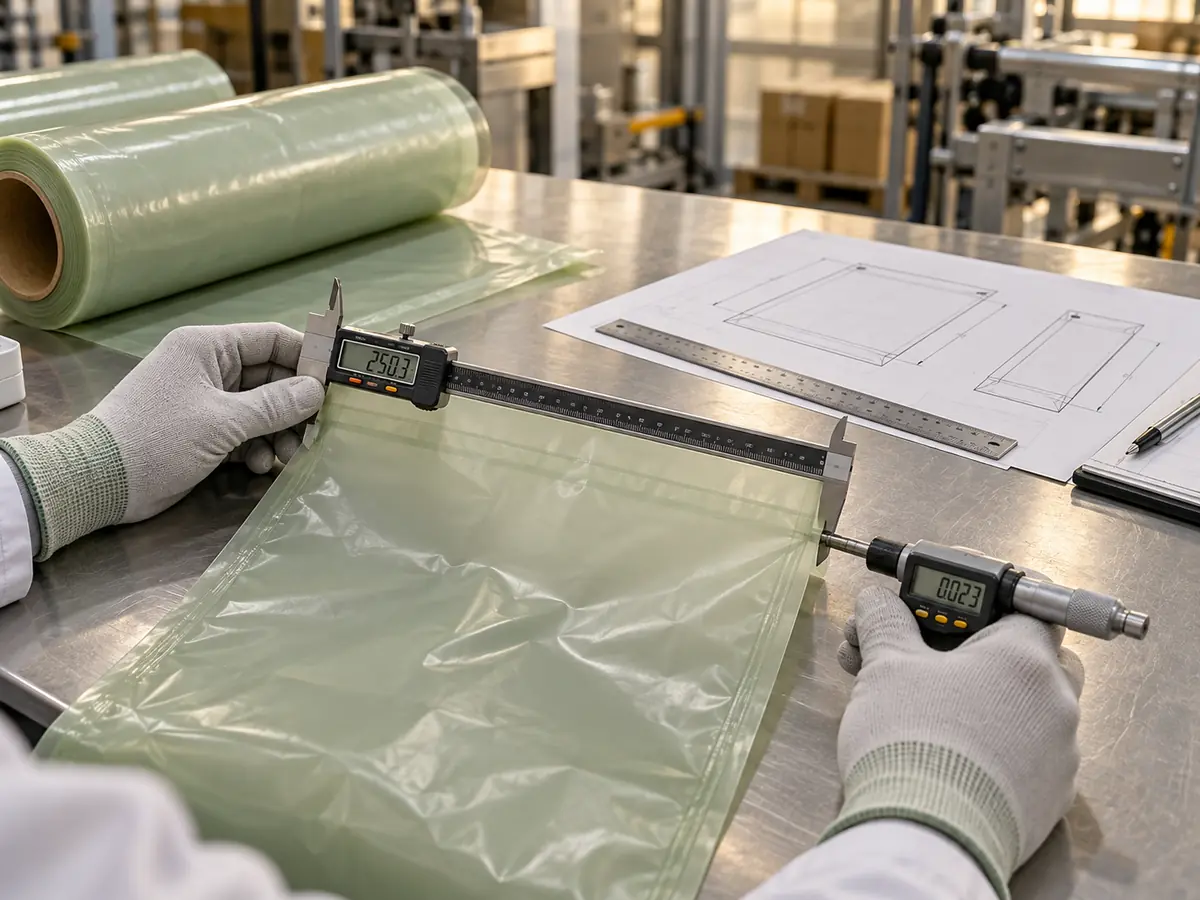
Specify film thickness in mils or microns and distinguish your target from the acceptable tolerance. Then describe the failures you cannot accept: leaking bottom seals, torn perforations, bags that cling together, or a roll that jams a dispenser.
Ask suppliers to propose test methods and limits for seal strength, puncture resistance, load capacity, and opening force. Comparable numbers need comparable methods. A bare claim that a bag “holds 20 pounds” says little about how it was tested.
Temperature, storage, and shelf-life conditions
Where will inventory sit? A climate-controlled warehouse and a hot loading dock are different environments for moisture-sensitive films. Share expected storage conditions, shipping exposure, and the time between manufacture and use. Request a recommended shelf life with its storage assumptions rather than accepting an unsupported guarantee.
For a closer look at handling and performance, see ESINLE’s guide to compostable bag quality.
2. Specify materials, claims, and evidence without guessing
Material and performance objectives
You may have a technical reason to request PLA, PBAT, PHA, or a starch blend. If you do not, avoid writing an invented recipe into the RFQ. Tell the manufacturer the performance, compliance, and price targets, then ask for the proposed formulation’s technical data sheet and relevant change-control commitments.
“Cornstarch bag” is particularly slippery language because it says little about the complete film. Ask what else is in the structure, including coatings, adhesives, and print components. For molded containers, identify the fiber or other substrate and any barrier treatment separately.
Target market and composting route
State every intended sales market and whether the proposed claim is for industrial or home composting. These are different conditions, and neither label guarantees that a local collection program accepts the product. ASTM D6400 addresses plastics designed for aerobic composting in municipal or industrial facilities; it is not a blanket home-composting claim. European buyers commonly assess packaging against EN 13432, but market-specific labeling and waste rules still require review.
That distinction is especially important when selling in more than one region. ESINLE’s home-versus-industrial composting guide provides questions for the supplier conversation. The European Commission also explains the role and appropriate use of biobased, biodegradable, and compostable plastics.
Certification and finished-SKU evidence
Ask for the certificate number, issuer, scope, validity dates, and a way to verify the specific finished SKU. A certified resin does not automatically make a printed, sealed, and labelled bag certified. Confirm whether the submitted construction and artwork remain within the certifier’s approved scope.
For North American projects, use the BPI certified product catalog to check listed products at item or SKU level. Ask about current requirements for additives, inks, and fluorinated chemicals rather than relying on an old logo file. If food contact is involved, request documentation applicable to the material’s intended use and destination market; compostability evidence does not establish food-contact compliance.
Claims need their own review. California, for example, has specific requirements affecting compostable product labeling. The official CalRecycle truth-in-labeling guidance is a useful starting point, but the final design should still be checked for the exact product and market.

3. Lock down print, packing, and logistics details
Printing, artwork, barcode, and color requirements
Send the dieline, editable artwork, number of print colors, coverage, placement, and any required certification-mark approval. Identify whether ink appears on the bag, its paper wrap, the retail box, or all three. Ask for color tolerances and a press proof if brand color is critical.
For private-label bags, specify barcode size and placement, lot identification, country-of-origin text, and who approves the final labeling. A beautiful render cannot tell you whether the barcode scans on curved film.
Retail pack, export carton, and pallet plan
Give units per roll, rolls per retail pack, packs per master carton, and your preferred carton weight or handling limit. Request carton dimensions and pallet configuration in the response. These details affect freight cost and the number of sellable units that arrive intact.
Trial order, first PO, and annual volume
Separate the quantity needed for validation from the first commercial purchase order and estimated annual demand. Ask for tiered prices at the same defined specifications. A supplier’s OEM minimum order quantity may reflect a resin purchase, print setup, or carton run; knowing which constraint drives it gives you room to negotiate.
Destination, Incoterm, and target delivery date
Provide the delivery address or port, requested Incoterm and named place, target arrival date, and whether import duties are included. “Delivered price” is too vague. An EXW factory quote and a DDP warehouse quote should never share a comparison column without adjustment. The ICC Incoterms rules clarify the allocation of tasks, costs, and risks.
4. Define sample and approval gates before production
Stock sample vs custom sample vs production-intent sample
A stock sample tells you whether a supplier can make a broadly similar item. A custom sample checks size and print. A production-intent sample should reflect the approved material structure, thickness, artwork, seals, and converting process as closely as the manufacturer can achieve before the full run. Ask which kind you are receiving.
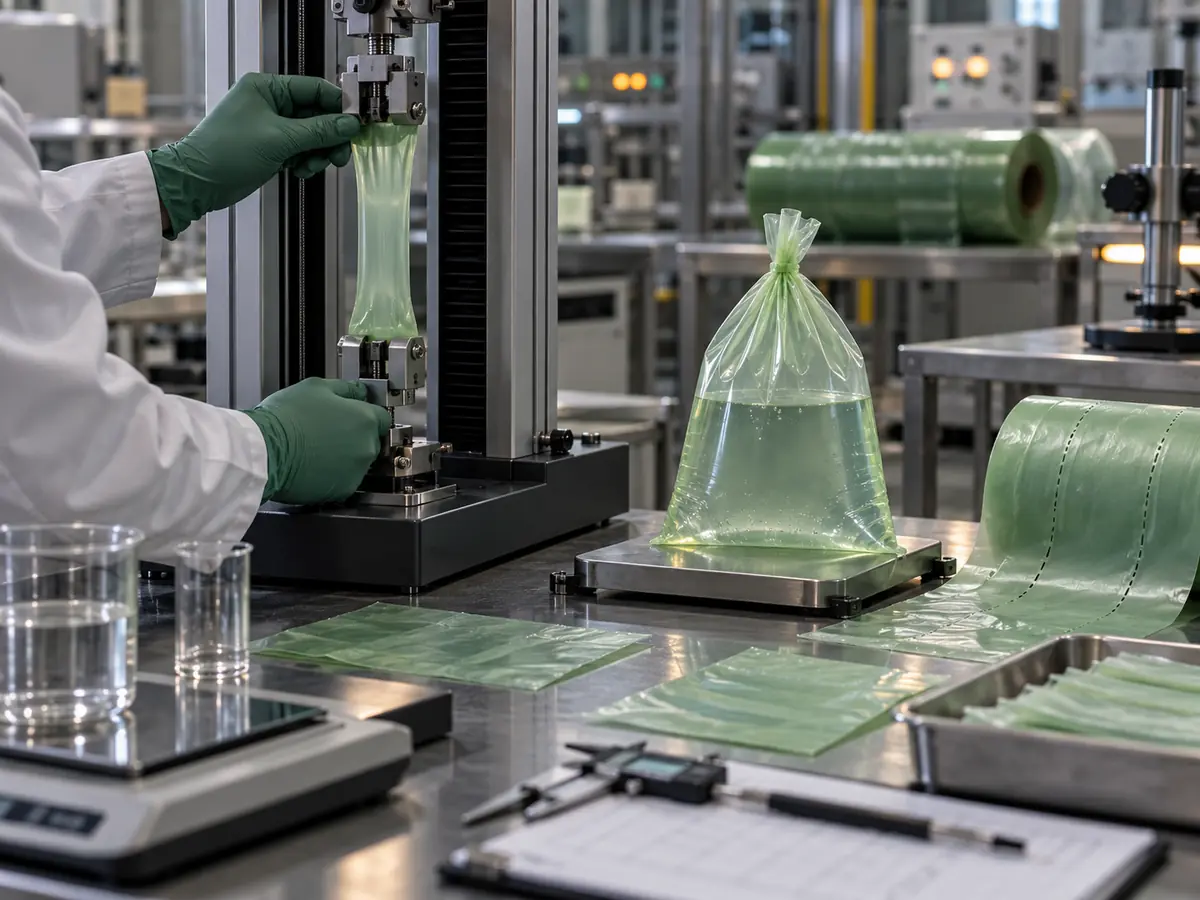
Request the production-intent sample before authorizing commercial manufacture, allowing time for machine trials and corrections. On your packing line, watch seal behavior, coefficient-of-friction issues, jams, and scrap rate. Attractive bags that slow the line are expensive bags.
Acceptance criteria and approval documents
Record measurements, test results, approved artwork, certificate references, and the signed sample revision. Agree on how many units will be inspected and what happens when a lot fails. For rolls, test samples from more than one position in the run; one perfect bag at the top of a roll proves very little.
5. What really changes MOQ, print cost, and lead time
The lowest-cost route is often an existing film, standard size, and unprinted bag with a separate retail label. Custom film color, unusual gauge, additional print colors, new tooling, and specialized retail packing can each raise setup cost or MOQ. Some costs occur once; others recur with every order. Ask the supplier to separate them.
Lead time needs the same treatment. Request distinct estimates for tooling, artwork approval, sampling, certification work if required, mass production, and transit. The clock may start only after a deposit and final artwork approval. If the date matters, get that starting point in writing.
6. Compare compostable packaging quotations apples to apples
Normalize each offer to a cost per usable delivered bag or other agreed sellable unit. Include tooling, plates, freight, duties where applicable, expected scrap, and testing fees. The lowest unit price can lose its charm once you pay for an oversized MOQ and hold nine months of inventory.
ESINLE’s lifecycle cost guide can help frame that trade-off. Keep environmental claims separate from the price math: a possible policy benefit or future EPR advantage is not a guaranteed discount.
Quote comparison matrix
| Compare on the same basis | What to capture from each supplier |
|---|---|
| Finished product | Dimensions, gauge and tolerance, construction, performance limits |
| Evidence | Proposed material, finished-SKU certificate scope, food-contact documents if needed |
| Economics | Unit price by volume, MOQ, tooling, plates, sampling, testing, and payment terms |
| Execution | Sample type, approval steps, production lead time, capacity, and change controls |
| Delivery | Carton and pallet quantities, Incoterm and named place, freight, and duties |

7. Six red flags in a compostable packaging quotation
- “Biodegradable” appears without a defined standard or disposal route. It is not interchangeable with a substantiated compostable claim.
- The certificate covers only a raw material. Request evidence that matches the finished item you plan to sell.
- The price has no stated gauge, tolerance, or test method. The factory may have priced a lighter construction.
- Print setup and artwork approval are missing. Expect a later charge, delay, or both.
- MOQ and lead time have no assumptions. Ask when the lead-time clock starts and whether MOQ applies per design or color.
- A supplier promises acceptance by “all composters.” Facility rules vary; certification alone cannot make that promise.
8. Copy-and-paste custom compostable packaging RFQ template
Send the same brief to every bidder. If an input is unknown, mark it “supplier to propose” rather than quietly guessing.
Product and use: [Format, contents, food-contact status, dispensing or machinery requirements]
Finished specifications: [Dimensions in inches/mm and measurement method; thickness in mils/microns and tolerance; closure, seal, perforation, roll or pouch construction]
Performance and storage: [Load, puncture, leak, opening or sealing targets; test methods if known; storage conditions and shelf-life target]
Market and evidence: [Sales destinations; industrial or home composting claim; requested finished-product certification and food-contact documents, if applicable]
Print and packing: [Dieline, artwork format, colors, barcode, labels, units per retail pack, packs per carton]
Volumes: [Trial quantity, first order, annual forecast, requested price breaks]
Sampling and delivery: [Required sample stages, acceptance tests, destination, Incoterm and named place, target arrival date]
Quote response: [Material proposal, specification sheet, certificate details, itemized setup fees, MOQ basis, lead-time assumptions, payment terms, quotation validity]
9. Turn the approved brief into a controlled purchase specification
The RFQ gets you a comparable offer. The purchase specification keeps the next shipment from becoming a different product.
Attach the approved drawing, artwork revision, material description, performance limits, packing plan, inspection method, and sample reference to the PO. Require written approval before changes to resin, film thickness, inks, manufacturing site, or certified construction. Set a process for nonconforming goods and retained lot samples. Boring paperwork? Perhaps. It is much less boring than discovering after launch that the second run will not fit your dispenser.
Frequently asked questions
What is the minimum information needed for an OEM quote?
Give the format and use, finished dimensions, target thickness, approximate order quantity, print requirements, destination, and intended composting claim. That may get you a budgetary price. For a firm comparison, add tolerances, performance criteria, packing details, and required evidence.
Should I prescribe PLA/PBAT percentages?
Only if you have a validated technical reason. Otherwise, state the performance and compliance targets and ask the manufacturer to propose a documented formulation. A precise-looking percentage is no help if the finished bag fails on your equipment.
What certification documents should I request?
Request the current certificate and public listing details for the relevant finished SKU, including scope, certifier, expiration date, and limits on printing or accessories. Ask for supporting test information and applicable food-contact documentation separately. In North America, the BPI product finder can be used to verify listed items.
How early should I request a production-intent sample?
Request it before placing the full production order, with enough time to test, revise, and test again. Put the sample milestone in the RFQ so every supplier prices and schedules the same approval process.
Why do quotes with the same bag size differ?
Size is one variable. Film gauge, resin formulation, certification scope, print coverage, converting speed, packing labor, MOQ, and delivery terms all move the price. Ask bidders to disclose those assumptions before treating the lowest number as a saving.
Turn the checklist into a quote-ready brief
Use ESINLE’s OEM/ODM process to align the application, dimensions, material objectives, artwork, packing plan, evidence, and production-intent sample before commercial manufacture.
Send My RFQ for ReviewAlso review ESINLE’s material pathways and certification documentation as inputs to your own market, legal, and claims review. Final specifications, claims, and certification scope remain subject to project review.