What buyers are sourcing
A flat, flexible reusable food pouch for sandwiches, fruit and dry snacks. It delivers the familiar convenience of a press-to-close bag without being confused with an insulated lunch tote.
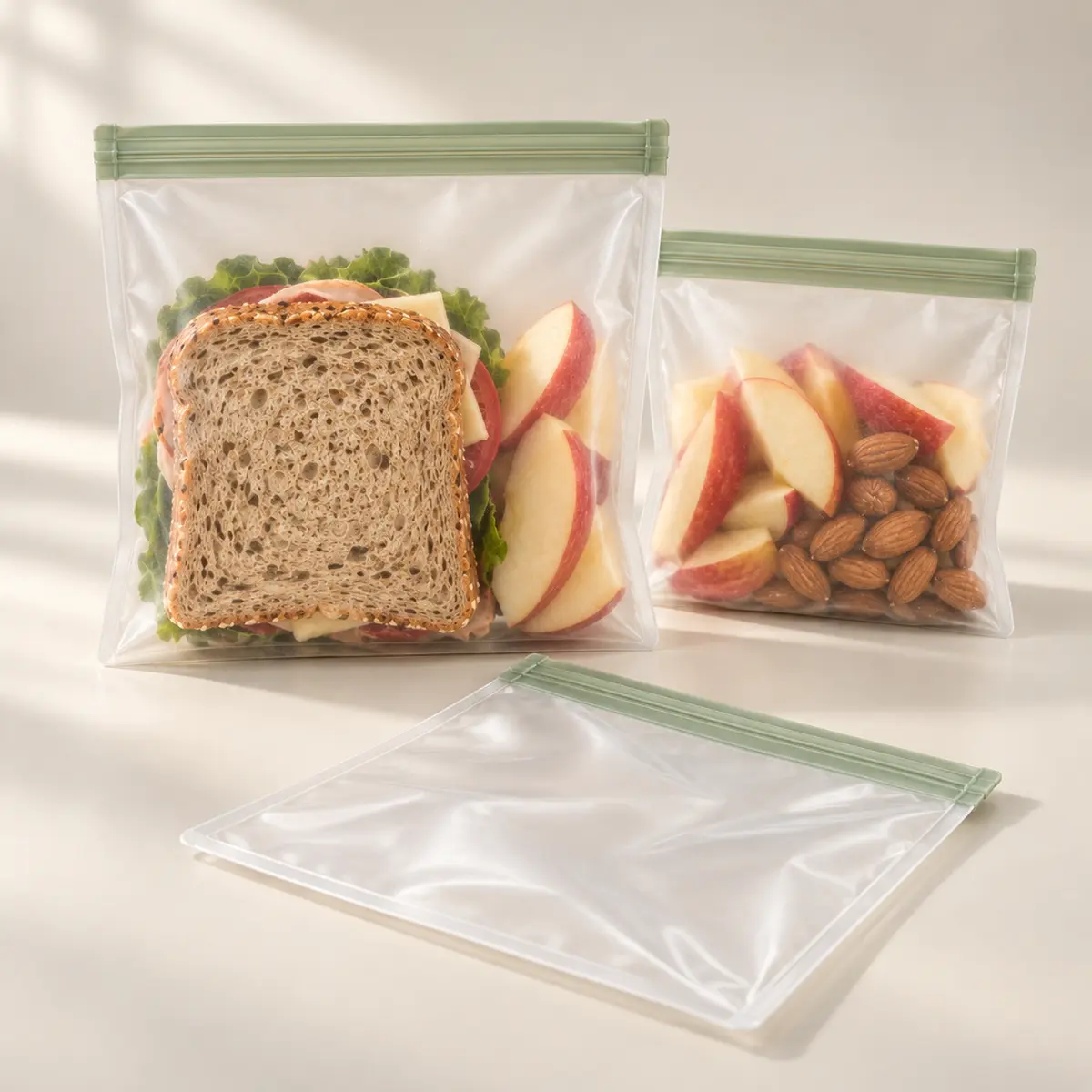
Reusable zip-seal compostable food pouches for sandwiches, snacks and branded lunch programs
| Material | PLA + PBAT compostable film; blend and evidence scope confirmed by SKU |
| Thickness | 30–60 μm starting range; final gauge validated with the approved sample |
| Dimensions | Standard starting size: 200 × 200 mm; custom 150–250 mm range subject to review |
| MOQ | Quoted after size, gauge, print and pack-out review |
| Lead Time | Typically 15–25 days after artwork and specification approval; reconfirm per order |
Request samples and test fill, closure, transport, cold storage and the planned wash routine · Dimensions, tolerances, storage, shelf life and document scope are governed by the approved order specification
PRODUCT OVERVIEW
A lightweight reusable food-storage pouch for organizations that need familiar zip closure, private-label presentation and a documented end-of-life route in one procurement program.
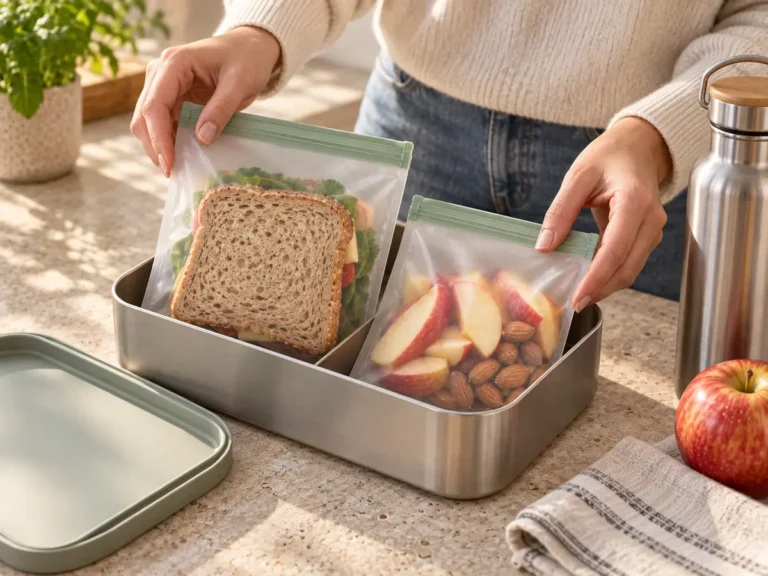
A flat, flexible reusable food pouch for sandwiches, fruit and dry snacks. It delivers the familiar convenience of a press-to-close bag without being confused with an insulated lunch tote.
The frosted film keeps contents visible, the double-track zipper supports repeated opening, and the printable surface gives schools, workplaces and food-service programs a consistent branded touchpoint.
Lock dimensions, gauge, zipper, intended contents, wash routine, cold-storage target, print coverage, pack-out and destination-market documents before commercial production.
Complete inputs reduce back-and-forth and help us match the sample, evidence and commercial quote to one defined construction.
WHY CHOOSE THIS PRODUCT
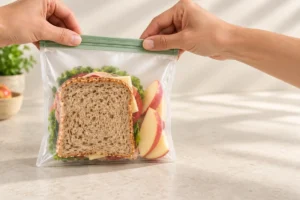
A familiar press-to-close format for sandwiches, fruit and dry snacks. Confirm closure force and transport performance with the intended fill.

Designed for gentle cool-water hand washing and complete air drying between uses. Service life depends on handling, food type and care routine.
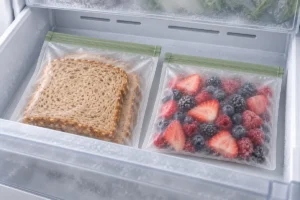
Film gauge and zipper construction can be reviewed for chilled or frozen storage. Validate the target temperature and duration on an approved sample.
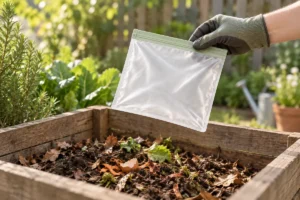
Home- or industrial-compostability wording is used only when current evidence covers the exact film, closure, printing and finished format.
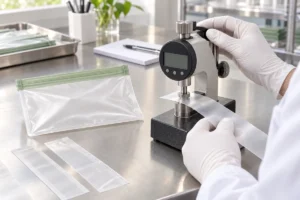
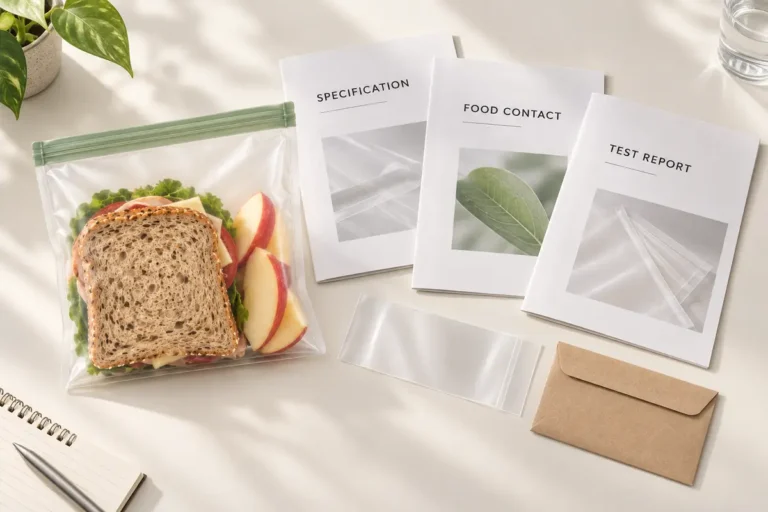
Review the available specification, food-contact declaration and applicable test reports before artwork and purchase approval.
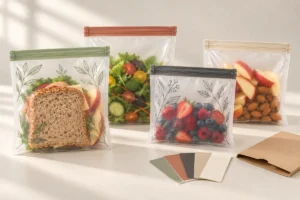
Coordinate pouch size, zipper colour, one- or multi-colour artwork, retail sleeve and master-carton marks for a consistent program.
TECHNICAL SPECIFICATIONS
| Material | PLA + PBAT compostable film; blend and evidence scope confirmed by SKU |
| Thickness | 30–60 μm starting range; final gauge validated with the approved sample |
| Dimensions | Standard starting size: 200 × 200 mm; custom 150–250 mm range subject to review |
| Color | Natural frosted or transparent; custom zipper colours and printed designs |
| Capacity | Sandwich and snack portions; approve the sample with the intended contents |
| Pack Count | Retail or bulk pack-out; units per inner and carton confirmed after sizing |
| MOQ | Quoted after size, gauge, print and pack-out review |
| Lead Time | Typically 15–25 days after artwork and specification approval; reconfirm per order |
| Carton Dimensions | Calculated after final pouch dimensions and pack-out are approved |
| Packaging | Bulk inner packs, printed sleeves or custom cartons |
CERTIFICATIONS
Request the current certificate or test report and match its holder, product name, formulation, thickness, zipper, printing, validity and permitted mark to the finished pouch being quoted.
Ask for the available declaration and supporting test scope for the intended food type, contact time, temperature and sales market. Approval is not inferred from the base resin alone.
A compostability document does not establish a fixed reuse count, leak resistance or freezer performance. Validate those requirements on a production-representative sample.
OEM / ODM
Configure pouch width and length, film gauge, frosted or transparent finish, zipper colour, artwork coverage and retail or bulk pack-out. Final MOQ, plate cost, tolerance, lead time and permitted compostability wording are confirmed after artwork and evidence review.
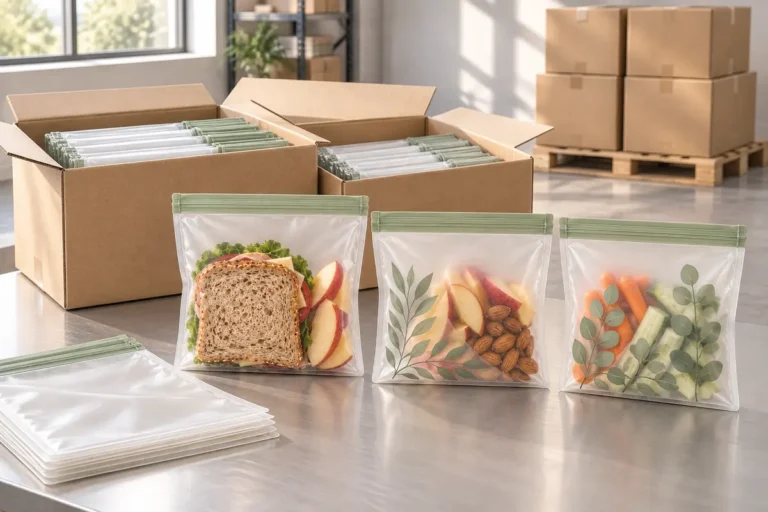
FACTORY CAPABILITIES
The selected format can be reviewed against these Guangzhou manufacturing capabilities. Final feasibility, tolerances and MOQ are confirmed in the approved specification.
Width, gusset depth and length can be reviewed against your packaging-line requirements and converting limits.
Flexographic artwork, colour count, print coverage and plate requirements are checked before MOQ and pricing are confirmed.
PLA, PBAT and starch blend options are selected around flexibility, strength, processing and the documented claim required for the SKU.
BEHIND EVERY PRODUCT
The workflow covers compounding, film blowing, printing and bag conversion, with the order specification used as the reference for in-process and final checks.

USE CASES
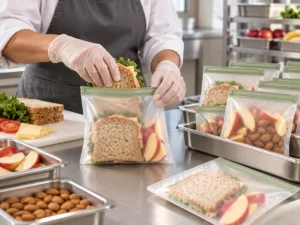
Portion sandwiches, fruit and snacks in a repeat-use format. Validate cleaning instructions, age suitability, allergen controls and disposal messaging before rollout.
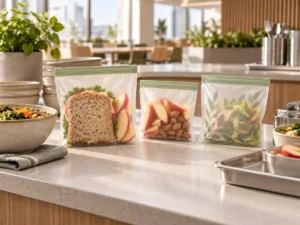
Use branded pouch sets for employee meal-prep or return-and-reuse initiatives, with pack-out and care guidance adapted to the site workflow.
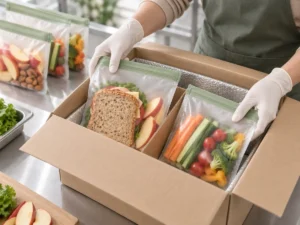
Pre-portion dry or damp solid ingredients in a resealable pouch after confirming cold-chain conditions, contact time and pack integrity.
BUYER DOCUMENTATION
Before artwork or volume production, match every environmental and food-contact statement to the exact pouch construction and destination market.
HONEST TRANSPARENCY
Designed for cool or ambient dry and damp solid foods. Not for free liquids, hot filling, microwave, dishwasher, sous-vide or vacuum-sealing use unless a separate approved construction and test program covers the requirement. Reuse life and cold-storage performance vary with gauge, contents and care. Store unused stock sealed, cool and dry, away from heat, moisture and direct sunlight.
FAQ
No. It is a flat zip-seal food-storage pouch for sandwiches, fruit, snacks and portioned ingredients. It does not provide thermal insulation and should be placed inside an appropriate lunch carrier or cold-chain system when temperature control is required.
There is no universal cycle count. Useful life depends on gauge, contents, washing, zipper handling and storage. Approve a production-representative sample with your real use-and-wash routine before setting consumer guidance.
Empty it promptly, hand wash gently with mild soap and cool water, rinse thoroughly, then stand it open until completely air dry. Do not use a dishwasher, microwave or high-heat drying cycle.
A cold-storage construction can be reviewed, but temperature, duration, fill type and drop or flex requirements must be specified. Validate seal and film performance with the intended contents before launch.
Only make that claim when current product-specific evidence covers the finished pouch, including film, zipper and any printing, and when the destination market permits the wording. Local collection and composting acceptance may differ.
They are intended primarily for sandwiches, snacks and other solid foods, not free liquids. Do not market them as leakproof without a defined test method and passing result for the approved construction.
Send destination market, pouch dimensions, target gauge, zipper style and colour, intended contents, temperature range, artwork, retail or bulk pack-out, annual forecast and required documents.
DEEPER READING
GET A QUOTE
Send the destination market, dimensions, gauge, artwork and forecast volume. We will reply with the missing decisions, sample path and available documentation.
Request current specs & quoteRELATED PRODUCTS